
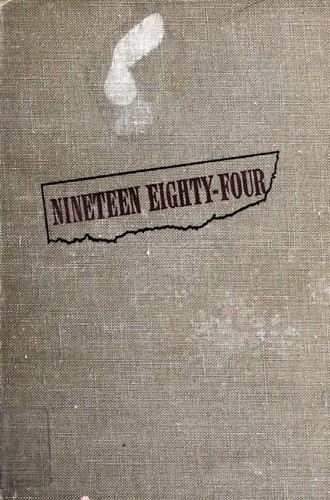
Nineteen Eighty-Four
Winston Smith works at the Ministry of Truth in London, in the province of Oceania, where his job is to correct old newspaper records until they agree with the Party's current account of events.
About
Spoiler notice: Spoilers: this overview includes major plot developments and the ending.
George Orwell's Nineteen Eighty-Four begins in a London that belongs to Oceania, a superstate perpetually at war and divided into regions whose official names conceal their familiar geography. Winston Smith returns to Victory Mansions beneath posters of Big Brother, enters a flat monitored by a telescreen that cannot be switched off, and moves through streets watched by patrols and the Thought Police. The city is materially shabby: the lift fails, electricity is rationed, food and household goods are scarce, and public language insists that production is flourishing. This difference between what a person can see and what the Party says is one of the novel's daily conditions. The opening stays close to Winston's movements and perceptions, so the political system first arrives as noise, cold, poor repairs, public slogans and the effort of keeping an ordinary expression from revealing a private thought.
Winston works at the Ministry of Truth, where he revises newspaper records to make earlier reports agree with the Party's present account. A discarded document is sent down a memory hole, and a person removed from favour can be erased from the record as though they had never existed. Winston's job makes this official rewriting concrete: he invents a model Party hero, Comrade Ogilvy, for a revised account, then watches the invented man acquire a convincing past. The Ministry's name is one of several reversals; it manufactures lies while speaking in the language of truth. At home Winston secretly writes in a diary, an act that would be treated as thoughtcrime if discovered. His recollections of childhood, family and earlier versions of public life are incomplete, leaving him to test his own memory against a society that denies any independent standard for checking it.
The story follows Winston as he tries to turn private doubt into a life that is not wholly governed by the Party. He watches Julia, a young woman from the Fiction Department, and first assumes that her outward orthodoxy makes her dangerous. After she slips him a note declaring her love, they begin a clandestine relationship, meeting outside the city and later renting a room above a shop in a poorer quarter. Julia approaches rebellion through practical secrecy and appetite; Winston gives it a larger historical meaning and hopes that ordinary people may eventually overturn the regime. Their refuge is fragile because neither can know what the telescreens, informers or Thought Police have already observed. The contrast between their ways of thinking matters to the plot: they share a forbidden present, but Winston wants a theory of resistance while Julia mainly wants room to live.
Winston's search for an account of how the Party maintains power converges on O'Brien, an Inner Party member whom Winston has privately imagined as an ally. O'Brien speaks in a way that seems to confirm Winston's suspicions and invites him to visit his flat. Winston and Julia go there together, and O'Brien presents himself as a member of the underground Brotherhood. He arranges for Winston to receive a book attributed to the dissident Emmanuel Goldstein. Its long explanatory sections describe the competing superstates, managed war, social hierarchy, surveillance and the Party's control of history and language. The shift from Winston's immediate experience to this orderly analysis gives the novel a deliberately different texture: the book lays out a system that his own daily observations have suggested but could not fully explain. It does not give him the certainty he wants about the people behind the resistance, and the story keeps the gap between a plausible explanation and a safely verified truth in view.
The room that seemed to shelter Winston and Julia is revealed as part of the surveillance network, and the couple are arrested. The final part moves into the Ministry of Love, where Winston is isolated, questioned and repeatedly subjected to pain. O'Brien is no longer a possible comrade but the person conducting Winston's remaking. Their conversations turn abstract questions into tests: the Party demands that Winston accept not merely a dictated statement but the authority to decide what is real, even when it contradicts what he can see. The process includes forced confessions and, in Room 101, the threat of rats attacking Winston's face. Unable to bear this terror, he begs for Julia to be subjected to it instead, surrendering the loyalty he believed the Party could never reach. The novel gives this coercion time to unfold, returning to physical details of the cell and interrogation while showing how memory, loyalty and judgment become targets. Its central conflict has narrowed from whether the regime can be opposed to whether a private inner life can survive it.
Nineteen Eighty-Four ends after Winston has been released back into public life, not with a rescue or an uprising. He spends time in the Chestnut Tree Café, drinking gin, hearing official bulletins and occupying a minor, nearly meaningless committee post. His reunion with Julia confirms that their earlier bond has been broken inside each of them; both admit to betrayal under pressure. When a military announcement reports a major victory, Winston experiences relief and love for Big Brother, completing the reversal of his earlier resistance. The closing scene is quiet and outwardly ordinary, which gives the ending its full force without turning it into a conventional escape story. After the narrative, an appendix presents the principles of Newspeak in an explanatory, reference-like voice, describing how the language was designed to reduce the range of possible thought. The shift in form leaves the reader with a textual question about the Party's language and the history the novel has just shown.
Book details
- Author
- George Orwell
- Published
- 1949 (earliest confirmed edition)
- Series
- No series listed
- Subgenre
- Dystopian, Classic science fiction
- Primary genre
- Sci-Fi
- Tags
- No tags for this book.
Review
Editor profile
Baby Bat
Goodreads and social links will be added soon.
- Goodreads — link coming soon
- Social media — link coming soon