
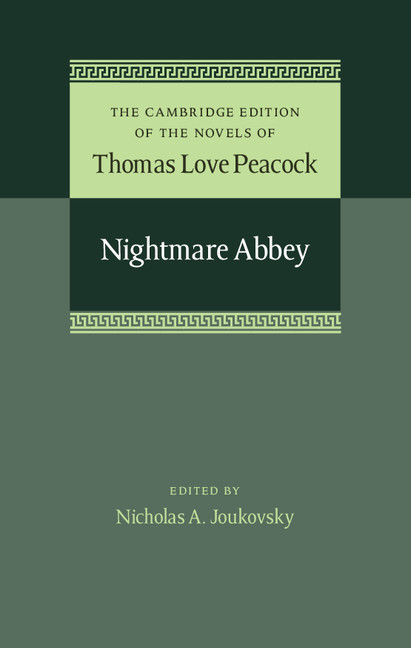
Nightmare Abbey
At his father’s gloomy Lincolnshire mansion, Scythrop Glowry pursues philosophical schemes and becomes entangled with two women.
About
Spoiler notice: Full-plot spoilers, including Stella’s identity, the two rejection letters and Scythrop’s final response.
Nightmare Abbey stands between the sea and the Lincolnshire fens, a decaying family mansion whose owner finds its atmosphere agreeably gloomy. Christopher Glowry is a widower with a settled habit of disappointment, and his son Scythrop has begun to cultivate troubles of his own. Thomas Love Peacock’s novel, published in 1818, turns the household into a meeting place for people who can explain why existence is miserable without surrendering the comforts of dinner. Even the servants’ names contribute to the effect: Raven and Crow belong to a domestic establishment selected with melancholy in mind. The setting supplies towers, secluded rooms and an expectation of mysterious events, while the occupants provide an inexhaustible willingness to interpret ordinary difficulties in the most extravagant terms.
Scythrop’s earlier love affair ended when negotiations between the families failed and the woman married someone else. The disappointment sends him towards solitary reading and ambitious schemes for the regeneration of society. His father offers little comfort beyond a philosophy in which disappointment is what anyone should expect. Yet the son remains susceptible to a new attachment. His lively cousin Marionetta O’Carroll brings a very different energy into the abbey, and her alternations of affection and distance keep him unsettled. Glowry objects to the match on financial grounds and prefers Celinda Toobad, a prospective bride with a fortune. The possibility of arranging a suitable marriage therefore sits uneasily beside Scythrop’s desire to imagine himself free of the ordinary calculations governing other people.
The visitors give that uneasy household a succession of conversations in which a personal habit readily becomes a universal theory. Mr Listless finds exertion troublesome, Mr Flosky thrives on intellectual obscurity, and Mr Toobad repeatedly discovers evidence that the devil has taken charge of the world. At dinner, the departing poet Mr Cypress describes life through disappointment and despair, receiving enthusiastic approval from companions who share his taste for misery. Mr Hilary challenges the performance, objecting to the assumption that genius must be unhappy or that humanity deserves condemnation for failing to realise impossible ideals. Their exchange is conducted over wine, with the company’s social pleasures continuing throughout. Eventually a cheerful song draws the assembled pessimists into a chorus despite their earlier declarations.
Scythrop’s own lofty interests acquire a more immediate test when a woman calling herself Stella asks him for refuge. Her appeal connects protection from persecution with the philosophical principles he has been publishing. He conceals her in an apartment within his tower and becomes attached to her, even while his relationship with Marionetta continues. The arrangement depends on keeping different people from discovering how he behaves in their absence. His father grows suspicious of the locked door, unexplained sounds and a woman’s voice. Scythrop attempts to account for them through acoustics and a supposedly unfinished German tragedy. Each explanation demands more invention, while Glowry’s refusal to accept it makes the hidden room increasingly difficult to preserve as a separate world.
The concealment collapses when Glowry mentions Scythrop’s expected marriage to Marionetta. Stella hears him, opens the concealed entrance behind the bookcase and demands an explanation. Other members of the household are drawn into the dispute, until Marionetta arrives to find Scythrop holding the stranger’s hand. Mr Toobad recognises Stella as his daughter Celinda. She has fled the marriage her father intended for her, only to seek refuge with the very man he had selected. Neither woman welcomes the discovery that she shares Scythrop’s affections. Both renounce him, while he remains unable to choose which relationship he is willing to lose. The scene turns the secret chamber into a place where the characters’ incompatible accounts must finally encounter one another.
After the visitors depart, Scythrop announces that his disappointments have left him no possible future. Raven’s suggestion that he should eat before continuing to be miserable temporarily diverts him, but he later fixes a deadline for his father to restore one of the relationships. Glowry departs to negotiate, leaving a week of waiting. Scythrop’s resolve fluctuates with the weather: rain and wind encourage his darkest intentions, while sunshine and dinner make continued life more attractive. On the appointed evening, he demands that Raven admit the clock is wrong and put his watch back. The servant’s frightened compliance supplies extra time just before the sound of a carriage offers hope. Glowry returns, however, without either of the young women.
He brings letters instead. Celinda rejects the attempt to negotiate through their fathers and announces her intention of marrying Flosky; Marionetta writes affectionately as a cousin but looks forward to becoming Mrs Listless. Scythrop tears up both letters and complains about women’s inconstancy, although his own refusal to choose has helped produce the situation. His father advises him to pursue only one attachment next time and points out that the fatal deadline has already passed. Scythrop accepts a new account of his disappointments as preparation for an advanced standing in misanthropy. When Raven reappears, the confrontation ends with an order for Madeira. No wedding or reconciliation restores either romance to him: the conclusion leaves him alive, still theatrical and able to resume the household’s familiar comforts.
Book details
- Author
- Thomas Love Peacock
- First published
- 1818
- Series
- No series listed
- Subgenre
- Literary fiction, Modern classics
- Primary genre
- Literary Fiction
- Tags
- No tags for this book.
Review
Editor profile
Baby Bat
Goodreads and social links will be added soon.
- Goodreads — link coming soon
- Social media — link coming soon