
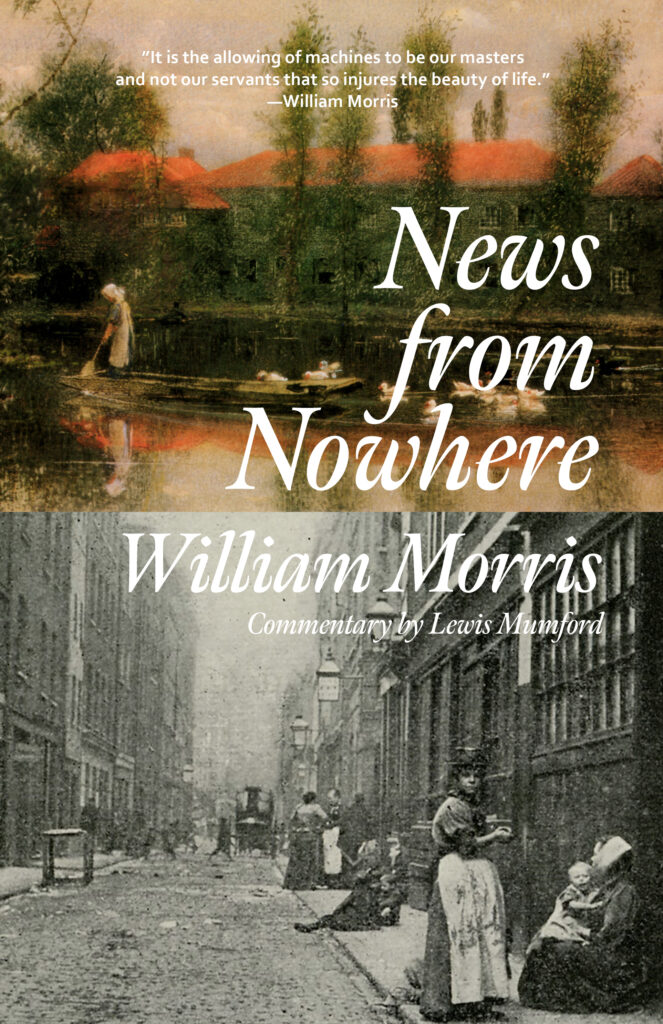
News from Nowhere
After a heated Socialist League discussion, a Victorian visitor wakes in a transformed future London.
About
Spoiler notice: Spoilers for the social order revealed through Guest’s visits, Old Hammond’s account of the Great Change, Dick and Clara’s relationship, Walter Allen’s story of a killing, and the final haymaking feast and Guest’s return to Hammersmith.
News from Nowhere begins with a discussion at the Socialist League about what life might be like after a revolution. One participant leaves in frustration, wishing that he could see a day of the society they have been arguing about. He goes to bed in winter and wakes into summer beside the Thames, with London’s familiar geography changed around him. The story then stays close to this visitor’s first-person account: he tries to interpret new customs through the habits of the world he has left, while people he meets answer his questions from within their own everyday experience. The narrator suggests that his hosts call him William Guest, a name that also describes his temporary position among people whose assumptions he does not share.
On the river Guest meets Dick Hammond, who rows him ashore and treats his offer of money as an unfamiliar, awkward gesture. The Hammersmith he sees has gardens along the water and houses set among open land. At the Guest House, communal meals and a room are available to travellers; there is no bill to settle. Dick takes him through transformed streets and markets, including a Piccadilly where displayed goods recall shops although nobody is buying or selling them. Guest recognizes the sites of the old city but finds the Creek uncovered, the roadway running through meadows, and buildings designed as places to live and gather. These scenes supply the novel’s first evidence about daily life: food, lodging, transport and useful objects are organized as shared provisions and neighbourly services, not commercial transactions.
Dick brings Guest to his great-grandfather, Old Hammond, after other residents have begun asking the stranger about the earlier world. Their conversation gives the novel a second rhythm: Guest asks about love, education, government and work, and Hammond draws on his study of history as well as his experience of the present. More than a century old, he has worked as a custodian of books at the British Museum and knows about the changes of the preceding two hundred years. His explanations do not replace the journey with a formal treatise; they answer the particular confusions that Guest encounters in houses, markets and public spaces. Dick and Clara are reuniting after a separation: they have two children, and Clara had left Dick for another man before seeking Hammond’s help in returning to him. Their relationship gives Guest a human point of comparison as he tries to understand how courtship and family life work without the legal and economic pressures he assumes are unavoidable.
Hammond describes a society without a national government or professional political class. Neighbours meet in local Motes to discuss proposed changes; if disagreement persists, a decision can be delayed for further argument rather than settled immediately by a narrow count. People who enjoy making things practise crafts, while others find satisfaction in keeping shared work and supplies organized. Guest’s old vocabulary does not always fit what he sees: the buildings he calls shops display goods, but the habits of buying, selling and accumulating money have disappeared. Hammond also explains how communities respond to harm. The novel does not pretend that people never act violently; instead, Hammond argues against prisons and retaliatory punishment, describing remorse, acknowledgement and atonement as social responses. Guest hears this account before meeting an instance that tests it.
The change itself is presented as a historical process rather than a peaceful overnight reform. Hammond recounts the pressures of commercial society, failed attempts to soften class inequality, and a period of conflict that included both strikes and armed fighting. He describes a civil war lasting about two years, followed by a difficult adjustment as people rebuilt and learned again how to make and grow what they needed. Later, people moved from towns into the countryside, where knowledge of agriculture and craft could be recovered; the distinction between town and country gradually weakened. Guest’s travel shows the material results in worked fields, village workshops, small houses and restored landscapes. At one stop, a group called the Obstinate Refusers chooses to stay with a demanding building project rather than join haymaking, a choice their neighbours meet with good-humoured teasing rather than coercion.
The river journey also widens the cast. Dick, Clara and Guest travel upstream, stopping with households that welcome them and share food, conversation and beds. At Runnymede they meet Ellen, the granddaughter of a cantankerous host. Guest is drawn to her, and later passages let the two talk apart from the others as their party continues toward the upper Thames. Haymaking is work, but it is also a seasonal gathering in which people with different skills can take part; some rest or travel while particular workers are needed. At Walter Allen’s house the visitors hear of a jealous suitor who attacked his rival with an axe. The man under attack struck back and killed the aggressor. Walter fears that the surviving man may harm himself. The group debates how best to help him, without police custody or a court deciding the event for them.
As the party reaches the haymaking country, Guest and Ellen visit an old house by a ford. Their conversation turns to how Ellen’s life might have been constrained had she been born into the poverty and dependence of Guest’s era. The final feast is set in a village church decorated with flowers and scythes. Guest expects to join the gathering, but the people there cease to notice him; Ellen alone seems to recognize him briefly before turning away. Outside, he sees a ragged, bent man whose appearance recalls the world he knows, then a black cloud overtakes him. He wakes in his Hammersmith bed. The book leaves the future’s status open to the narrator, who asks whether it was a dream and concludes that others might call it a vision. The ending returns him to the present with a changed sense of what that future might mean.
Book details
- Author
- William Morris
- First published
- 1890
- Series
- No series listed
- Subgenre
- Classic science fiction, Literary fiction
- Primary genre
- Sci-Fi, Literary Fiction
- Tags
- No tags for this book.
Review
Editor profile
Baby Bat
Goodreads and social links will be added soon.
- Goodreads — link coming soon
- Social media — link coming soon