
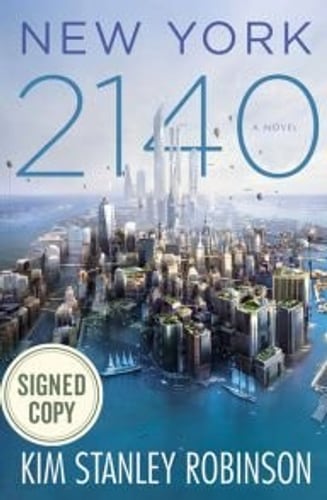
New York 2140
Two rises in sea level have left most of New York City permanently under water, and the streets have become canals while the skyscrapers have become islands.
About
New York 2140 is a climate fiction novel by the American science fiction writer Kim Stanley Robinson, published in 2017. It is set in a New York City that has been altered beyond recognition by rising water.
Two major rises in sea level, both caused by climate change, have left most of New York under water. Manhattan south of 46th Street is flooded, the district has picked up the nickname SuperVenice, and the streets of the old city are now canals, with people living on the upper floors of buildings in a way that has more in common with contemporary Venice than with the city that was there before. New towers have gone up in the parts of uptown Manhattan and around The Cloisters that remain above the waterline, and Denver has replaced New York as the centre of American finance and culture. Several of the characters live in the MetLife Tower on 23rd Street, whose tenant association has fitted it with flood defences and boat storage; the building was chosen because it was designed to resemble the campanile of St Mark's in Venice. The novel moves through the lives of the people in that one building as the city continues to change around them.
Robinson's science fiction usually concerns the way societies organise themselves over long stretches of time, and this book applies that interest to a single city rather than a planet or a solar system. Its chapters are distributed across a large cast, and the action stays close to the concerns of people living and working in a city that has already had to accept a great deal of change.
Book details
- Author
- Kim Stanley Robinson
- First published
- 2017
- Series
- No series listed
- Subgenre
- Climate fiction, Dystopian
- Primary genre
- Sci-Fi
- Tags
- No tags for this book.
Rating
Review
Editor profile
Baby Bat
Goodreads and social links will be added soon.
- Goodreads — link coming soon
- Social media — link coming soon