
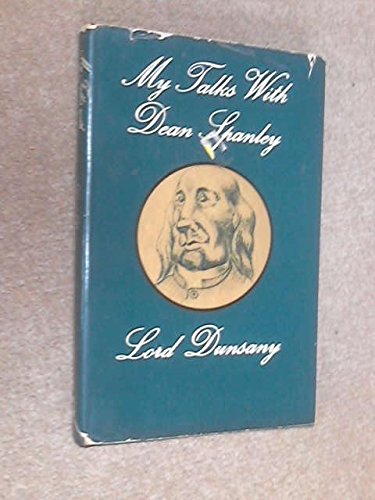
My Talks with Dean Spanley
A reserved clergyman’s interest in dogs and fine wine persuades a fellow club member that he is hiding memories of another life.
About
Spoiler notice: This overview discusses the Dean’s canine recollections and reveals the outcome of the final dinner and investigation.
A clergyman who knows his port and keeps his conversation within respectable limits hardly seems the likeliest source of a discovery about life after death. The narrator of My Talks with Dean Spanley thinks otherwise. At the Olympus Club, he notices the Dean becoming unusually quiet whenever dogs or the passage of souls between different bodies are discussed. Those silences convince him that something extraordinary is being concealed. Lord Dunsany’s 1936 story begins with this determined investigator arranging a dinner, ostensibly to obtain an opinion on some wine. What follows is a succession of carefully managed evenings in which a solemn adult voice begins describing a world organised around smells, territory, food and the almost divine importance of the people who open doors.
The first dinner produces nothing. Spanley appreciates the port but stops drinking before his reserve gives way. For the next attempt, his host borrows a bottle of imperial Tokay, a rare wine whose reputation makes it harder for the Dean to refuse another glass. The conversation eventually takes an unexpected turn: Spanley offers advice about getting through a doorway before it closes, then explains the usefulness of fleas. His recollections move between human expressions and recognisably canine sensations. The narrator interrupts a reference to whiskey, only to discover that Spanley means the invigorating effect of racing around a lawn. These small misunderstandings establish the story’s method. Familiar behaviour becomes strange when a cultivated man explains it from inside a dog’s experience.
The narrator presents all this as serious research and stakes his standing as a scientific writer on the Dean’s sincerity. His procedure, however, depends on misleading his guest, directing his attention and keeping the wine flowing at exactly the right pace. After returning the borrowed bottle, he appeals to a Maharajah who can supply more. He also develops a personal interest in the results. If becoming a dog is a real possibility, he reasons, useful information might be worth carrying into another existence. Questions about sleep, water and food acquire an anxious urgency. Spanley’s answers repeatedly frustrate the expectations behind them: water with a powerful smell is interesting, while meat approaching decay can be especially attractive. The would-be researcher’s own appetite suffers considerably.
Within the Dean’s accounts, the house and its surrounding countryside form an expansive, busy world. A fox near the lawn represents an intolerable threat, even when the humans fail to appreciate the danger. Barking is an essential warning that they keep interrupting. A scent left on a cart wheel supplies news of another dog living miles away. When that stranger eventually arrives with the cart, a fight helps establish their respective claims before they become hunting companions. Spanley gives these events the gravity of encounters between important people. His confidence is also conveniently elastic. The dogs can loudly advertise their courage while deciding, after reflection, that perhaps they should leave a nearby fox alone. Their descriptions disclose both the excitement of an unfamiliar perspective and the reassuring excuses its inhabitants make for themselves.
That perspective reaches beyond comic appetite. Darkness, woodland and the moon can make an ordinary evening feel crowded with powers that have to be challenged or warned away. The Dean recalls an outing with his companion as a succession of hunts, ending with the moon itself among their imagined quarry. Home offers warmth and food, but getting back inside depends on people understanding a noisy appeal at the door. Their response can be harsh, yet his account returns to admiration for their wisdom and gratitude for a meal. The people he reveres remain capable of actions he cannot explain. Dunsany lets the animal’s certainty coexist with that gap in understanding, giving the recollections a mixture of swagger, vulnerability and absolute attachment to the household.
A second guest, Wrather, changes the balance at the table. The narrator recruits him for his ability to encourage drinking, presenting the Dean’s stories as entertainment rather than revealing the full scale of his supposed investigation. Wrather helps sustain the evenings, but a careless remark can bring Spanley abruptly back to his clerical identity and spoil the opportunity. Later, he asks questions that expose the limits of what the stories can explain. Spanley remembers answering to Wag, although he thought of himself as Moon-chaser; his companion’s name, Lion-hunter, expresses a readiness for an adventure rather than an actual encounter with a lion. When the dogs find their way home through unfamiliar country, the Dean can describe turning towards home without explaining how he knew the direction.
The final effort gathers the narrator, Wrather, the Maharajah, his secretary and the Dean around the same table. The host hopes that a stronger combined encouragement will carry Spanley beyond amusing observations into genuinely inaccessible knowledge. His guest does seem to speak, and the narrator insists that, for a brief interval, he understood the secrets he had pursued. Unfortunately, everyone trying to extract them has also been drinking. He cannot remember the revelation, Wrather cannot supply it, and inquiries the following day recover no usable account. Soon afterwards, Spanley becomes a bishop. The narrator senses enough of a change in their relationship to abandon further dinner invitations, leaving the supposed breakthrough beyond recovery.
The story’s whole shape depends on that uneasy partnership between disclosure and obstruction. Conversation opens a passage into another way of living, while interruptions, social caution and the investigator’s own methods repeatedly close it. The narrator’s emphatic belief belongs to his account; it does not require the reader to treat reincarnation as a demonstrated fact. Nor does the lost revelation cancel the vividly particular life that Spanley has described along the way. Across thirteen short chapters, the movement between club, dining room, lawn and woodland keeps returning to the problem of understanding another creature on its own terms. The narrator wants a discovery he can announce to the world. What survives for his readers is the stranger, funnier experience of listening to the Dean.
Book details
- Author
- Lord Dunsany
- First published
- 1936
- Series
- No series listed
- Subgenre
- Literary fiction
- Primary genre
- Literary Fiction
- Tags
- No tags for this book.
Review
Editor profile
Baby Bat
Goodreads and social links will be added soon.
- Goodreads — link coming soon
- Social media — link coming soon