
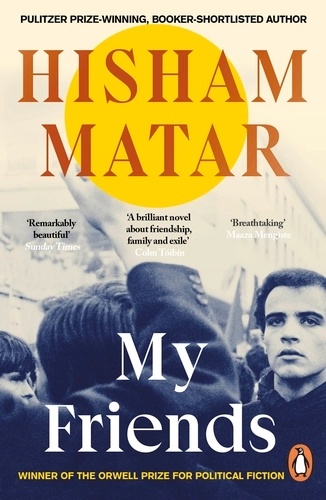
My Friends
As a boy in Benghazi, Khaled becomes captivated by a story read on the radio and by its elusive author, Hosam Zowa.
About
Spoiler notice: Spoilers for Khaled’s childhood encounter with a story, the 1984 Libyan embassy shooting, and the novel’s central exile and friendship conflicts; the ending is not disclosed.
My Friends begins with a story inside the story. Growing up in Benghazi, Khaled hears a strange tale read on the radio: a man is being eaten alive by a cat. Its writer, Hosam Zowa, becomes an object of fascination for the boy, and the broadcast stays with him as his life carries him far from home. Hisham Matar uses that early encounter to establish literature as more than a pastime in this novel. Words can travel beyond their maker, lodge in another person’s imagination and shape the direction of a life before the two people meet. The idea gives the book a quiet connection between private reading and public history: a story heard in one household eventually belongs to a friendship formed across borders and years.
Khaled’s path takes him from Benghazi to the University of Edinburgh, where he meets Mustafa, another Libyan student. Their presence in Britain does not make Libya distant or safely past. Both young men expect to return after their studies, and the lives they are building abroad remain tied to family and political realities at home. When Khaled and Mustafa travel to London to join a demonstration outside the Libyan embassy, the protest is met with gunfire. They are wounded, and the event changes the course of their lives. Matar roots a long meditation on exile in a specific public act, showing how political violence can abruptly convert an anticipated visit abroad into a forced separation from home.
The consequences are intimate as well as political. Khaled cannot simply return to Libya, and even communicating with his parents carries danger. The distance between Britain and Benghazi is therefore measured in more than geography: it reaches into the ordinary obligations of a son, the news he can safely share and the future he had assumed was waiting for him. The novel’s attention to these constraints makes exile a continuing condition rather than a single departure. A person may have a home in one place and a daily life in another, while neither location can fully answer the needs created by the other. Khaled’s uncertainty grows from that divided existence, not from an abstract debate about belonging.
Hosam enters Khaled’s life first through the radio story and later through a chance meeting. He is a writer, but also a person whose presence changes the shape of Khaled’s relationship with Mustafa and with the past they share. The three men become bound by friendship, though a common history does not make them interchangeable. Each must respond to the pressures of family, political change and the possibility of return from a different position. Matar’s title places friendship at the centre while leaving room for its complications: closeness can sustain people, but it also carries expectations, absences and the knowledge that friends may make choices one cannot make oneself.
The novel follows these lives across decades and into the revolution in Libya. That historical change brings the question of return into sharper focus. The country left behind is not fixed in memory; events alter what it means to go back, while the men’s lives in Britain have acquired their own attachments and responsibilities. A decision to return cannot be reduced to courage, just as remaining abroad cannot be reduced to indifference. Safety, family, political conviction and personal temperament pull in different directions. By placing these pressures within a friendship, Matar gives large events a human scale: history is encountered through the uneven decisions people make when every available course asks something of them.
Storytelling provides another way of thinking about what survives those choices. Hosam’s tale reaches Khaled before the author does, and the novel keeps that order meaningful. A writer can be known through words before he is known as a friend; a work of imagination can cross a distance that a person cannot. This does not erase the material force of politics. The shooting, the danger to Khaled’s family and the upheaval in Libya remain consequential facts in the characters’ lives. Instead, the book places literature beside those facts as a form of attention: it can preserve an image, make a stranger imaginable and give people a language for experiences that cannot be easily resolved.
Matar’s own biography offers context for the novel without turning it into memoir. He was born in New York to Libyan parents, spent parts of his childhood in Tripoli and Cairo, and has lived much of his life in London. My Friends is fiction, and its characters’ experiences should be understood as theirs; still, the novel’s movement among Libya, Britain, memory and political history sits within the writer’s sustained engagement with displacement and home. The book was recognised by the 2024 Orwell Prize for Political Fiction and longlisted for the Booker Prize that year. Those distinctions point to its place in contemporary literary fiction, but its central concern remains close and human: what friends can offer one another when the places that formed them become difficult to reach, and when a shared past cannot dictate a shared future.
Book details
- Author
- Hisham Matar
- First published
- 2024
- Series
- No series listed
- Subgenre
- Literary fiction, Historical fiction
- Primary genre
- Literary Fiction, Historical Fiction
- Tags
- No tags for this book.
Review
Editor profile
Baby Bat
Goodreads and social links will be added soon.
- Goodreads — link coming soon
- Social media — link coming soon