
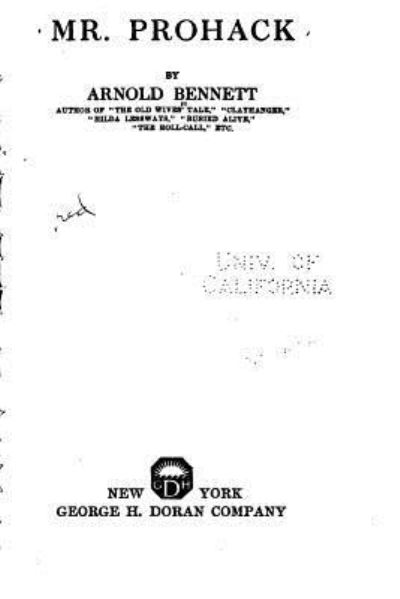
Mr. Prohack
Arthur Charles Prohack is a senior Treasury official whose London household finds its accustomed way of life increasingly difficult to afford.
About
Spoiler notice: This overview discusses Sissie's marriage, Charlie's financial crisis and Prohack's decision to enter the paper-making business at the ending.
Arthur Charles Prohack has spent more than twenty years at the Treasury learning how to resist demands for money. At forty-six, he possesses considerable authority within the institution and almost no public celebrity outside it. His household occupies a respectable London address, but its income no longer comfortably supports the life that respectability implies. Arnold Bennett begins Mr. Prohack with the conversation of a husband and wife accustomed to each other's habits, jokes and evasions. Their financial difficulty is real without being absolute destitution: they have tastes and expectations that make economizing painful. Prohack can laugh at distinctions of rank while enjoying his own, and question conventional conduct while expecting his family to recognize his position. The comedy develops from the limitations concealed inside that apparent self-knowledge.
An inheritance from his old acquaintance Silas Angmering changes the scale of the problem. Softly Bishop brings news that Prohack will receive at least a hundred thousand pounds after deductions. The announcement creates an inward commotion that he tries to disguise with a tranquil manner. Angmering's money also raises questions about profits made during the war, complicating the pleasure of receiving it. Prohack is too conscious of ordinary human weakness to condemn the dead man easily, and too interested in the fortune to remain detached. The arrival of wealth gives Bennett a way to examine judgment under altered circumstances. A man practised in scrutinizing other people's expenditure must decide what he is entitled to want when the money belongs to him.
His family does not wait for him to complete that examination. Sissie already prefers the possibility of earning money to the prospect of endless household economies, and pursues a dancing studio. Eve displays initiative of her own, buying a motor-car while her husband is ill and arranging the practical details he expects to find neglected. He admires her daring even as he makes the purchase an occasion for interrogation and teasing. The new chauffeur, Carthew, becomes a person with whom Prohack wants to establish relations before entrusting him with his life. Such encounters keep the story grounded in the people required to sustain an affluent household. Money increases the available choices, while also multiplying the decisions and relationships that Prohack cannot supervise entirely on his own terms.
Sir Paul Spinner's Romanian oil venture brings another adjustment in Prohack's sense of himself. A financier associated with enormous sums now wants access to his capital, and the discovery produces an intoxicating reversal of their apparent importance. Prohack's technical understanding of finance does not prevent him from enjoying that sensation. His investment subsequently leaves him reckoning his possessions at more than a quarter of a million pounds. Meanwhile, Dr. Veiga proposes a demanding cure for his inability to inhabit leisure: idleness must be organized as a serious occupation. Turkish baths, dancing and attention to clothes fill the hours once governed by official work. The prescription is funny because Prohack wants relief from demands yet remains dependent on having something definite to do.
Parenthood supplies demands of its own, particularly when his children act as adults without waiting for his permission. Sissie's relationship with Oswald Morfey culminates in a private marriage that Eve presents to Bishop as an arrangement enthusiastically agreed upon by the family. Prohack's response reveals the effort required to preserve dignity when events have overtaken his authority. Charlie's independence takes a financial form. A gamble in Royal Rubber shares leaves him facing a crisis far larger than his father initially imagines. Prohack's offer of securities worth a hundred and fifty thousand pounds combines affection, pride and a refusal to let his son be defeated. His motives are not tidied into pure generosity; the chance to demonstrate his own power is part of his happiness in helping.
The final chapter shows that Charlie has needed only a small portion of the promised support and has repaid it within weeks. That favourable outcome does not give Prohack a permanent occupation. He is bored again, having abandoned the elaborate routines of scientific idleness, and he has resigned from the Treasury rather than obstruct a friend's promotion. Charlie takes him to Southampton to inspect an extravagant yacht whose crew has been waiting for the owner to find time to use it. Prohack measures the waste in wages, labour and meals served to two visitors. Charlie answers with the grievance of a returning serviceman who tried unsuccessfully to obtain useful work. His deliberate extravagance becomes, in his own account, a way of retaliating against the country that failed him.
The argument leads Prohack towards a different response. Instead of delivering the crushing lecture he prepares in his head, he asks about Charlie's paper-making concern. After visiting the works, he tells Eve that he has bought half the business and intends to help establish it properly. He acknowledges his ignorance of manufacturing and the worries the enterprise will bring; the novel does not follow him forward to prove that it succeeds. What changes is his willingness to accept an occupation that requires production rather than the management of leisure. Eve, whom he expects to protest about his health, understands enough to welcome the decision. Their closing exchange returns the comedy to the marriage, where familiarity continually coexists with the discovery that the other person can still surprise.
Book details
- Author
- Arnold Bennett
- First published
- 1922
- Series
- No series listed
- Subgenre
- Literary fiction, Modern classics
- Primary genre
- Literary Fiction
- Tags
- No tags for this book.
Review
Editor profile
Baby Bat
Goodreads and social links will be added soon.
- Goodreads — link coming soon
- Social media — link coming soon