
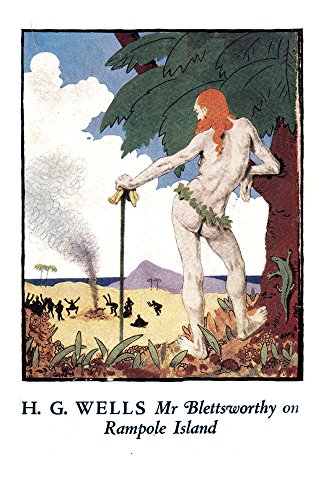
Mr Blettsworthy on Rampole Island
Arnold Blettsworthy sets out on a sea voyage after his faith in the people around him collapses.
About
Spoiler notice: This overview discusses the island’s reinterpretation, Rowena, the wartime injury and the final debate with Graves.
Mr Blettsworthy on Rampole Island begins with Arnold Blettsworthy trying to explain what sort of person his family has made him. He is proud of a tradition of gentleness, culture and civilized conduct, yet his account repeatedly exposes qualifications which that reassuring picture cannot quite absorb. Commercial activity becomes benevolence, awkward events require generous explanation, and belonging to the family seems to involve knowing which facts to emphasize. H. G. Wells gives Arnold the first-person voice through which all the later adventures must pass. His insistence upon respectability is therefore useful information about the storyteller, rather than a guarantee that everything he sees or does has the meaning he assigns to it.
Disillusionment begins within the world he has considered safe. His feelings for Olive Slaughter and his friendship with Lyulph Graves have become bound up with hopes for his future, including their business undertaking. Discovering an intimacy between the two wounds more than a romantic expectation. It damages the explanation of life on which he has relied, and his own angry responses complicate his distinction between civilized behaviour and the impulses he wishes to disown. Advice to take a long sea voyage offers a way of finding a different self. Boarding the Golden Lion initially feels like release from a small, constricted existence, but the ship soon becomes another place where dependence upon other people provides little assurance of humane treatment.
Violence, fear and disaster carry the voyage towards the derelict ship on which Arnold is left behind. His recollection increasingly mixes external events with nightmares and uncertain perceptions, preparing the reader for the strange world into which he believes he has fallen. On Rampole Island he describes a society governed by brutal customs and a hierarchy that does not recognize the dignity he expects for himself. His condition gives him an exceptional position: the inhabitants regard him as a sacred lunatic, a status which protects him because their cannibal practices prohibit eating such a person. The supposed outsider's civilization offers a standard for judging them, but the frame of his narration keeps raising questions about where that standard came from and how securely he possesses it.
Chit, Ardam and the island's elders become part of his effort to understand power, religion and conflict in this unfamiliar place. The giant ground sloths called Megatheria add a fantastic natural world to the social nightmare. Arnold's attachment to Wena brings a possibility of intimacy and escape, and the pursuit that follows ends with an injury, shelter and care. Then the surroundings change their meaning. The cave becomes a room, the cliffs become buildings, and the woman tending him is Rowena in Brooklyn Heights. The transition is more unsettling than a simple return voyage. Details that seemed to establish the island's reality acquire counterparts in ordinary life, leaving Arnold to ask how two incompatible accounts can feel so vividly true.
Dr. Minchett supplies an explanation based on rescue, treatment and Arnold's way of interpreting experience. He says a scientific expedition found Arnold aboard the Golden Lion and that the long island adventure developed during a period in which his mind transformed the world around him. Minchett can explain the Megatheria through the expedition's interests and Chit's resemblance to himself through Arnold's altered perceptions. Arnold listens without finding the explanation sufficient. The important difficulty is moral as well as factual: Rowena's distress and the real world's war cannot be dismissed by establishing that particular images were mistaken. He begins to accept New York as reality while insisting that the cruelty he called Rampole Island remains visible within it.
The First World War makes that insistence difficult to separate from experience. Arnold serves, suffers a severe wound and loses a leg, bringing the distance between civilized claims and bodily destruction into another part of his life. The postwar narrative returns him to relationships and practical work rather than allowing adventure or recovery to end the story neatly. Graves reappears with confidence in possibilities which Arnold's disappointments make harder to believe. Their history gives the argument an awkward personal basis. Graves acknowledges vanity and wrongdoing, while maintaining that imperfect people can participate in something better than the arrangements they inherited. Arnold must decide what to make of optimism offered by someone whose earlier conduct gave him reasons for distrust.
Their concluding conversation leaves that decision open. Arnold sees recurring fear, stupidity and cruelty; Graves sees growing knowledge, education and the possibility of a collective purpose. The island becomes a way of thinking about the surrounding civilization, not merely a place whose coordinates or existence need to be settled. Their old business failure returns as an example which can support either account: evidence of human insufficiency or an imperfect attempt that better conditions might allow others to fulfil. Even Graves's promise of repayment requires a qualification when Arnold questions it. The last word belongs to Graves's confidence that Arnold's Rampole Island will pass away. Wells ends before history or personal experience can prove him right, preserving the tension between an enduring nightmare and a future someone remains willing to attempt.
Book details
- Author
- H. G. Wells
- First published
- 1928
- Series
- No series listed
- Subgenre
- Literary fiction, Classic adventure, Modern classics
- Primary genre
- Literary Fiction, Adventure
- Tags
- No tags for this book.
Review
Editor profile
Baby Bat
Goodreads and social links will be added soon.
- Goodreads — link coming soon
- Social media — link coming soon