
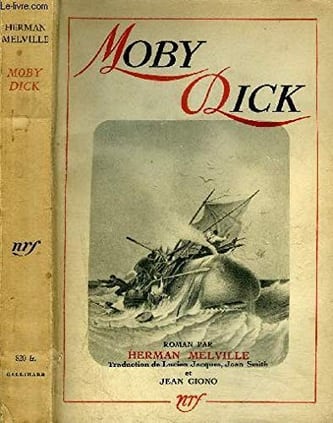
Moby-Dick
Ishmael goes to sea because he feels like it, signs aboard the whaling ship Pequod in Nantucket and only discovers once the voyage has begun what the captain intends.
About
Spoiler notice: Spoilers for the full voyage and ending follow.
Ishmael begins by explaining why he turns to the sea: life ashore has lost its hold on him, and a voyage offers a way to move through that restlessness. In New Bedford he shares an inn bed with Queequeg, a harpooner from the Pacific islands whose tattoos and unfamiliar customs initially unsettle him. The two become close companions, and their friendship leads Ishmael to Nantucket, where they sign aboard the whaling ship Pequod. The opening takes its time with lodging, food, sermons and hiring, establishing a world in which a great ocean passage is made from everyday choices and chance encounters. Hiring brings its own negotiations. Their pay is a fractional share of the voyage’s profits, binding their livelihood to its commercial success. Ishmael's curiosity about people and places remains part of the voyage from the start.
The Pequod’s owners, Peleg and Bildad, arrange the voyage, but its captain remains out of sight until the ship is well underway. Ahab appears as a commanding and physically marked figure: a previous encounter with the white whale cost him part of his leg. When he finally addresses the crew on deck, he reveals that the voyage has a private purpose. He offers a gold coin to the first sailor who spots Moby Dick and turns a commercial whaling expedition into a hunt. Starbuck, the first mate, objects to making vengeance the ship’s business, while Stubb and Flask respond differently to their captain’s resolve. Ahab's leg is replaced by a piece fashioned from a whale's jaw, so his injury is also a visible reminder of the encounter he wants to repeat. The coin fixed to the mast makes the crew's attention answer to his aim, even as the ship still sails under the usual authority of its officers.
The Pequod is a working vessel as well as the setting for this pursuit. Its crew lowers boats to kill whales, cuts the carcasses apart, renders blubber into oil and stores the product in the hold. Ishmael explains the dangerous handling of harpoons and lines, the division of work among the boats, and the ranks aboard ship. Queequeg, Tashtego and Daggoo serve as harpooners; the mates direct the boats, while sailors keep watch and tend the ship. Meetings with other vessels, or gams, bring news of the sea and of the elusive whale, but Ahab repeatedly steers the conversation back to his quarry. Ishmael's description of the monkey-rope makes that danger personal: while Queequeg works on a carcass alongside the ship, the rope joins him to Ishmael on deck. One man's movement can imperil the other. The machinery of the voyage depends on this kind of cooperation, even when Ahab's chosen goal threatens everyone aboard.
The story is told by Ishmael, yet his account ranges far beyond what a single sailor could simply witness. He pauses the voyage for chapters on whale anatomy and classification, whaling equipment, the processing of oil, and the whale’s place in art and books. Some passages sound like a lecture or a catalogue; others become comic scenes, philosophical argument or dramatic dialogue. These changes are part of the book’s form: the Pequod’s forward movement sits beside Ishmael’s attempts to describe a creature and an industry that resist neat explanation. His narration also admits uncertainty, memory and conjecture, especially when he imagines events beyond his own view. The book prepares this method before the ship sails: it opens with collected references to whales and an etymological preface, then lets its narrator move among sources, memories and scenes. A chapter may briefly leave the central action to describe a tool or a bodily feature, and then return to the deck without resolving every question it has raised.
As the ship crosses the oceans, its ordinary work continues alongside Ahab’s fixation. The Pequod encounters vessels with their own losses and warnings, including the Rachel, whose captain asks Ahab to help search for a missing boat carrying his son. Ahab refuses because he is following Moby Dick. Starbuck continues to question the hunt, but he does not take command from his captain. Meanwhile, the crew’s varied backgrounds and duties remain visible in the shared routines of watch, meal, chase and repair. The distance between Ahab’s singular purpose and the crew’s practical labour grows as the white whale becomes more than a reported sighting. Encounters such as the Albatross and the Samuel Enderby offer contrasting views of the hunt, from a ship that cannot answer Ahab's questions to one whose captain has also lost a limb to a whale. These meetings widen the voyage beyond the Pequod while making clear how uncommon Ahab's all-consuming purpose is among other whalemen.
In the final sequence, the Pequod reaches Moby Dick and the pursuit stretches across three days of repeated boat launches. Ahab’s boat is wrecked, the whale rams the ship, and the Pequod sinks. Ahab throws a final harpoon, but its running line catches his neck and drags him from the boat. He and the crew are lost, while Ishmael survives because he is away from the ship when it sinks. He clings to Queequeg’s coffin, which has been remade as a life buoy, until the Rachel finds him. The closing frame explains the coffin's presence: Queequeg had it made during an earlier illness, and it is later converted into the buoy that keeps Ishmael afloat. The Rachel takes him aboard while continuing to search for her own missing sailors. An object intended for burial has become Ishmael’s means of survival, connecting his rescue to the friendship with which the voyage began.
Book details
- Author
- Herman Melville
- First published
- 1851
- Series
- No series listed
- Subgenre
- Naval adventure, Literary historical fiction
- Primary genre
- Historical Fiction
- Tags
- No tags for this book.
Review
Editor profile
Baby Bat
Goodreads and social links will be added soon.
- Goodreads — link coming soon
- Social media — link coming soon