
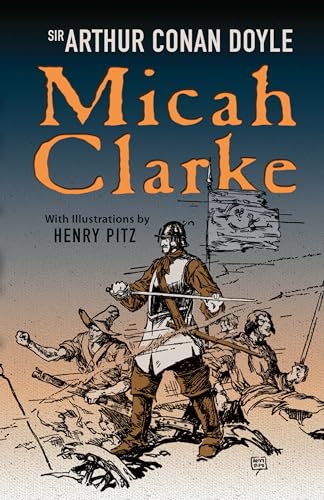
Micah Clarke
In the hard winter of 1734, Micah Clarke tells his grandchildren how his youth in Havant led him into the Monmouth rising of 1685.
About
Spoiler notice: This overview discusses the defeat at Sedgemoor, Micah’s sentence and escape abroad, and the later lives and unresolved fates described in the final chapter.
Micah Clarke speaks from the far side of the adventure he is about to tell. An old man addressing his grandchildren during the winter of 1734, he remembers a youth that carried him from Havant into the Monmouth rising. The distance between those moments matters: he can describe youthful hopes while knowing that the cause failed, and he can distinguish the excitement of joining an army from the grief of surviving its defeat. Doyle gives this historical novel the intimacy of a family account, with interruptions and direct appeals keeping the listeners present. Micah wants the dead to become recognisable people again, rather than remain names within a record whose compressed events cannot convey how it felt to live through them.
His childhood home is already a place where the country's religious divisions meet. His father Joseph, known as Ironside Joe, has carried convictions formed in military service into his life as a leather merchant and tanner. Micah's mother belongs to the established Church, while the village contains several communities whose worship places them in different relations to authority. These differences are close enough to affect everyday acquaintance instead of remaining distant theological disputes. The family also supplies an example that the narrator will return to at the end: his parents retain their beliefs without sacrificing affection and respect. Zachariah Palmer's gentler influence offers another way of thinking about conduct, giving Micah more than one model of what a principled life might require.
A fishing outing with Reuben Lockarby brings Decimus Saxon into that local world. The soldier of fortune carries news and letters connected with the planned rising, transforming an encounter into a decision about action. Joseph Clarke supports Monmouth's cause and expects his son to take a place in it, but Micah does not accept every argument without question. His response to his father's defence of the Rye House plot shows a conscience capable of resisting convenient descriptions of violence. Setting out west therefore involves both inherited allegiance and personal judgement. Reuben's companionship and Saxon's military experience then carry those questions onto the road, where enthusiasm must coexist with danger, uncertain information and the need to make choices quickly.
At Taunton, the journey becomes participation in a collective effort. Saxon drills the recruits repeatedly, trying to turn local men into a force that can handle weapons and respond to commands together. Micah takes responsibility for a company, learning that leadership means knowing men and their needs as well as occupying a rank. The growing regiment attracts attention through its improving appearance, but Saxon's methods also reveal political calculation: he cultivates religious zealots because he believes their fervour can become power. Monmouth's arrival and the councils surrounding the campaign place the companions inside a movement with ambitions beyond their own circle. Micah's dispatch to the Duke of Beaufort gives him a further role in the uncertain traffic between political claims, messages and competing loyalties.
The campaign reaches Sedgemoor through worsening conditions and the effort to turn a night attack into victory. Doyle's battle narrative follows Micah through fighting and retreat, keeping the consequences close to the men who encounter them. One of its most disturbing moments comes away from the massed struggle, when the fleeing companions find a wounded veteran attempting to free himself from a shattered arm. Micah explicitly contrasts that sight with the splendour of horses, uniforms and trumpets. His later voice does not let the language of honour conceal what has happened to a human body. The episode makes the cost of defeat more immediate than a tally could, while also challenging the attractive picture of warfare with which young men may enter it.
Capture and a sentence of transportation expose Micah to another form of helplessness. His future seems likely to be determined by those who can sell or dispose of prisoners, until Saxon intervenes at Poole. The veteran uses leverage over Beaufort to obtain his own pardon and a command, along with money and a route abroad for Micah. Their gains are different: Micah can leave, but remains an outlaw if he stays in England. He hesitates because the other prisoners have depended on him, refusing to regard personal release as a sufficient answer to their predicament. Saxon's information about plans aboard their ship helps him accept departure. Reunited with his father's sword, he leaves towards Flushing and an uncertain life beyond his country.
The closing chapter returns to the grandchildren and deliberately declines to turn that departure into a second complete adventure. Micah tells what he knows of his companions instead. Reuben recovers, receives a pardon and marries; Saxon establishes a later life in Virginia; Solomon Sprent dies after a marriage and family of his own. Micah's parents live to welcome him back, and even his horse Covenant receives an account of its comfortable old age. Other outcomes remain less certain, especially the final destination of the prisoner ship. The grandfather's limits preserve that uncertainty. His remembered failure ends with a hope that religious rivalry might express itself through better lives and care for others, rather than renewed punishment and war.
Book details
- Author
- Arthur Conan Doyle
- First published
- 1889
- Series
- No series listed
- Subgenre
- Historical adventure, Classic adventure
- Primary genre
- Historical Fiction, Adventure
- Tags
- No tags for this book.
Review
Editor profile
Baby Bat
Goodreads and social links will be added soon.
- Goodreads — link coming soon
- Social media — link coming soon