
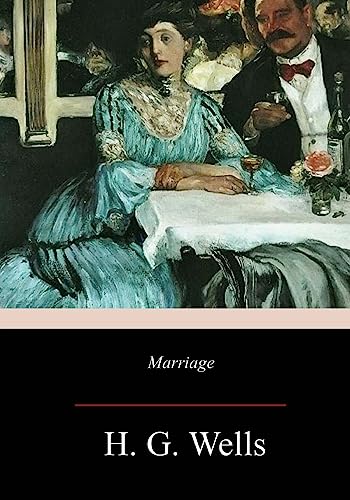
Marriage
Marjorie Pope breaks an engagement to marry the scientist Trafford, only to discover that affection does not settle the demands of money, work and family.
About
Spoiler notice: This overview discusses Marjorie's broken engagement, the Traffords' wealth, the Labrador expedition, Trafford's injury and the return journey at the ending.
Marriage begins with Marjorie Pope in a family whose ideas about respectability, education and a suitable future do not fit neatly together. She is engaged to Mr. Magnet, a prospect that offers security without settling her feelings. H. G. Wells gives her an active inward life beyond the labels through which her surroundings attempt to define her. Religious affiliation, parental authority and the expectation of marriage provide categories, but fail to organize everything she wants or thinks. Professor Trafford enters through an aviation accident, when his monoplane crashes near the family during an afternoon game. The spectacular interruption creates an encounter; the relationship that follows will require much more than the excitement of something new arriving from outside an established routine.
Her decision to break with Magnet makes the limits of parental tolerance tangible. Educational support and money become instruments through which her father can express disapproval, joining the supposedly personal choice of a husband to the practical conditions of independence. Trafford offers a different kind of attraction, associated with scientific work and intellectual seriousness rather than the safer arrangements already proposed. Their eventual elopement to Italy seems to promise a life selected for themselves. Wells then follows the promise into its material requirements. The difference between choosing one another and knowing how to live together becomes the novel's main business, with love expected to sustain people whose assumptions about time, money and necessary work have not yet been tested in a shared household.
That household supplies pressures which cannot be dismissed simply because they are ordinary. Bills, domestic organization, children and social expectations compete with Trafford's research. Marjorie's efforts to manage life are not automatically understood by a husband whose work provides a strong sense of purpose. Equally, her wish to create an attractive and socially successful home can draw resources away from the freedom his research requires. Wells allows affection to coexist with the suspicion that one's partner is responsible for a frustration whose causes extend beyond the marriage. The couple must work within a society that attaches status to possessions and leisure while depending upon labour performed elsewhere. Their disagreements therefore concern both individual habits and the larger system in which those habits have acquired value.
Trafford's move into industrial work with Solomonson changes their position dramatically. Rubber provides wealth and the ability to establish a more ambitious home, bringing relief from earlier constraints. The improvement does not make the relation between work and purpose straightforward. Trafford moves between the comforts available to his family and the factory world supporting them, gradually accommodating circumstances he might once have found intolerable. Scientific intelligence has proved capable of making money, but the use to which that success is put remains a separate question. Marjorie's family recognizes the visible achievement readily enough. Trafford himself becomes increasingly doubtful that prosperity answers the need which originally drew him towards investigation. Having secured an affluent life, he finds himself asking what that life is ultimately for.
His proposed answer is to go to Labrador and think away from the world that has absorbed them. At first he plans to leave Marjorie behind. His mother challenges the assumption that private discovery will solve a shared difficulty: if he returns changed while she remains within the old arrangements, they will still face the same division. Her insistence that he take his wife redirects the expedition. Marjorie joins him, leaving their four children at home, and the couple establishes itself at Lonely Hut. The wilderness removes familiar distractions while imposing its own demands. Food, fuel, shelter and the management of cold make the conditions of existence immediate, and intellectual independence no longer means freedom from practical work that somebody else quietly performs.
Trafford's encounter with a lynx turns those demands into a crisis. Badly injured, he depends upon Marjorie's capacity to act, protect him from the cold and nurse him through the consequences. The experience changes the terms upon which they can discuss their lives. A wife whom he has associated with the distracting arrangements of society now makes his survival possible through judgment and endurance. Their conversations do not require them to become people without appetites or weaknesses. Later, watching the trapper who helps them return, they recognize that even this apparently remote existence supplies the urban market for fashionable furs. Isolation has not carried them wholly outside the world they left. Their fresh understanding must include the connections that still join personal comfort to other lives.
Louis Napoleon Partington guides their departure, and the final chapter follows the journey towards the coast. Marjorie's longing for the children intensifies as reunion becomes a real possibility; a wireless message confirming that everyone is well breaks through her attempt at composure. The return also allows moments of exhilaration, including a sledge race that recalls the slower journey on which the couple first talked. At Port Dupré they wait for the steamer from St. John's, hearing its signal through the fog. The novel ends before the family reunion or a demonstration of how their revised marriage will function at home. What it supplies is a shared movement back towards the world, with greater understanding and obligations still waiting to be lived.
Book details
- Author
- H. G. Wells
- First published
- 1912
- Series
- No series listed
- Subgenre
- Literary fiction, Modern classics
- Primary genre
- Literary Fiction
- Tags
- No tags for this book.
Review
Editor profile
Baby Bat
Goodreads and social links will be added soon.
- Goodreads — link coming soon
- Social media — link coming soon