
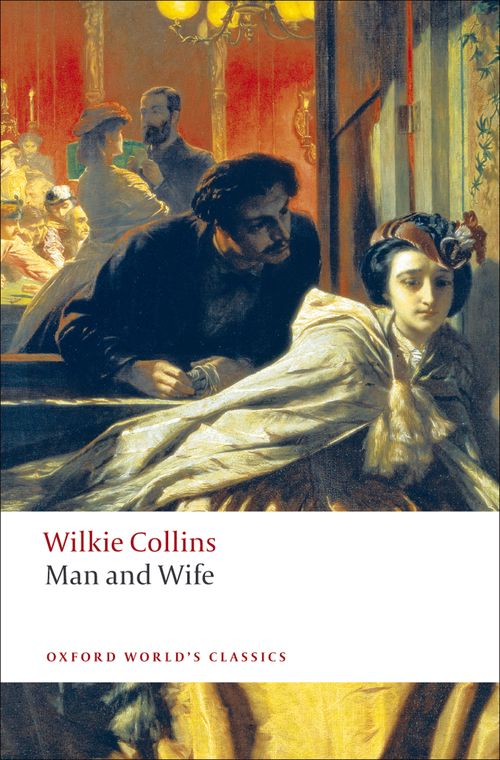
Man and Wife
At Windygates, Anne Silvester needs Geoffrey Delamayn to fulfil his promise of marriage, while her friend Blanche Lundie loves Arnold Brinkworth.
About
Spoiler notice: Full-plot spoilers, including the marriage evidence, Geoffrey's death and Anne's later marriage.
A promise between two school friends begins the history that Wilkie Collins carries into Man and Wife. Parting in 1831, Anne and Blanche pledge to remain devoted to one another even if their lives take them far apart. By their reunion in 1855, both have daughters bearing their own names, and the girls have formed a similar attachment. The apparent repetition is affectionate, but it will acquire a darker meaning. The elder Anne's husband, Vanborough, regards her as an obstacle to his social and political advancement, despite the qualities his friend Kendrew admires in her. Published in 1870, the novel makes the insecurity of a woman's married position part of its story before bringing the younger generation into the central action.
The younger Anne Silvester's friendship with Blanche Lundie survives a difference in their circumstances. Anne becomes a governess, while Blanche belongs to the household whose arrangements help determine her friend's working life. At Windygates, Blanche is attached to Arnold Brinkworth, and Geoffrey Delamayn enjoys the reputation attached to a conspicuous athlete. Sir Patrick Lundie's scepticism about the worship of physical accomplishment introduces a question that Geoffrey's conduct will make urgent: how much does public admiration actually tell anyone about the man receiving it? Anne's connection with Geoffrey is already far more serious than the social company around them understands. She wants him to keep his promise of marriage, while he begins looking for a way to escape that obligation without exposing his own behaviour.
The encounter at the Craig Fernie inn complicates that private wrong by involving another man. Anne expects Geoffrey, but Arnold comes in his place and represents her to the people at the inn as his wife, trying to protect her position and assist his friend. Neither Arnold nor Anne intends a marriage between them. Yet their conduct and declarations become material from which a marriage can be alleged under the Scottish rules debated in the novel. Geoffrey seizes upon the possibility of turning his friend's kindness into a means of deserting Anne. Arnold, who loves Blanche, is left with a secret whose disclosure could appear to condemn him, while silence gives Geoffrey more opportunity to manipulate what others believe. An act meant to provide immediate shelter becomes a threat to two people's futures.
Sir Patrick's investigation eventually finds decisive evidence in an earlier exchange between Anne and Geoffrey. Her letter demands fulfilment of his promise and calls herself his wife; his reply renews the promise in writing. Within the legal argument Collins constructs, that correspondence establishes a marriage preceding Arnold's arrival at the inn. The discovery can clear Arnold and protect his marriage to Blanche, but it also binds Anne to the man whose cruelty has become unmistakable. Sir Patrick recognises that cost and tries to avoid forcing the evidence into public acknowledgement. Anne insists upon producing it for Blanche's sake. The result turns an apparent legal protection into a personal danger, asking what a declaration of marital status is worth when it delivers the supposed beneficiary into the power of someone who hates her.
Geoffrey accepts the legal outcome as an opportunity to assert control. Anne goes with him, while Sir Patrick continues trying to arrange a safe separation. Her isolation makes seemingly ordinary domestic details consequential: which room she occupies, whether she can communicate with someone outside, and how much reassurance she should draw from a husband suddenly allowing her to visit his family. Hester Dethridge's presence adds another concealed history. Her written confession of violence against her own husband supplies Geoffrey with leverage, and he uses it to force her assistance. Collins brings the older woman's past into the younger woman's immediate danger, connecting a secret act within one marriage to a planned act within another. Knowledge that might expose wrongdoing instead becomes a resource for someone preparing to repeat it.
The final scheme depends upon an opening cut through the wall beside Anne's bed and concealed beneath the paper. Its position lets Geoffrey reach her pillow from the adjoining room, while the movable coverings are designed to leave little sign of interference. Anne, exhausted and encouraged by misleading appearances of goodwill, sleeps while intending to make her escape later. Geoffrey prepares to suffocate her, but Hester's response to the apparition she believes she sees interrupts him. She attacks; he suffers a sudden collapse; and she then kneels upon him and grips his throat. The noise wakes Anne, whose cries reach Sir Patrick outside. Arnold and a policeman enter the house and find Geoffrey dead, with Hester praying beside him. The planned murder has been prevented, through a confrontation whose violence leaves its own lasting consequences.
The epilogue returns to society's interpretation of the survivors. Lady Lundie reports visiting Hester, now confined for life, then probes for news of the relatives from whom she has withdrawn. Blanche and Arnold are together, expecting an addition to their family. Sir Patrick has also married, and his new wife is revealed to be Anne Silvester. Lady Holchester describes the match as a good action that offers a woman tested by suffering a calmer future, while Lady Lundie discovers that she herself has become the dowager. The social comedy does not undo the danger through which Anne has passed. It closes a story that repeatedly contrasts the authority given to marriage with the conduct required to make it humane, finally placing her beside a man whose earlier actions have shown concern for her welfare rather than an appetite for possessing her.
Book details
- Author
- Wilkie Collins
- First published
- 1870
- Series
- No series listed
- Subgenre
- Literary fiction, Modern classics
- Primary genre
- Literary Fiction
- Tags
- No tags for this book.
Review
Editor profile
Baby Bat
Goodreads and social links will be added soon.
- Goodreads — link coming soon
- Social media — link coming soon