
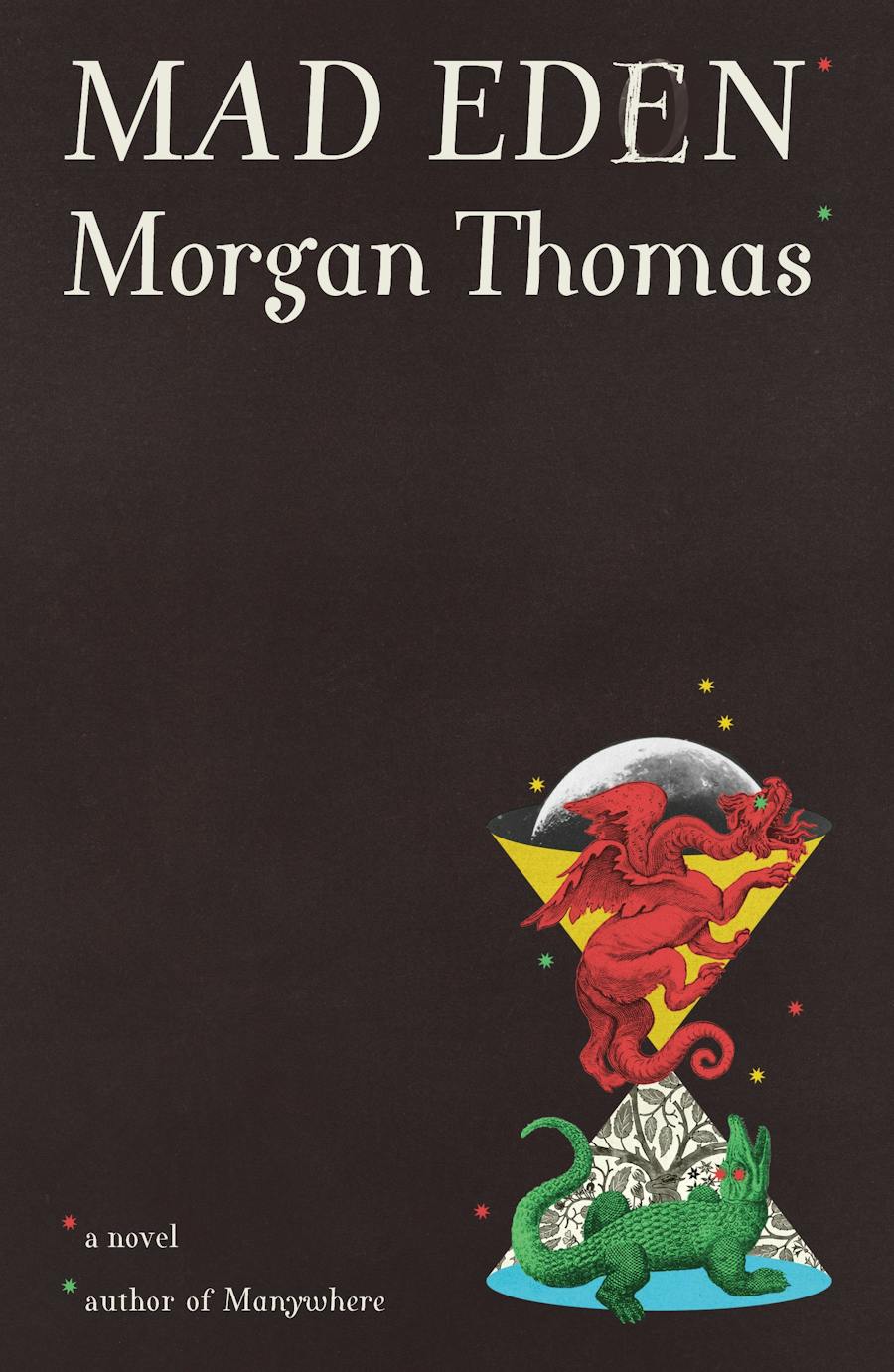
Mad Eden
In a secluded Florida home, trans patient navigator Ro and their partner Liam try to preserve a joyful life amid strain and an inhospitable climate.
About
Spoiler notice: Spoilers for the opening premise, including Ro and Liam’s life in Florida, the arrival of Quentin, and the online serial that draws Ro’s attention. Later developments and the ending are not summarized.
Ro begins the story trying to explain a summer of joy that does not fit neatly into a list of reasons. They and Liam live in a secluded Florida cabin, where ordinary pleasures sit alongside unease about money, the surrounding political climate and what may happen next. The novel opens by circling that feeling rather than moving straight through a chain of events: Ro looks backward for a beginning, considers what can and cannot account for happiness, and notices how a life can feel altered without any single change explaining it. A quiet home, time outdoors and the routines two people share matter, but the book resists treating comfort as proof that the world around them has become safe. Their fragile domestic peace is real, and so are the forces pressing against it.
Ro is a trans patient navigator whose work helps people seeking gender-affirming care find their way through a difficult landscape. They are also newly diagnosed as autistic, a change that prompts them to reconsider earlier experiences and the words used to describe them. The novel stays with Ro’s own account of that shift rather than turning it into a general explanation of autism. In the opening pages, Ro reflects on memory, time, sensory experience and the labels attached to distress; the language can offer new ways to understand a life even when it carries clinical assumptions of its own. Thomas keeps Ro’s identity and work connected to the intimate scale of daily life: a person can be caring for others, negotiating their own needs, and trying to preserve a home with someone they love at the same time.
Liam is Ro’s partner, and their relationship is one of the book’s central uncertainties. They have chosen a shared life that does not follow every conventional milestone, and the opening frames their closeness through small habits, domestic decisions and the care they show each other. Yet intimacy does not make them perfectly aligned. Ro’s attention can become absorbed elsewhere, while Liam has needs and frustrations of their own. Rather than making the partnership a simple refuge from public pressure, the novel lets affection and strain occupy the same space. This tension also shapes how Ro thinks about the people who count as family. Quentin, a trans teenager who sometimes calls himself their child or their son, is not their child by blood or legal arrangement, but the connection is consequential all the same.
Quentin’s visit brings a new urgency into the cabin. He is on his way to college in Missouri and hopes to start testosterone there. His plan brings the novel’s questions about access to gender-affirming care close to the family who supports him, while remaining one young person’s particular experience. Instead, Quentin is a particular young person with a relationship to Ro and Liam that includes reliance, affection, disagreement and generational friction. Their informal family can offer support, but it cannot make every decision for him or remove the practical uncertainty surrounding his plans. The novel’s interest lies partly in that boundary: caring about someone means showing up amid imperfect knowledge, not becoming an all-knowing authority over their life.
A second story grows inside the first. Ro becomes engrossed in an online fantasy serial called Mad Eden, about magicians and dragonlike creatures. Its opening follows Nova, a magician who struggles with the sameness and rituals expected by the other magicians, and whose attention is caught by a dragno during a ceremony. The serial uses an unusual, constrained vocabulary and lets its fantastical rules bend around questions of difference, prediction and cause. Thomas built the fictional text from words in a scientific paper about autism and prediction. In the novel, that source becomes material for imaginative play: a clinical vocabulary is rearranged into a dragon fantasy rather than treated as the last word on autistic life. The embedded installments give Ro something absorbing to follow while also changing the shape and pace of the book around them.
A seemingly ordinary patient video call eventually sets off consequences that threaten the life Ro and Liam have built. The precise mechanism remains out of view here, but the stakes are clear: private work, public attention and political pressure can collide in ways that leave people exposed. This danger draws together the personal and professional parts of Ro’s life. The work that brings them into contact with people seeking care is not separate from the relationship and home they are trying to protect. Quentin’s needs, Liam’s own frustrations and Ro’s attachment to the fantasy serial continue alongside that threat, preventing the crisis from reducing everyone to a single role or argument.
Mad Eden moves between domestic scenes, Ro’s reflections and the fantasy serial, using shifts in time and form to ask how people make meaning from language, memory and one another. Its trans and autistic characters are not interchangeable examples of an identity or a debate: Ro and Quentin have different ages, needs and positions within their family, while Liam’s presence complicates the picture of who can care for whom. Thomas has described wanting multiple, non-stereotyped lives rather than a single representative account. That choice is felt in the book’s structure, where an online story can illuminate the real world without standing in for it, and where joy can coexist with fear without cancelling it. The result is a novel about the labor of staying connected in a precarious summer, and about the stories people make when the available language seems too narrow for what they are living.
Book details
- Author
- Morgan Thomas
- First published
- 2026
- Series
- No series listed
- Subgenre
- Literary fiction, Experimental fiction
- Primary genre
- Literary Fiction
- Tags
- No tags for this book.
Review
Editor profile
Baby Bat
Goodreads and social links will be added soon.
- Goodreads — link coming soon
- Social media — link coming soon