
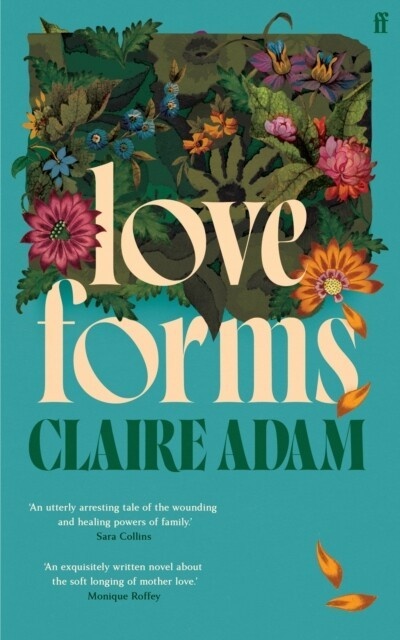
Love Forms
In 1980 Trinidad, sixteen-year-old Dawn Bishop travels to Venezuela, gives birth to a daughter and leaves the baby with nuns for adoption.
About
Spoiler notice: Premise spoilers: a teenage pregnancy, birth and adoption in Trinidad and Venezuela, and a possible contact more than forty years later. Later developments and the ending are not summarized.
The story begins in Trinidad in 1980, where Dawn Bishop is sixteen and pregnant. Her parents send her across the sea to Venezuela, where she gives birth to a daughter and leaves the baby with nuns to be adopted. That journey sets the novel’s central absence in motion: Dawn returns without the child, while the daughter grows up beyond the life Dawn can see. The separation is a family decision shaped by the social expectations surrounding a teenage pregnancy. From its first movement, the book links private attachment to the pressures that determine what a young woman is permitted to choose.
The distance between Trinidad and Venezuela is both geographic and emotional. Dawn’s departure takes her away from home at a moment when her future has been altered by adults around her. The novel’s premise does not reduce that decision to a single feeling: it involves a birth, an adoption, family authority and the practical need to continue living afterward. The baby is not present in Dawn’s later household, but the adoption remains part of her inner history. In this way, the past is established as an active force, not a completed episode. What Dawn cannot know about her daughter sits alongside the facts of the life she must build.
Over the following decades, Dawn moves to England, marries, has two sons, develops a career and eventually divorces. These milestones give her a recognisable adult life, but they do not erase the question of the child she left in Venezuela. The novel frames the passage of time through the contrast between outward continuity and an unresolved private past. Dawn has relationships and responsibilities in the present, yet she continues to imagine the life that might have unfolded with her first child. Her story therefore considers how a person can carry an old decision through changing homes and roles, and how family history persists even when it is not openly discussed.
When the narrative returns to Dawn at fifty-eight, she is divorced and her two grown sons are occupied with their own lives. This moment brings the earlier separation into a new stage: Dawn is no longer the teenager sent away by her parents, but a mother looking back across more than forty years. Her circumstances have changed, while the longing attached to her daughter has endured. The novel’s attention to this later life places motherhood across time rather than confining it to pregnancy or early childcare. It asks how care, memory and responsibility continue when a relationship has been interrupted before it could begin in ordinary ways.
A possible opening arrives through an internet forum, when a woman contacts Dawn and says she may be the daughter she gave up. The contact turns a long-held uncertainty into a possibility that Dawn must consider in the present. The premise leaves room for complicated feelings: hope has to coexist with the knowledge that the woman’s identity is not yet certain and that both lives have unfolded separately. The online message also introduces a modern means of searching across distance, connecting a family history rooted in the Caribbean with a later life in England. Dawn’s response becomes the point where remembrance may lead toward action.
Love Forms is a contemporary literary family novel about separation, reunion and the many shapes a mother’s love can take. Its movement across Trinidad, Venezuela and England gives the family story a transnational frame, while its long span follows Dawn from adolescence into middle age. The central search raises questions about what can be recovered after adoption, how social shame and family choices shape a life, and whether a person can meet the past without being defined only by it. Claire Adam’s second novel was longlisted for the 2025 Booker Prize. Its premise keeps the focus on one woman’s uncertain search and on the bonds that remain meaningful across years, distance and lives lived apart.
The circumstances of Dawn’s pregnancy matter because the choices in the story are distributed across a family. At sixteen, she is sent away by her parents, and the adoption separates her from the baby before she can raise her. The premise places her longing beside the decision-making power held by other people at that point in her life. Decades later, the search belongs to Dawn herself. This change in age and agency gives the story a way to consider how a person might revisit decisions made under pressure, while respecting that the lives shaped by those decisions cannot simply be rewound.
The possible reconnection also raises a question of what a search can promise. A message from someone who may be the daughter creates a path toward contact, but it does not erase the time both women have lived apart or establish what a relationship between them would mean. Dawn’s uncertainty is therefore central to the premise: the hope of finding family is paired with the difficulty of approaching a stranger whose history is bound to hers. The novel sets that present-day uncertainty against a long private remembrance, asking what kinds of recognition and care may still be possible when a family bond begins with separation.
Book details
- Author
- Claire Adam
- First published
- 2025
- Series
- No series listed
- Subgenre
- Family novel, Literary fiction
- Primary genre
- Literary Fiction
- Tags
- No tags for this book.
Review
Editor profile
Baby Bat
Goodreads and social links will be added soon.
- Goodreads — link coming soon
- Social media — link coming soon