
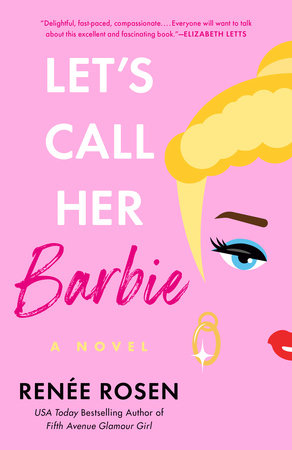
Let's Call Her Barbie
In 1956, Ruth Handler pitches a new kind of doll at the toy company she co-founded and gathers engineer Jack Ryan and designers Charlotte Johnson and Stevie Klein to bring the idea to life.
About
Spoiler notice: Spoilers for later family and career developments, including a 1970 diagnosis and conflicts over Mattel royalties; the final resolution is not described.
In 1956, Ruth Handler brings a proposal to the boardroom of the toy company she helped build: a doll shaped like an adult woman, with clothes that suggest a life beyond the nursery. The idea challenges a market in which girls’ dolls largely invite them to pretend at motherhood. Ruth imagines a different kind of play, one in which a child can picture herself in roles that have not yet been offered. In Renée Rosen’s fictionalized account, that pitch is the beginning of a long contest between an idea and the business, collaborators and public opinion needed to make it real. Ruth’s ambition gives the story its forward motion, but the doll’s eventual legacy cannot be controlled by its originator. The novel uses real people and milestones as its framework while inventing private scenes and character dynamics; those imagined moments belong to the story, not to the historical record.
Making the doll requires more than persuading a boardroom. Ruth gathers engineer Jack Ryan and designers Charlotte Johnson and Stevie Klein, whose work turns a proposal into a figure with a shape, wardrobe and identity. Jack’s engineering talent is paired with secrets he keeps closely guarded. Charlotte and Stevie bring their own hopes to the fashions that will help define Barbie. Each person’s contribution becomes tied to the project’s success, and that dependence makes collaboration fragile as well as necessary. The team is racing against a clock to get the idea off the ground, but the work also opens questions that outlast the launch: who gets to shape the doll, whose labor is visible, and who will claim ownership if the creation becomes valuable? The novel treats Barbie as a collective achievement even as its characters struggle over the credit and control attached to that achievement.
The doll’s design carries a tension from the start. Ruth intends Barbie to offer girls a grown-up figure and an expansive wardrobe, a way to imagine futures beyond the roles represented by baby dolls. Yet Barbie’s tiny waist, small feet and long neck make her body impossible to reproduce. The novel follows a product meant to widen play into a culture that can also turn its proportions into a standard. That contradiction reaches beyond the workshop: parents, girls and critics bring their own hopes and fears to the figure. Rosen’s story keeps those meanings side by side rather than resolving them into a single judgment. The design becomes both a creative decision and a public argument, and the people who made it must live with interpretations they cannot fully anticipate or direct.
As Barbie succeeds, the makers’ relationships become harder to separate from their business interests. The novel follows disputes over Jack’s royalties and place at Mattel, including Ruth and Seymour Rosenberg’s efforts to reduce what he receives and phase him out. Jack’s connection with Stevie adds another strand to the personal and professional bonds formed around the doll. The people who once needed one another to develop the project now face competing claims about contribution, loyalty and reward. Those conflicts complicate Ruth’s role as both the force behind the idea and a company leader protecting its interests. The story does not let the success of the product erase the costs borne by the people who helped create it. Questions of authorship reach beyond who first imagined Barbie: they include whose technical and design work counts, who is remembered, and who controls the legacy after the collaborators part ways.
Public controversy follows Barbie through the decades. Growing Up Skipper becomes a flashpoint when the National Organization for Women criticizes the doll, placing Mattel’s products within broader arguments about how girls are represented. Barbie’s own origins are also entangled with Bild Lilli, the German gag doll that inspired her design. These episodes unsettle any simple story of an American icon arriving fully formed through one person’s vision. The novel connects decisions made in meetings and design rooms with the meanings consumers and critics attach to the finished toys. A product can outgrow its creators’ intentions, yet its makers remain answerable to the choices they made. As the doll accumulates careers, controversies and changing ideas about representation, the story’s central question shifts from whether Barbie can be made to what responsibility comes with making a figure that enters so many people’s lives.
Ruth’s family life and later illness bring the pressures of work into sharper focus. Her relationship with her daughter, Barbara, sits alongside her effort to sustain a career and a company. In 1970, Ruth develops breast cancer and goes on to create Nearly Me, a prosthetic-breast business. That chapter of the story places her work on a doll’s body beside a later effort to serve women living with changes to their own bodies. The parallel gives the novel a way to explore the distance between an idealized image and the needs of real people, while Ruth’s motherhood and partnership complicate any portrait of achievement as a simple triumph. These are real-life milestones incorporated into a fictional narrative; Rosen’s scenes of private motive, dialogue and relationships are a retelling, not evidence of what the historical people said or felt in private.
Book details
- Author
- Renée Rosen
- First published
- 2025
- Series
- No series listed
- Subgenre
- Historical fiction, Biographical fiction, Literary fiction
- Primary genre
- Literary Fiction, Historical Fiction
- Tags
- No tags for this book.
Review
Editor profile
Baby Bat
Goodreads and social links will be added soon.
- Goodreads — link coming soon
- Social media — link coming soon