
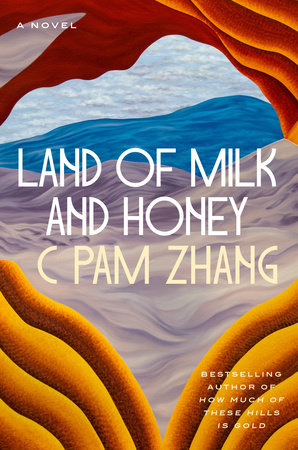
Land of Milk and Honey
After climate catastrophe and crop failures make ordinary food scarce, an unnamed chef takes a position at a secluded research community on the Italian-French border.
About
Spoiler notice: This account covers the climate crisis, the chef’s move to the mountain enclave, her work for its wealthy residents, her connection with Aida and the questions raised by the research community. It avoids later revelations and the novel’s ending.
The world of Land of Milk and Honey has lost the ordinary abundance that makes a meal possible. A heavy smog has dimmed the sun, crops have failed, and the food available to most people has narrowed to government-distributed substitutes. The novel begins with an unnamed chef whose profession has become difficult to practice in this altered economy. She has spent years pursuing demanding kitchens, but the ingredients that gave cooking its range are scarce and borders have closed around her. When an opportunity appears at an isolated research community high in the mountains near the Italian-French border, she takes it. The job promises access to a rare store of food and a chance to keep working at a craft that the wider world can no longer support. That choice brings her into a place where scarcity exists alongside extravagant private comfort.
The chef arrives at a compound shaped by its elevation, security and separation from the communities below. Its wealthy backers and scientific staff have access to ingredients and living things that have become unobtainable elsewhere. Her task is to prepare meals for investors and residents, including Aida, the employer's daughter, whose attention to the chef becomes an important part of daily life. Cooking gives the narrator a precise role inside the enclave: she can make meals, observe how people respond to them and learn what the institution values. Yet her access is carefully bounded. The mountain offers sunlight, fresh produce and a protected workplace, while also cutting her off from ordinary contact with the outside world. The setting's abundance is never separate from the restrictions that preserve it.
Aida's presence unsettles the practical arrangement between chef and employer. She is a gifted, unpredictable young woman, and her visits turn the kitchen into a place of testing as well as service. The narrator must read what Aida wants and decide how much of herself to adapt in response. Her namelessness leaves that process open: she can be defined by her work, her background, her appearance or the roles other people assign her, and those definitions do not necessarily agree. The novel follows the distance between being seen and being understood. It also connects the narrator's labour to a specific history of how Asian women are perceived, including the possibility of being treated as interchangeable even while attracting focused attention. Her employment depends on more than culinary skill, though the precise shape of that dependence emerges gradually.
Food gives the book a sensory vocabulary for survival. The ingredients the chef handles are not merely signs of luxury; their rarity makes each act of preparing and eating them carry a cost. Meals create moments of pleasure in a world where many people have little control over what they can consume, while the supply behind those meals reflects who has the power to protect land, species and resources. The chef's craft is a form of knowledge grounded in touch, smell, timing and transformation. It lets her make something immediate from ingredients that others have collected or preserved. At the same time, the lavish table raises a harder question: whether pleasure can be separated from the systems that reserve it for a few. The novel keeps appetite complicated, moving between nourishment, ambition, desire and complicity.
The research community presents itself as a response to planetary damage. Scientists work with rare organisms and engineered life, while the wealthy figures who fund the project imagine a future beyond the crisis. This programme gives the compound an apparent purpose larger than private comfort, but the distance between its stated aims and the way it operates remains important. The chef sees only parts of the work and must interpret what the people around her choose to reveal. Her position is intimate enough to notice routines and moods, but limited enough that she cannot immediately know what the institution intends. The resulting tension comes from observation, secrecy and dependence rather than from a conventional investigation. Questions about the enclave's plans gather alongside questions about the narrator's own reasons for staying.
Across the novel, climate catastrophe and private desire meet in the daily choices of people who know the world is changing but occupy very different places within it. The chef wants to continue cooking and to experience the abundance that has nearly vanished; she is also aware that her access has been purchased through work for people whose interests she cannot fully share. Aida's attention complicates the chef's duties and attachments, while the research project enlarges the stakes beyond the kitchen. Zhang's story follows how identity can be revised under pressure and how pleasure might feel when it is both vivid and unequally distributed. It stays close to the narrator's shifting perceptions, allowing the ethical questions to arise from work, food and relationships rather than resolving them into a simple lesson.
Book details
- Author
- C Pam Zhang
- First published
- 2023
- Series
- No series listed
- Subgenre
- Climate fiction, Dystopian, Literary fiction
- Primary genre
- Literary Fiction, Sci-Fi
- Tags
- No tags for this book.
Review
Editor profile
Baby Bat
Goodreads and social links will be added soon.
- Goodreads — link coming soon
- Social media — link coming soon