
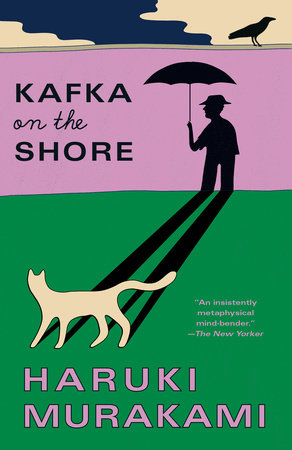
Kafka on the Shore
On his fifteenth birthday, Kafka Tamura runs away from home to escape a prophecy made by his father.
About
Spoiler notice: Spoilers cover Kafka’s flight from home, Nakata’s quest, and the novel’s central prophecy and supernatural framework. Major late revelations and the ending are not disclosed.
Kafka Tamura leaves home on his fifteenth birthday with a practical aim: to get far enough away to survive. His father has made a terrible prophecy about his future, and Kafka believes distance may be the only way to escape it. At the same time, the novel follows Satoru Nakata, an elderly man who cannot read and whose life was changed by a childhood wartime incident. Nakata has a gift for finding lost cats and an unusual ability to speak with them. These two lives begin in separate places and move along parallel tracks, while the book withholds the reason their stories belong together. The structure makes each chapter part of a journey and part of a larger question about connection.
Kafka travels by bus toward Takamatsu, where he finds refuge in a private library. There he encounters Oshima and Miss Saeki, whose lives become part of the questions that follow him. The library offers books, routine and human company, but it also sits at the edge of Kafka’s uncertainty: memories, dreams and the present do not remain neatly separated. A forest hideaway beyond the town deepens that instability. The story treats these places as more than stops on a map; each becomes a threshold where Kafka has to decide what he can face and what he still hopes to avoid. Even in apparent shelter, he cannot simply leave his father's prophecy behind.
Nakata’s journey takes a different shape. He sets out westward in search of an entrance stone, though he cannot explain what it is for or why he feels compelled to find it. His plainspoken manner and limited understanding of ordinary systems make him easy to underestimate, yet his route pulls him toward events that have consequences beyond his own life. His encounters with Hoshino give the book a grounded counterpoint to its supernatural turns: travel requires practical choices, rest and food, even when the destination seems to belong to a realm outside ordinary explanation. The entrance stone is an object with a purpose neither he nor the reader can readily grasp, so his determination matters more than a clear itinerary.
The novel’s world makes the impossible arrive without fanfare. Cats talk with Nakata, fish fall from the sky, and figures cross boundaries between body and spirit. A shape-shifter takes the recognizable form of Colonel Sanders; wartime soldiers remain untouched by time. These episodes are strange in their particulars, but they are connected to the book’s central concerns rather than offered as isolated spectacle. The characters encounter forces they cannot fully name, and the narrative lets the reader share that incomplete knowledge. Even when an event seems to invite a literal explanation, another layer remains open: a dream may carry weight in waking life, and a coincidence may feel like a message without becoming a solved code.
Fate is one pressure bearing on Kafka. He tries to outrun a prophecy that echoes the Oedipus story, but flight does not guarantee freedom from what he fears. The book asks whether a person can choose a path when inherited stories, desire and chance seem to shape it in advance. Its recurring crow imagery and the voice of the ‘boy named Crow’ give Kafka an inner companion as well as an unsettling point of view. Rather than explaining these symbols once and for all, the novel lets them change meaning as Kafka moves through fear, isolation and the possibility of growing up. His journey is therefore both outward, across Japan, and inward, toward a self he cannot simply leave behind.
Time and memory complicate that journey. In Takamatsu and beyond, the past can feel near enough to touch, while the present seems to stretch or contract around a character’s state of mind. Nakata’s wartime experience brings questions of isolation and shared memory into the lives of the principal figures. That history is one strand in a story also concerned with intimate loss, love and family. The novel does not turn into a historical account; instead, the wartime past becomes part of the imaginative structure through which it considers what people carry, what they cannot remember clearly and how one life may remain connected to others. This movement between personal and collective memory gives the parallel journeys emotional as well as metaphysical stakes.
Kafka on the Shore moves among coming-of-age story, metaphysical thriller and meditation on time. Each current pulls at a different thread: Kafka’s attempt to become more than the prophecy imposed on him, Nakata and Hoshino’s quest for the entrance stone, and the uncertain meeting point between their narratives. Their convergence is the suspenseful promise that carries the story forward, while the smaller encounters along the way give it breadth and texture. The shifts invite readers to follow clues without expecting every mystery to collapse into a single answer. The questions that remain open are part of the journey: the characters must keep choosing how to live even when they cannot know what their choices will mean.
Book details
- Author
- Haruki Murakami
- First published
- 2002
- Series
- No series listed
- Subgenre
- Magical realism, Translated literary fiction, Coming-of-age
- Primary genre
- Literary Fiction, Fantasy
- Tags
- No tags for this book.
Review
Editor profile
Baby Bat
Goodreads and social links will be added soon.
- Goodreads — link coming soon
- Social media — link coming soon