
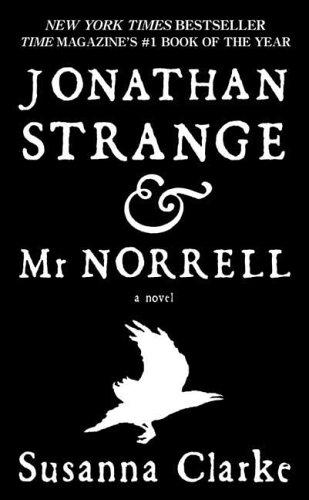
Jonathan Strange & Mr Norrell
In 1806 practical magic in England has been reduced to a theory that nobody practises, which is a problem for a country at war with Napoleon.
About
Spoiler notice: Spoilers for the complete novel, including Lady Pole’s bargain, Arabella’s disappearance and the final return of English magic.
Jonathan Strange & Mr Norrell imagines an England where magic belongs to the nation’s history but has largely disappeared from its present. In the early nineteenth century, respectable gentlemen discuss magical scholarship without actually practising it. John Segundus’s question about that absence leads him and Mr Honeyfoot to the reclusive Mr Norrell, whose library contains books other scholars can scarcely imagine seeing. Norrell demonstrates his power by making the stones of York Minster speak, but attaches a condition: the local society must give up being magicians. Reviving magic therefore begins with restricting access to it. His move to London brings this desire for control into a social world of introductions, patrons and political usefulness. Performing an extraordinary act is not enough to secure the authority he believes should follow from it.
Norrell’s decisive opportunity comes when Emma Wintertowne dies shortly before marrying the politician Walter Pole. To bring her back, he bargains with a fairy known as the gentleman with the thistle-down hair, surrendering half her life and a finger. The apparent miracle helps establish Norrell’s standing, but its cost falls on someone else. Emma, now Lady Pole, must spend her nights dancing at the fairy’s house of Lost-hope. Stephen Black, the Poles’ capable butler, is also drawn into the enchantment. Attempts to explain their situation emerge as stories that others cannot understand. The respectable household’s exhausted inhabitants seem ill to the people around them, while Norrell refuses to acknowledge the bargain responsible. A revival celebrated in public has created suffering that its beneficiaries find easy to overlook.
Jonathan Strange arrives through a different route. He is a wealthy young gentleman searching for a purpose, with a talent for improvisation that unsettles Norrell and eventually delights him. Their apprenticeship produces a genuine intellectual companionship, even as access to Norrell’s books remains a source of tension. Strange’s marriage to Arabella also gives him commitments that his solitary teacher does not understand. When the government sends him to assist Wellington, magic becomes subject to the practical conditions of a military campaign. Roads can be made and then removed after troops have passed, changing how armies move. Other experiments expose much darker limits: raising dead enemy soldiers to obtain information leaves Strange unable to dismiss them safely. Practical success cannot keep magical knowledge separate from responsibility for what an experiment does.
Returning from the war, Strange is less willing to accept Norrell’s account of what English magic should be. Their disagreement centres on John Uskglass, the Raven King, whose legacy Norrell tries to contain and whose methods Strange increasingly wants to recover. Mirrors open routes onto the King’s Roads, connecting places through paths outside ordinary geography. An argument that begins in scholarship becomes a public break when Strange criticises the exclusion of Uskglass from a supposedly authoritative magical history. He then begins writing his own book. His independence does not make him attentive to everything happening at home. The fairy takes Arabella into Lost-hope and replaces her with an enchanted moss-oak double. When that double dies, Strange believes he has lost his wife, leaving him with grief based on a deception he has not recognised.
The rivalry continues through publication and travel. Norrell makes the words vanish from printed copies of Strange’s book, attempting to control knowledge by preventing anyone else from reading it. His buyers and allies respond as people whose property and interests have been violated, showing that magical acts do not automatically stand outside ordinary law. Strange, meanwhile, travels to Venice and tries to alter his perception so that he can reach the fairy. A dangerous tincture enables encounters with Lost-hope, where he discovers that Arabella and Lady Pole are alive. The discovery changes what he needs to accomplish, but does not immediately restore them. His experiments and the fairy’s retaliation bring an unnatural darkness into the world, turning the consequences of private ambition and cruelty into something that whole communities can see.
The resolution requires help from people whose abilities the magicians have not consistently valued. Childermass and Segundus free Lady Pole, while Strange returns to Norrell seeking assistance rather than another contest. They work together on a spell calling England’s natural powers to recognise its true king. The fairy’s interference redirects those powers to Stephen, who uses them to destroy his tormentor and becomes the new ruler of Lost-hope. Arabella escapes into the care of the Greysteels in Padua. Strange and Norrell remain together within the darkness, however, and their renewed collaboration does not undo every consequence. Magic returns to many more people in England, extending beyond the narrow community of gentlemen Norrell had tried to preserve. The transformation has exceeded either magician’s original intention.
Clarke gives this alternate history the appearance of a documented past, with footnotes, reported conversations, magical books and competing accounts woven into the narration. The disagreements are often about who can interpret a source, possess a library or be recognised as an authority. Servants, women and people outside fashionable society encounter powers that the accepted experts either miss or choose to hide. The final return of magic changes those boundaries without offering a complete return to the previous order. Arabella and Strange can speak again, but they remain apart; the two magicians continue their research within the darkness. Their partnership has recovered something valuable while the world beyond them has become less controllable. The novel leaves renewed possibility beside unfinished consequences, with knowledge no longer confined to the people who first claimed to restore it.
Book details
- Author
- Susanna Clarke
- First published
- 2004
- Series
- No series listed
- Subgenre
- Historical fantasy
- Primary genre
- Fantasy
- Tags
- No tags for this book.
Review
Editor profile
Baby Bat
Goodreads and social links will be added soon.
- Goodreads — link coming soon
- Social media — link coming soon