
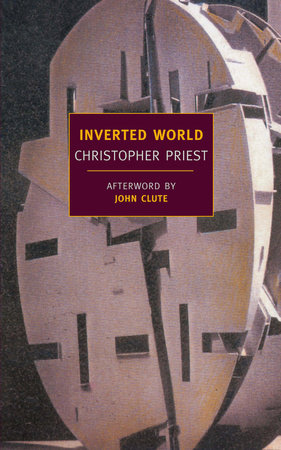
Inverted World
The city Earth is hauled across a warped landscape on railway tracks, laying new line ahead and lifting it behind.
About
Spoiler notice: Spoilers cover Helward’s childhood, guild apprenticeship and the city’s opening conditions; later developments and the ending are withheld.
The city called Earth moves on rails across a landscape whose shape unsettles ordinary geography. A winch hauls it forward; crews lay fresh track ahead and recover the line behind. The city must keep moving toward the ‘optimum’ to avoid falling farther into the planet’s crushing gravity. Rivers and mountains make the route difficult, but the book does not treat travel as scenery between settlements: the city itself is the vehicle, home and engineering project. Its residents depend on a continuing operation whose machinery is visible in the streets and whose purpose is only partly known to them.
Helward Mann’s life is measured in miles. At six hundred and fifty miles he is considered an adult and stands on the threshold of apprenticeship, an unusual coming-of-age measure that makes distance part of ordinary social language. The milestone changes his standing by admitting him to adult responsibilities and guild apprenticeship. The opening places him before a formal guild ceremony, excited to enter the work he has watched from a distance through his father. He knows the city through its walls and routines, but his father’s uniform and frequent absences suggest a larger life beyond the childhood spaces Helward has been allowed to see. His first step into adulthood is therefore also a step toward unfamiliar duties.
The ceremony reveals how carefully the city orders that transition. Helward is admitted as an apprentice to a first-order guild, the Future Surveyors, after his father proposes him and a Bridge-Builder seconds the nomination. Administrators leave the room while guild members deliberate, and Helward is asked to swear an oath before learning its full terms. Its demands place the city’s security above other concerns and restrict discussion of guild affairs and experiences beyond the walls. The scene gives institutional secrecy a physical form: who may stay, who must leave and who is entitled to know are decided in the same room.
Helward’s childhood supplies a smaller map of that enclosure. He grew up in a crèche near the southern end of Earth, with exercise confined to a gymnasium and a tiny open space bounded by high walls. He remembers friends and the administrators who raised him, but has no memory of his mother, who left the city soon after his birth. One friend, Gelman Jase, became an apprentice before him and returned to the crèche with the preoccupied air of the guildsmen. These details make the city’s restrictions part of an individual childhood, not only a policy described from above.
The guild system also breaks the city’s survival into distinct kinds of work. Alongside Future Surveyors are guilds for Traction, Track-Laying and Bridge-Building, which handle the movement and infrastructure on which Earth depends. Militia and Barter support those four, giving the city a practical division of labour without explaining every duty to its young recruits. Helward hears these titles gathered together for the first time and realises that even bridge-building carries ritual and secrecy in this society. His questions about why bridges and militia matter show how little a young resident can infer from public life alone.
The people who guide Helward through the ceremony do not simply hand him a job description. Apprenticeship binds him to guild rules, and the oath is tied to the security of what he sees outside. He is eager to leave the walls, but the adults around him impose obligations before offering explanations. That gap between anticipated knowledge and his new duties shapes his first contact with authority. The scene’s tension comes from small social procedures—a father whose guild work keeps him away, a closed meeting, an oath whose wording is withheld—rather than from an immediate display of force.
Outside the ceremony, the city’s larger crisis presses in. Its population is dwindling and residents are growing restive, while the rulers know that Earth is losing ground to the optimum. The named guilds make the labour behind continued movement legible, but their existence does not solve the political strain or explain every part of the world. Helward enters the Future Surveyors at a moment when the institutions that define his adult life are under pressure. The city’s survival is thus both a collective engineering task and the condition governing his new role.
The opening stays with a young man who has learned to describe age in distance and is only beginning to understand the institutions around him. The land beyond the walls stretches strangely, and the city’s measured progress offers no guarantee that its inhabitants understand the world through which they move. Ceremonies, apprenticeship and divided guild responsibilities make the larger mystery part of everyday life. Helward’s new role promises access to places he once knew only through rumour, but binds that access to silence. The novel’s speculative questions grow from these concrete customs: who may travel, who lays the line, who surveys the route and what an apprentice is permitted to tell.
Book details
- Author
- Christopher Priest
- First published
- 1974
- Series
- No series listed
- Subgenre
- Classic science fiction, Hard science fiction, Dystopian
- Primary genre
- Sci-Fi
- Tags
- No tags for this book.
Review
Editor profile
Baby Bat
Goodreads and social links will be added soon.
- Goodreads — link coming soon
- Social media — link coming soon