
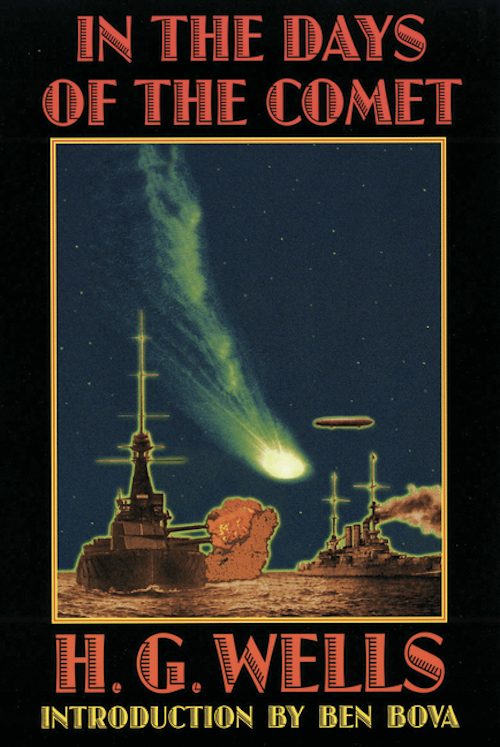
In the Days of the Comet
Framed as the memoir of an old man, H.
About
Spoiler notice: This overview includes the Change, Willie Leadford's later relationships and the novel's ending.
The apparent disaster in In the Days of the Comet becomes the beginning of a different human world. H. G. Wells approaches that transformation through a story within a story: an observer encounters an elderly man writing in a beautiful tower room and begins reading his account of the Change. The writer, Willie Leadford, looks back across decades to a youth that now feels almost impossible to recognize as his own. This distance shapes the novel. The young Willie experiences his circumstances as immediate grievances, while the older man sees a whole arrangement of habits and institutions that made those grievances seem natural. The comet therefore enters an account already concerned with how people understand their lives. It interrupts much more than the ordinary movement of a planet through space.
Willie's early world is an industrial Midlands landscape of cramped rooms, uncertain work and frustrated hopes. Visiting his friend Parload, he finds the other young man absorbed in observing the approaching comet. Willie wants to discuss his employer and his troubled relationship with Nettie Stuart instead. Their argument over science and socialism becomes revealing because he can scarcely tolerate an interest that does not immediately serve his own urgency. After leaving his job, unsuccessful attempts to find another position deepen his misery, and his anger reaches his mother as well as his friend. The older narrator's attention to shabby furniture, poor lighting and dirt gives those emotions a physical setting. He is describing a world that wastes effort and makes discomfort ordinary, while also recognizing how readily he once turned his own unhappiness against the people nearest him.
Nettie becomes the focus of that anger when she chooses young Verrall. Willie treats the loss as an injury demanding revenge, and the gulf between his language of love and his desire to control her grows frighteningly explicit. Armed with a revolver, he pursues the couple while the country moves towards war and the comet becomes an overwhelming presence in the sky. On the coast, the sound and flashes of a naval engagement briefly compete with his private purpose, but he regards them mainly as an interruption. He fires ineffectual shots and chases the fleeing lovers. Wells places personal and national violence in the same field of vision without making one cancel the other. Willie can condemn the disorder around him and still reproduce it in the belief that another person's life belongs to his wounded feelings.
The green vapours overtake him during that pursuit. When he wakes among barley and flowers, the first change is in how the world appears: light, colour and living things command an attention previously consumed by resentment. For a time he believes that he has died and reached a peaceful afterlife. His recollection of the angry young man who fired the shots seems remote and pitiable. Animals that looked dead begin moving, and the stillness proves to be a suspension rather than a final extinction. The narrative later explains the worldwide event through a fictional alteration of the atmosphere. Its importance lies in the new capacity for understanding and fellow feeling attributed to the survivors. Wells has imagined an interruption powerful enough to break habitual responses that argument, education and goodwill had not been able to dislodge.
Willie's subsequent proximity to the statesman Melmount brings him into the practical reorganization of society. Shorthand, an ordinary skill from his earlier working life, makes him useful at meetings where the possibilities of a world state are discussed. The opening of conversations once treated as secret contrasts with the concealment and rivalry he remembers as normal public conduct. Transformation still requires decisions and sustained labour. In the following period, the great Beltane burnings remove buildings' discarded fittings, obstructive possessions, documents and symbols associated with the old order. Willie celebrates this clearance as liberation, but the scale of destruction also gives the imagined renewal an uncompromising character. A changed heart does not merely make existing life more pleasant. It changes what people consider worth keeping, and what they are willing to sweep away.
The new world cannot abolish loss. While Willie is occupied with preparations for the festival, his mother's illness worsens and she dies, leaving him painfully lonely amid the surrounding celebrations. Nettie's absence returns to him with renewed force. Anna, who has helped care for his mother, offers comfort that becomes love, and they marry and have a son. Yet his affection for Anna does not permanently remove his love for Nettie. The older Willie describes relationships freed from the possessiveness that once drove him towards murder: Nettie can remain important to him without becoming a betrayal of his wife. This is the novel's imagined arrangement, explained by someone who regards it as natural. The transition from jealousy to generosity reaches into intimate life as directly as it reaches into politics and the rebuilding of towns.
The epilogue makes clear that accepting this account is harder for the visiting reader inside the story. As the manuscript moves further from familiar emotions and customs, he begins to feel estranged from its beautiful world. His questions about Willie, Anna, Nettie and Verrall reveal suspicions that the writer scarcely understands. The observer admires these people but also misses something recognizable in their imperfections, even feeling an impulse to puncture the older man's serenity. Wells preserves that resistance within the frame rather than allowing Willie's explanation to end the discussion by itself. When the tower window opens, the city is finally visible directly instead of through a distorting reflection. The last gesture offers the transformed world as a shared home. Whether that prospect feels liberating or unnervingly unfamiliar remains part of the encounter the novel has arranged.
Book details
- Author
- H. G. Wells
- First published
- 1906
- Series
- No series listed
- Subgenre
- Classic science fiction
- Primary genre
- Sci-Fi
- Tags
- No tags for this book.
Review
Editor profile
Baby Bat
Goodreads and social links will be added soon.
- Goodreads — link coming soon
- Social media — link coming soon