
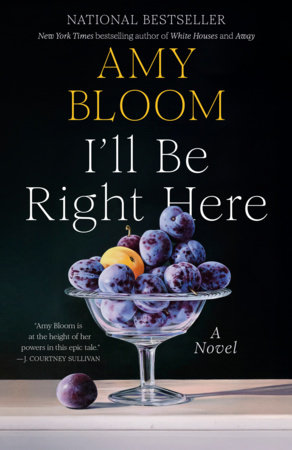
I'll Be Right Here
After World War II, Gazala immigrates alone from Paris to New York and befriends sisters Anne and Alma.
About
Spoiler notice: Spoilers for the opening setup and family relationships; later outcomes are not described.
Amy Bloom’s I’ll Be Right Here follows a chosen family across decades, beginning with Gazala’s childhood in Paris and extending into the twenty-first century. After World War II, Gazala immigrates alone to New York, where she befriends sisters Anne and Alma. Her brother Samir later joins her in Manhattan, and the four become the central group whose lives and attachments shape the novel. Bloom moves among different generations and stages of ordinary life, placing the family’s beginnings beside its later losses, new relationships and changing homes. The book’s scale is broad, but its attention repeatedly returns to what people do for one another: the everyday acts of staying close, making room, arguing, caring and returning.
The siblings’ early history gives this family story a passage between places and periods. Gazala and Samir grow up in Paris in an Algerian family; the novel’s authorized opening excerpt begins in 1930 and presents Gazala’s childhood through sensory memories of the courtyard, her brother and their father. The publisher’s description then moves to Gazala’s postwar immigration to New York. These details make migration part of the family’s formation, rather than a brief preface before the story settles elsewhere. A life is shaped by the people who are absent as well as those who become present, and the distance between Paris and Manhattan gives the siblings’ reunion particular weight. The novel uses that movement to show how a family can be carried forward while also being remade in a new setting.
Anne and Alma Cohen widen that circle. Their friendship with Gazala develops into a durable bond, and Samir’s arrival makes the foursome the group later known as the Greats. Bloom places this chosen family beside biological kinship without treating either form as simple or fixed. The relationships are shaped by loyalties, conflicts and desires that do not always fit conventional household arrangements. The publisher’s description notes that Gazala and Samir make a home together and that Anne leaves her husband for his sister. Such choices alter how the group understands itself, but the novel’s premise emphasizes continued connection through those changes. Belonging here is something built through time and mutual presence, not a status guaranteed by a family label.
The story’s multigenerational movement brings a second set of questions into view. Anne’s restless daughter grows up, raises a child on her own and joins a throuple; the next generation experiences its own attachments, disappointments and turns. The four older friends remain central to the younger people, who call them the Greats. That arrangement creates a structure in which age does not simply hand authority downward. Younger family members form lives of their own, while the elders remain witnesses, sources of support and people with needs of their own. A family spanning so many years must absorb change without pretending that every generation will repeat the one before it. Bloom’s frame makes continuity visible through these differences: the group persists because its members keep responding to one another as their circumstances shift.
The title suggests a promise of presence, though the novel’s long reach gives that promise a complicated shape. No one can remain beside another person through every place, year or loss. The publisher’s description frames the book from the beginning of life to its end and stresses that the Greats stand by their friends and loved ones. Read together, those details make “I’ll be right here” feel less like a claim that nothing will change than a form of devotion repeatedly renewed. The people in this family protect, annoy and celebrate one another; affection does not require them to become agreeable or to share the same desires. The title’s reassurance therefore sits alongside the ordinary friction of lasting relationships. Being present means accepting that closeness includes both care and irritation.
Bloom’s focus on everyday existence gives the decades-spanning design an intimate scale. The publisher describes a life marked by work, family routines and the surprises of passion, joy and despair. Rather than treating the characters only as examples of an unconventional arrangement, the novel’s premise makes room for the practical, changing business of living together: people make homes, raise children, move through relationships and keep one another in view. Those details connect larger ideas about love and chosen kinship to decisions made within households and friendships. The span from postwar migration to the present also lets the book place private lives within a changing world, while the family remains the primary lens through which those years are understood.
I’ll Be Right Here ultimately centres on the ways people become family and continue to choose one another across time. Gazala, Samir, Anne and Alma form its central bond, while younger relatives and beloveds extend the group into later generations. The novel gives that bond room for unconventional relationships, departures, reunions and the imperfect daily work of remaining connected. Its scope may be described as sweeping, but its core question is personal: what does it mean to stay available to the people whose lives are intertwined with yours? Bloom approaches that question through a family that changes shape without losing its history. The 2025 first publication and the selected 2026 paperback are separate edition events; this entry identifies the later Random House Trade Paperbacks edition while presenting the novel’s broader publication as a 2025 work.
Book details
- Author
- Amy Bloom
- First published
- 2025
- Series
- No series listed
- Subgenre
- Literary fiction, Family novel, Historical fiction
- Primary genre
- Literary Fiction
- Tags
- No tags for this book.
Review
Editor profile
Baby Bat
Goodreads and social links will be added soon.
- Goodreads — link coming soon
- Social media — link coming soon