
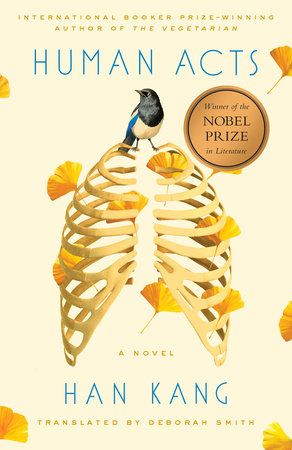
Human Acts
In Gwangju during the May 1980 uprising, schoolboy Dong-ho helps at a makeshift facility where the dead are gathered.
About
Spoiler notice: Discusses the Gwangju uprising, deaths, state violence, trauma and bereavement; avoids later chapter outcomes and the ending.
Human Acts begins in Gwangju in May 1980, during the uprising against military rule and the violent suppression that followed. Its first section centres on Dong-ho, a schoolboy who helps at a makeshift facility where bodies are gathered and identified. The work quickly widens beyond his immediate view. Across linked chapters, people who knew him, worked beside him, or carry the event in their lives speak from different moments and positions. The novel moves from the days of the uprising into later years, showing how an event can end as public news while continuing inside those who survived it. Han Kang builds the book around the ordinary people caught in state violence, giving individual lives room within a history often reduced to dates, institutions and casualty figures.
The novel’s account of Gwangju draws on the May 18 Democratic Uprising, a real pro-democracy movement that began on 18 May 1980 and lasted ten days. It is useful to keep the historical event distinct from the novel’s fictional characters: Han’s story is fiction shaped by historical research, not a documentary transcript. That distinction lets the book imagine private experience without presenting invented individuals as archival witnesses. The setting nevertheless carries the weight of a documented history of repression, silencing and later remembrance. Public records and memorial work have been part of the struggle over how the uprising is named and understood. In this context, the novel’s attention to the dead and the bereaved becomes a way of considering who gets remembered, whose testimony is believed, and what a society asks survivors to carry.
After its opening, Human Acts changes perspective rather than following one protagonist along a conventional line of action. A friend of Dong-ho’s, a young editor, a former prisoner, a factory worker and Dong-ho’s mother each come into focus. Their circumstances differ, but the chapters connect them through memory, grief and the consequences of violence. Some sections look back to the uprising; others show people living years later with what happened. A voice may address the reader directly, while another stays close to a person’s inward thoughts. The structure asks readers to assemble relationships and echoes between chapters. This movement among voices broadens the novel’s scale, but it also keeps attention close to particular people: their work, bodies, silences and attempts to continue living amid pressures that are not evenly shared.
Memory in the book is neither a clean record nor a private possession. The people who remain recall events differently, and some memories return through physical sensations or involuntary images rather than orderly explanation. At the same time, official denial and censorship threaten to make public accounts disappear. The novel follows what happens when the need to testify meets fear of speaking, and when the person who remembers must also negotiate employment, family life and the demands of authorities. Han does not turn recollection into an easy cure. To remember can preserve a person’s presence and resist erasure, yet it can also reopen pain. This tension gives the book its ethical focus: remembrance matters because people were harmed and silenced, but the burden of keeping history alive falls heavily on those who have already endured loss.
The title invites attention to conduct at several scales: violence carried out by institutions, choices made by people under pressure, and small efforts to protect or acknowledge someone else. Human Acts does not flatten these into a simple opposition between heroic witnesses and passive bystanders. It considers how fear, coercion, solidarity and responsibility meet in specific situations. The characters’ responses are not interchangeable, and their later lives show that survival does not mean returning untouched to an earlier self. Han’s questions about humanity emerge through these particular encounters rather than through an abstract argument. Acts of care may be limited and costly, while cruelty can be organized and repeated. The book gives moral weight to both, asking what it means to remain answerable to other people when power tries to make their suffering invisible.
The form supports that subject. The chapters are distinct in voice and shape, yet recurring people and memories make them answer one another. This arrangement widens the account without suggesting that a single narrator can contain the whole event. The gaps between perspectives matter: a reader encounters what one person can say, what another cannot bear to recount, and what remains beyond any one viewpoint. Han’s prose is spare and attentive to the body, placing physical vulnerability beside the language of public events. The English edition was translated from Korean by Deborah Smith; its publication history should be kept separate from the original novel’s. The Korean Sonyeoni onda (소년이 온다) was published by Changbi in 2014, while the selected Hogarth paperback appeared in 2017 as Human Acts, ISBN 9781101906743.
Human Acts is a demanding novel about historical violence, but its concern is not limited to reconstructing a past moment. It follows the ways the past enters later rooms, relationships and decisions, and how those still living respond to the dead and to one another. Its linked perspectives resist the distance that can come from treating a massacre as an impersonal event, while its movement across years shows that recognition cannot undo what happened. Han keeps the reader close to grief without claiming that grief offers a complete explanation. The result is a work about testimony and its limits, about the fragility of human life and the effort to preserve another person’s dignity. It rewards careful attention to shifts in voice and time, and it leaves the moral questions raised by its characters open for the reader to consider.
Book details
- Author
- Han Kang
- First published
- 2014
- Series
- No series listed
- Subgenre
- Literary fiction, Historical fiction, Translated literary fiction
- Primary genre
- Literary Fiction, Historical Fiction
- Tags
- No tags for this book.
Review
Editor profile
Baby Bat
Goodreads and social links will be added soon.
- Goodreads — link coming soon
- Social media — link coming soon