
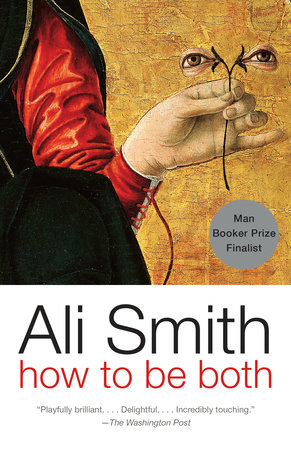
How to be both
Ali Smith links two young women across five centuries through art, grief and questions of identity.
About
Spoiler notice: This overview discusses George’s bereavement, Francescho’s identity and the two-part structure; it does not summarize the ending.
Ali Smith builds How to be both from two narratives that can be printed in either order. One follows George, a bright and questioning teenager in contemporary Cambridge; the other follows Francescho, a Renaissance artist whose name and life recall the historical painter Francesco del Cossa. Depending on the copy, readers begin with George’s section, called “Camera,” or Francescho’s, called “Eyes.” The reversal is more than a rearrangement of chapters: each opening gives the reader a different first idea of what connects these lives. Their central link is a work of art, but the book also lets one story cast a changing light over the other, so that the same details may seem like memory, evidence, invention or coincidence.
George’s story begins in the aftermath of her mother’s death. She lives with her father and younger brother, carrying grief alongside the impatience and alertness of adolescence. Her mother is absent, yet remains active in George’s thoughts: remembered conversations keep opening questions about what survives when a person is gone, and whether the past can be treated as finished. The novel does not present mourning as a straight passage from loss to recovery. George can be intellectually sharp and emotionally unsettled at once. Her attempts to interpret her mother’s words, choices and interests show a young person trying to hold onto a relationship while also becoming someone distinct from the person she has lost.
Art gives that effort a physical focus. During a trip to Ferrara, George and her mother visit the Palazzo Schifanoia and see frescoes associated with Francesco del Cossa. The paintings become more than a travel memory: they give mother and daughter a shared object to look at, discuss and revisit in thought. George’s interest in the artist grows through this connection, and she returns to the images after the trip. Their surfaces invite questions about what can be seen, what remains hidden and how a viewer supplies meaning. The novel’s concern with looking is therefore personal as well as aesthetic. George is studying a painter from another century, but she is also learning how to see her mother’s influence in the present without mistaking remembrance for a return.
The historical strand shifts into Francescho’s first-person voice. The artist’s account moves by association and recollection, following the rhythms of thought more than a simple chronological line. Smith imagines Francescho’s life around the world of Renaissance painting and the work that leaves an artist’s mark on walls long after a lifetime has ended. Francescho’s sense of self also resists the categories other people expect: the character was born female, lives as a man, and moves through a society with different limits and dangers from George’s. The narrative attends to art-making, desire and the problem of being recognised accurately. A friend takes Francescho to a brothel, but the artist responds by drawing rather than having sex with the woman there. Such episodes bring bodily experience and visual creation into the same frame.
George’s strand also brings questions of identity into ordinary contemporary life. She has a boy’s name, and her sexuality is beginning to take shape, while her family tries to understand how to live after the mother who once held them together is gone. Her younger brother and father have their own relationships to the loss, and George cannot simply speak for them. With her friend H, she undertakes a school project about empathy and develops an imagined account of Francescho. This creates a deliberate uncertainty around the historical section: is Francescho’s voice a presence that reaches across time, or might it be partly the result of George and H’s act of imagining? The novel keeps both possibilities in play, turning its formal experiment into a question about how stories are made and who gets to make them.
The two sections meet through more than a shared name on a painting. Francescho’s art survives its maker, while George’s attention gives that art a new life in another century. The novel repeatedly lets the dead remain part of the living through pictures, remembered speech and the acts of looking that connect one person to another. Its paired narratives also unsettle the borders between past and present, male and female, visible and unseen, historical fact and imaginative reconstruction. These are not puzzles with a single explanatory key. Instead, the book asks how people might occupy more than one position at once, and how a work can hold meanings its maker could not fully control.
The order of the sections makes this open structure especially clear. A reader who meets George first approaches Francescho through the painter’s connection to her family history; a reader who starts with Francescho carries that voice into George’s contemporary world. Neither order supplies a final solution to the uncertainty about how the strands relate. Their overlap is emotional and artistic as well as narrative: George’s grief and Francescho’s life each involve mothers, self-fashioning and the effort to leave something behind. Smith’s design asks readers to compare rather than rank the two stories, allowing details to echo across their divide. The paintings make their separate times mutually present. The book’s title points toward this continuing coexistence: a person, a story or an artwork may be understood through more than one truth at the same time.
Book details
- Author
- Ali Smith
- First published
- 2014
- Series
- No series listed
- Subgenre
- Literary fiction, Experimental fiction, Historical fiction
- Primary genre
- Literary Fiction, Historical Fiction
- Tags
- No tags for this book.
Review
Editor profile
Baby Bat
Goodreads and social links will be added soon.
- Goodreads — link coming soon
- Social media — link coming soon