
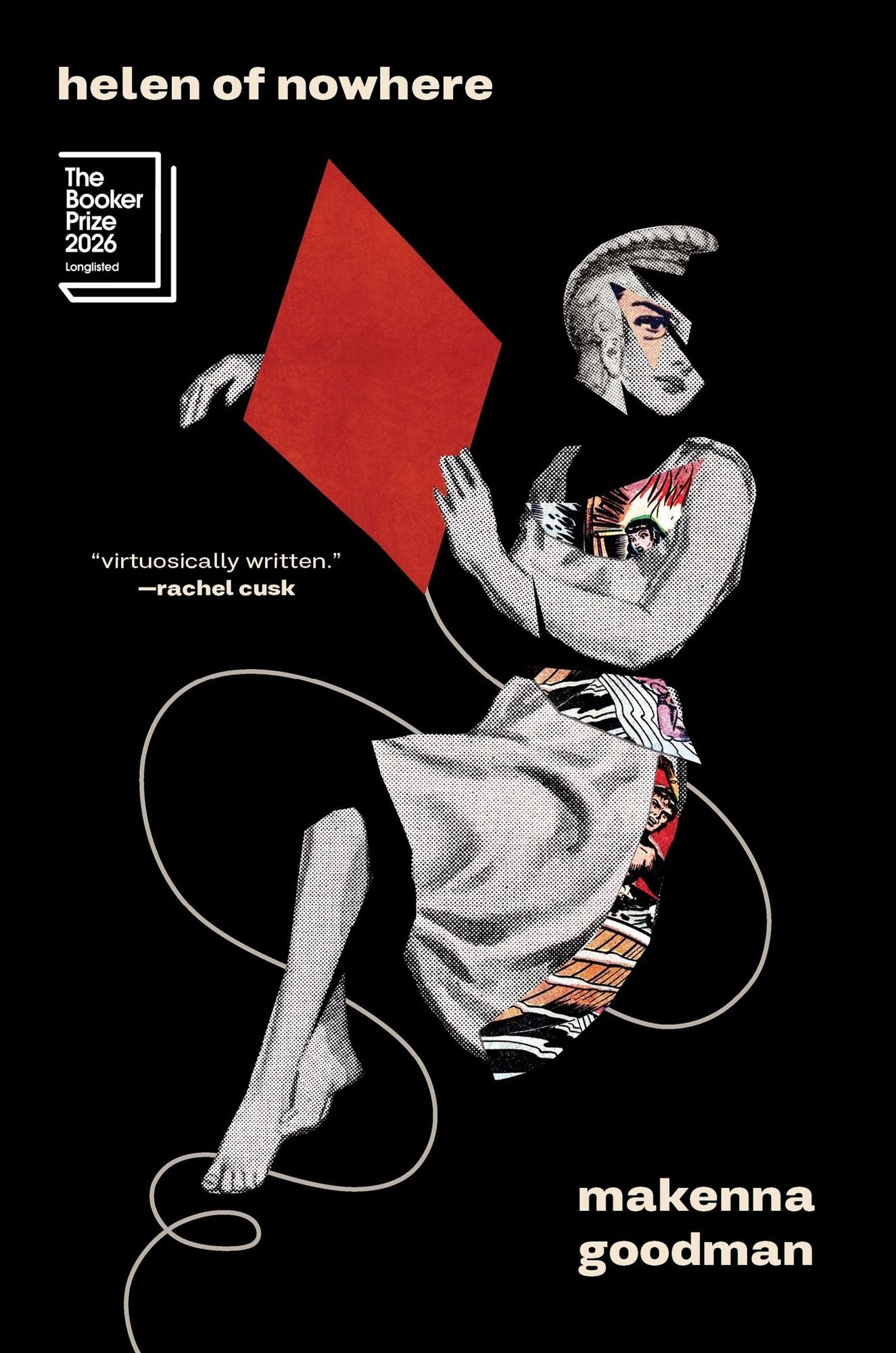
Helen of Nowhere
After his academic career and marriage unravel, an unnamed professor visits an idyllic country house with a realtor.
About
Spoiler notice: Spoilers for the premise and opening setup, including the professor’s professional and marital estrangement, his meeting with the realtor, and the stories about Helen. Later developments and the ending are not summarized.
Makenna Goodman’s Helen of Nowhere begins with a man looking back on the collapse of the life that once gave him authority. He is a professor whose standing has been damaged, and his marriage has lost the shared purpose that his career once supplied. The opening voice is self-conscious and defensive: he recounts his wife’s changing feelings while trying to frame his own loss as the central event. The story makes that point of view part of its subject. His explanations reveal how readily he turns other people into evidence for his own account, even as he describes feeling displaced and diminished. The novel’s unnamed central figure is therefore both a person in crisis and a speaker whose version of events needs to be examined. Goodman uses his personal reckoning to begin a broader inquiry into power, attention and what it means to change.
The action takes shape during a real-estate visit in the countryside. A realtor is showing the professor an idyllic house, and the tour gradually becomes something other than a practical inspection. She describes the home and its former occupant, the mysterious Helen, whose presence seems to linger in the rooms and objects. For the professor, the house promises a possible second life: a chance to leave the institutions and expectations associated with his old status and live closer to the land. Yet the realtor’s stories complicate that promise. The imagined retreat is not a neutral setting where a person can simply begin again; it comes with a history, relationships and terms he does not control. As daylight fades, the encounter grows stranger, and the idea of buying a fresh start acquires a cost beyond the house’s price.
Goodman’s professor carries the habits of an academic life into this rural setting. In an authorized excerpt, he recalls a nature-writing class in which students studied plants and discussed how their histories shaped their writing. One student’s work challenges his assumptions about nature as a space outside politics, and her thinking unsettles the teacher who believes he is guiding the inquiry. The episode links the book’s environmental questions to its account of institutional power: teaching can invite discovery, but it can also become a way to define, evaluate and contain another person. The professor’s narration gives readers access to his intellectual vocabulary while exposing the limits of his self-understanding. Ideas about ecology and the good life do not remain abstract; they meet his choices, his authority and his capacity to hear a perspective that does not confirm his own.
Helen is central to the house tour even while her identity remains uncertain. She is discussed through stories of how she chose to live, rather than introduced as a conventional character whose past can be neatly summarized. Goodman has said that the novel was inspired by Helen Nearing, associated with leaving city life for Vermont, and Helen of Troy, whose story has repeatedly been retold and blamed upon her. The invented Helen gathers these resonances without resolving into a single allegorical answer. Her presence becomes a way to examine who gets to define a life, whose account of a woman survives, and how an ideal of rural simplicity can conceal questions of labor, privilege and responsibility. The realtor’s account has its own force because she is not merely displaying rooms; she is shaping the professor’s encounter with the person who lived there before him.
The novel’s compact, play-like design supports this instability. Coffee House Press describes its scope as both intimate and cosmic, and the book moves among distinct voices and remembered scenes instead of following a simple chain of explanatory narration. The result places the reader near the professor’s thoughts while leaving room to doubt the frame he gives them. His memories of marriage and teaching, the realtor’s stories, and Helen’s example form overlapping accounts that do not settle into one authoritative version. That form makes interpretation part of the reading experience: a story can change when another person tells it, and the limits of a speaker’s knowledge matter as much as the ideas he can articulate. The book’s humor and surreal turns arise alongside its questions about reputation, marriage, feminism and the desire to escape the modern world.
At its centre, Helen of Nowhere asks what a person would have to relinquish to live differently, and whether a supposedly private transformation can avoid affecting other people. The professor wants a home and a new relationship to the land, but the stories he hears put that wish beside the structures that have shaped his identity: academic prestige, marriage, gendered authority and the tendency to treat care as something one performs rather than gives. The mysterious house concentrates these tensions without providing a simple moral lesson. Its setting makes the possibility of starting over vivid, while Helen’s uncertain presence prevents the professor from claiming the place as an empty stage for his own renewal. Goodman’s novel brings philosophical questions into a strange, close encounter among a man, a realtor and a house with a history, then leaves the meaning of that encounter open to interpretation.
Book details
- Author
- Makenna Goodman
- First published
- 2025
- Series
- No series listed
- Subgenre
- Literary fiction, Experimental fiction
- Primary genre
- Literary Fiction
- Tags
- No tags for this book.
Review
Editor profile
Baby Bat
Goodreads and social links will be added soon.
- Goodreads — link coming soon
- Social media — link coming soon