
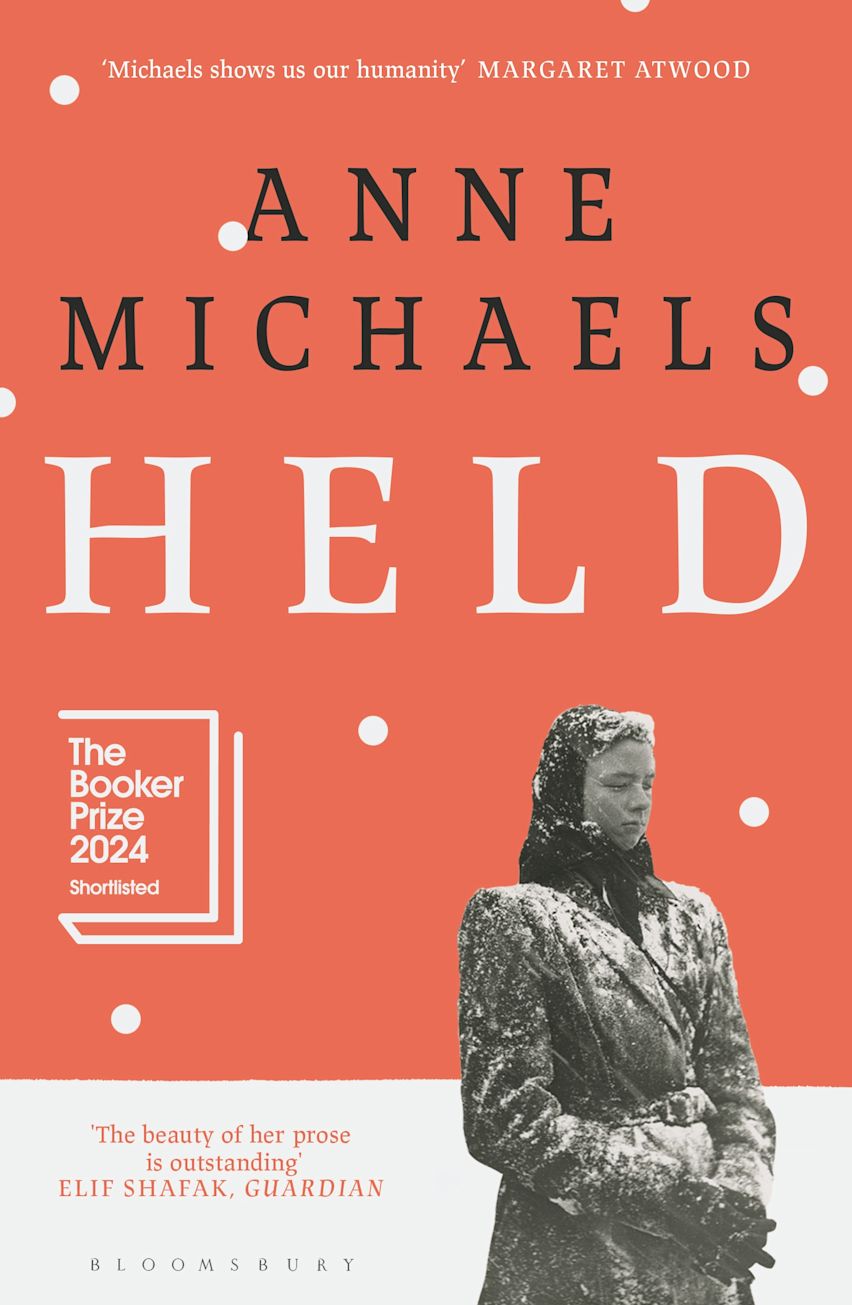
Held
In 1917, John is gravely injured on a battlefield in France.
About
Spoiler notice: This About discusses John’s wartime injury, his return to Helena, the family’s later generations, and the novel’s ghostly photographs. It does not reveal the ending or the final connections among the episodes.
Held opens in 1917, with John injured on a battlefield near the River Escaut. Unable to move or feel his legs, he drifts through memories as snow falls. Three years later, he is back in North Yorkshire, reunited with Helena, an artist, and trying to resume life through their photography business. The past will not stay behind him: apparitions begin to appear in the photographs he develops, though their messages are unclear. From this intimate beginning, Anne Michaels builds a novel that follows a family across four generations and a century of upheaval. Its movement between people and periods makes history feel less like a straight line of public events and more like a field of experiences that continue to affect one another.
The book’s structure asks readers to make connections across gaps. It does not advance through one continuous plot in which each scene explains the next. Instead, it moves among moments in different lives, sometimes leaving time and information between them. The Booker Prize’s guide describes a sequence of connections and consequences that ignite again as the century unfolds; its judges note the shifts between family members and the fragmentary, stanza-like shape of the chapters. This form suits a story about what is remembered, inherited or repeated without being fully understood. A brief encounter, an image, or a gesture can matter beyond the scene in which it first appears. The reader follows these echoes without being promised that every uncertainty will resolve into a neat explanation.
John and Helena establish one of the book’s central relationships. He returns from the First World War physically and psychologically changed; she is an artist who supports him while questioning her own talent. Their photography work gives them a shared practice of looking, but it also brings the novel’s uncanny element into ordinary life. The ghostly figures that appear in John’s images are not treated as a puzzle with a simple solution. They place the unseen beside the visible and make the camera’s record feel incomplete. Michaels uses this tension to explore the limits of what can be measured or proven, while keeping the effects of war grounded in a couple’s attempts to continue together. The supernatural presence deepens the questions around grief and memory without displacing the human cost of violence.
The family story widens through Anna, John and Helena’s daughter, and Mara, Anna’s daughter. Both women become doctors and are drawn to work in war zones, carrying care into places marked by conflict. Their lives extend the book’s concern with what passes between generations, while giving that concern a different setting from John’s postwar home and photography studio. War does not appear only as one historical episode in the background. It returns in altered circumstances, shaping the work people choose and the risks they accept. Michaels connects these lives through likeness and inheritance, but the book’s design allows difference as well: one person’s experience does not become another’s simply because they belong to the same family. The episodes invite attention to both continuity and divergence.
Memory is therefore more than recollection of private events. It is one of the forces through which individual lives touch histories beyond their own duration. Michaels has described the novel as interested in inner life—what people value, believe, love and aspire to—as a measure of history alongside actions and public events. That emphasis helps explain why Held can give weight to small scenes as well as to war and scientific change. A domestic image or a remembered encounter may carry consequences that remain invisible at first. The novel considers how chance, desire, empathy and loss help form a present moment, while resisting the idea that a person can see all the causes that brought them there. Its scale is at once familial and expansive. The Booker discussion guide also points to the novel’s attention to science, including figures such as Ernest Rutherford and Marie Curie, alongside its interest in what cannot be explained by evidence alone.
These strands are not presented as interchangeable kinds of knowledge. Their proximity instead gives the family episodes a wider frame, asking how observation, belief and feeling coexist when people confront forces larger than themselves. The title gathers several of these concerns without fixing them to one meaning. To hold can describe touch and care, but also the keeping of an image in memory or the tension between forces that remain unresolved. The Booker guide raises these possibilities as questions, and Michaels’s own account connects the novel’s interests in unseen forces, mortality and love that continues beyond a single life. Held approaches these ideas through linked episodes rather than a thesis delivered from outside the story. Its language and compressed scenes ask for patience with omission: the reader is often asked to notice a pattern before knowing its full shape. The result is a literary family novel in which tenderness coexists with historical damage, and where connection can be powerful even when it cannot undo what has happened.
Book details
- Author
- Anne Michaels
- First published
- 2023
- Series
- No series listed
- Subgenre
- Literary fiction, Historical fiction, Family saga
- Primary genre
- Literary Fiction, Historical Fiction
- Tags
- No tags for this book.
Review
Editor profile
Baby Bat
Goodreads and social links will be added soon.
- Goodreads — link coming soon
- Social media — link coming soon