
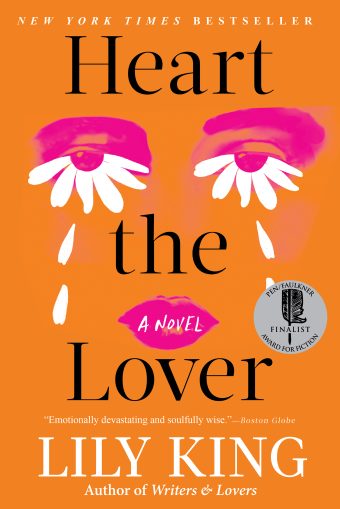
Heart the Lover
In her senior year of college, a literature student meets Sam and Yash, best friends whose shared home draws her into a lively world of reading, debate and card games.
About
Spoiler notice: Spoilers for the premise and major framing: Jordan’s college-year relationships, her later family life, and a return visit that reconnects those periods. The book’s later revelations and ending are not summarized.
In Heart the Lover, Lily King follows a woman through a defining stretch of college life and the much later return of its unfinished emotional history. The story begins in the narrator’s senior year, when an encounter with two close friends changes the scale of her social and intellectual world. It then moves across decades to a life that appears settled, with work, marriage and children, before a visit and new information reopen questions she thought belonged to the past. That movement gives the novel two kinds of intimacy: the immediate intensity of young people making choices without knowing what those choices will mean, and the older perspective of someone trying to understand the same events after time has altered their shape. The title points toward love as a subject and as a story the narrator has been carrying, while the book’s structure lets memory and present experience speak to one another.
The college chapters introduce the narrator in a 17th-century literature class, where she meets Sam and Yash, two high-achieving students who are also best friends. They live together in an off-campus house belonging to a professor on sabbatical, and invite her into a shared routine of conversation, reading and card games. They give her the nickname Jordan, drawing on a literary reference, and the name becomes part of her entrance into their circle. Their home offers a kind of intellectual and social life that feels distinct from a classroom: books and ideas are not confined to assignments, but spill into joking, arguments and everyday companionship. Jordan is drawn to the atmosphere and to the two people who make it possible. As she becomes more involved, she discovers forms of closeness and ambition that help her imagine herself differently. The Breach House is more than a place to visit; it is the centre of a temporary world that shapes how Jordan understands friendship, desire and who she might become.
Literature is woven into the characters’ relationships rather than treated as decoration. Jordan is studying literature, and books provide the group with common ground, material for debate and a language for interpreting experience. Their conversations move between serious ideas and playful talk, reflecting the way academic intensity can become part of young people’s private culture. Jordan’s emerging ambition to write also places her among people who take reading and thought seriously. The novel links the act of telling stories with the work of interpreting one’s own life: characters use literary frames to make sense of choices, but life does not arrange itself as neatly as a novel or a familiar love story. This tension matters to Jordan because she knows the conventions of romance while living through feelings that resist simple outcomes. The surrounding academic environment gives her room to grow intellectually, yet it also makes her personal decisions feel open to analysis and argument. Questions about judgment, responsibility and chance enter the characters’ discussions and echo through the relationships taking shape around them.
The friendship between Sam and Yash gives the romantic plot a three-person balance. Jordan is not simply choosing between two separate possibilities; she is entering a bond that already has its own history, habits and loyalties. The connection between the men influences how she experiences both of them and how she understands her place in their lives. Attraction, conversation, trust and rivalry overlap, and the resulting triangle becomes a test of how much a person can know about someone else’s motives. The publisher describes the choices made around graduation as changing all three lives, but the consequences develop over time rather than resolving with the end of college. The book’s focus stays on the way youthful passion can make immediate decisions feel absolute while their meaning remains unsettled. Friendship persists alongside romantic feeling, complicating any clean division between what is gained and what is lost. The emotional stakes come from the group’s closeness as much as from the question of whom Jordan loves.
The later section finds Jordan decades afterward living a life she once hoped for. She has become a writer and has a husband and children; the distance from college seems to place that earlier period safely behind her. A surprise visit and unexpected news disturb that sense of distance. Jordan is drawn back toward the people and decisions she left behind, and must consider what she concealed, what she misunderstood and how the younger self she remembers relates to the person she has become. This return does not erase the intervening life. Instead, the two periods remain in contact: adult commitments give Jordan a new vantage point, while the past still carries emotional force because it helped shape those commitments. The narrative’s shifts across time allow old attachments to be seen both as they were felt and as they are remembered. The renewed encounter also broadens the story from a college love triangle into a reflection on what people carry forward when a relationship has ended or a choice cannot be remade.
Across both periods, Heart the Lover attends to the ways identity changes while remaining connected to earlier versions of the self. Jordan’s nickname, her literary interests and her hopes for a writing life all belong to particular relationships and moments, but they do not disappear when she moves into adulthood. Memory can revise the past without making it irrelevant, and the novel’s return structure gives that revision a visible form. Its concerns include first love, friendship, family, loss, forgiveness and the uneven passage of time. Masculinity and gender also shape this story, including how young women navigate an environment where independence can carry danger and where men’s behaviour is shaped by different models of power and care. These concerns widen the personal story without turning it into an abstract argument: they arise through the lives and relationships the characters share.
Book details
- Author
- Lily King
- First published
- 2025
- Series
- No series listed
- Subgenre
- Literary fiction, Coming-of-age
- Primary genre
- Literary Fiction
- Tags
- No tags for this book.
Review
Editor profile
Baby Bat
Goodreads and social links will be added soon.
- Goodreads — link coming soon
- Social media — link coming soon