
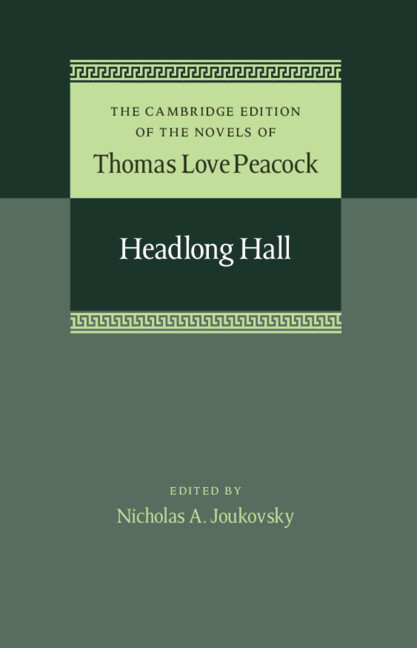
Headlong Hall
Squire Harry Headlong invites philosophers and enthusiasts to his Welsh estate for Christmas.
About
Spoiler notice: Full-plot spoilers, including the tower accident, the marriage negotiations and the final four weddings.
Headlong Hall brings together people who can turn almost any ordinary event into evidence for a favourite theory. Squire Harry Headlong has invited philosophers and enthusiasts to his Welsh estate for Christmas, hoping to hear them argue over the questions that interest him. Thomas Love Peacock’s novel, published in 1816, begins before the guests arrive, with four of them sharing the Holyhead mail. The coach itself soon becomes a subject of debate. Roads, machinery and improved communication look like proof of progress to one traveller and signs of deepening corruption to another. By the time they reach breakfast, the company’s competing accounts of human life have already established the pattern that will govern their stay: shared circumstances, incompatible explanations and very little willingness to reconsider.
Mr Foster, the perfectibilian, expects knowledge and invention to advance humanity towards happiness. Mr Escot, the deteriorationist, sees expanding wants and artificial habits drawing people further from a healthier original condition. Mr Jenkison keeps the rival accounts in balance, finding reasons to resist either conclusion. Their principles extend readily to diet, where Escot condemns the use of animal food and fire, Foster qualifies his objections, and Jenkison settles on eating whatever is good. The two more committed theorists nevertheless join him at the table. The Reverend Doctor Gaster adds another kind of authority to the discussion, along with a powerful interest in breakfast. Philosophical positions receive elaborate expression, but appetite has its own persuasive force whenever food interrupts the argument.
The host’s preparations give that combination of intellectual ambition and bodily comfort a suitably chaotic setting. Books, scientific instruments, pictures, musical equipment and provisions arrive in such quantities that the rooms fill with misplaced packages. Squire Headlong rushes between cellar, library, gallery and dining room, demanding a speed his servants cannot achieve. He wants learning, entertainment and abundant hospitality available at once. His visitors bring interests in landscape, music, painting, criticism and the workings of the human mind, broadening the range of disputes beyond the original travellers. The gathering has room for performance and courtship as well as formal argument. What holds it together is the host’s eagerness to set things in motion, even when he has scarcely considered how his latest enthusiasm will affect anyone else.
Landscape improvement supplies one of the clearest demonstrations of that eagerness. Mr Milestone admires a ruined tower but proposes altering its surroundings, including blasting away rock to create a more polished approach. Headlong immediately gathers gunpowder, equipment, servants and refreshments. The scheme becomes dangerous because Mr Cranium and Mr Panscope have climbed the tower without being noticed by those preparing the explosion. Although the structure remains standing, the blast startles Cranium into a leap that carries him over the edge. Ivy, hazel and an ash tree interrupt his descent before he reaches the water. Escot jumps in and rescues him. The party’s discussion of how scenery should look has produced an accident requiring a practical skill rather than another theory.
That rescue becomes entangled with the visit’s romantic complications. Escot loves Cranium’s daughter Cephalis, while Panscope is a competing suitor. Cranium’s attachment to explanations based on bodily organisation does not make him easily grateful in the terms others expect: he can describe a rescuer’s conduct as a necessary result of physical and external causes. Escot also acquires a skull represented as belonging to Cadwallader, bringing another object into the guests’ intellectual contests. Its alleged identity and unusual size make it valuable to people for different theoretical reasons. By the later negotiations, the skull has acquired a practical power quite apart from whether any claim about it is reliable. An object used to support arguments becomes something that can alter permission to marry.
Headlong’s aunt urges him to preserve the family line, and he decides with characteristic speed that he will marry. He wants his wedding to coincide with his sister Caprioletta’s marriage to Foster, then expands the occasion by arranging matches for other guests. He chooses Tenorina Chromatic after her father helps settle which daughter is available, and promotes Graziosa Chromatic’s union with Sir Patrick O’Prism. Escot and Cephalis would complete the four couples, if Cranium would consent. Persuasion about the rescue makes little progress, but the question of handing over Cadwallader’s skull changes matters. Escot agrees to surrender it, Cranium becomes satisfied, and Headlong moves between them announcing success. The argument has reached a settlement through a bargain that the participants’ abstract principles alone could not produce.
Doctor Gaster performs the four marriages, and the guests disperse after promising to return in August. The final exchange gives the newly married philosophers another opportunity to explain themselves without conceding anything. Foster presents domestic affection as the beginning of an expanding concern for humanity. Escot describes love between congenial people as a consolation, then returns to an attack on marriage as distorted by money, coercion and selfishness. His own happiness does not overturn his account of general deterioration. Jenkison finds the two positions still capable of balancing one another. The novel closes with changed personal circumstances and unchanged argumentative habits: the visit has produced marriages and memorable incidents, while leaving its central dispute about the direction of human life unresolved.
Book details
- Author
- Thomas Love Peacock
- First published
- 1816
- Series
- No series listed
- Subgenre
- Literary fiction, Modern classics
- Primary genre
- Literary Fiction
- Tags
- No tags for this book.
Review
Editor profile
Baby Bat
Goodreads and social links will be added soon.
- Goodreads — link coming soon
- Social media — link coming soon