
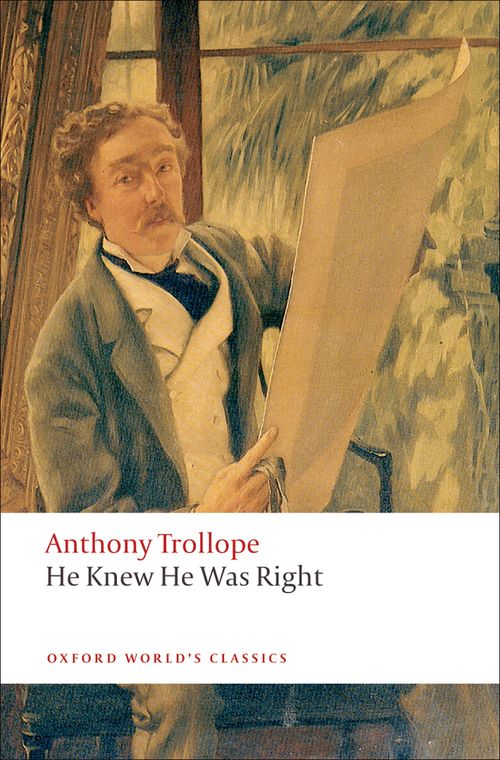
He Knew He Was Right
Louis Trevelyan’s suspicion of his wife Emily’s friendship with Colonel Osborne develops into separation and surveillance, threatening the household he wants to protect.
About
Spoiler notice: Full-plot spoilers, including Trevelyan’s death, Emily’s interpretation of his final gesture and the concluding marriages.
Louis Trevelyan appears to be an exceptionally fortunate husband. Wealthy, educated and free to choose his own future, he meets Emily Rowley while travelling and brings her into a comfortable London household. Her sister Nora joins them, and the birth of a son gives the marriage another bond. Anthony Trollope then begins dismantling the security that these circumstances seem to promise. A disagreement over Colonel Osborne’s visits becomes a struggle over authority, trust and the right to decide what another person’s behaviour means. First serialized in 1868–69 and published as a two-volume book in 1869, He Knew He Was Right follows that struggle through several connected households. Its central danger is announced in the title: certainty can become something a person defends even when maintaining it destroys what he claims to value.
Emily regards Osborne as an old family connection and feels humiliated by her husband’s objection to his presence. Louis expects his wishes to govern the matter and becomes increasingly preoccupied with what her resistance signifies. The narration complicates the situation by distinguishing Emily’s innocence from Osborne’s enjoyment of attention and his manner in the household. Her refusal to accept suspicion does not establish the misconduct Louis fears. Yet his insistence on being obeyed makes an ordinary disagreement difficult to resolve without someone appearing to surrender. Emily and Nora eventually find themselves away from the London home, staying with the Stanburys in Devon. That refuge offers practical assistance, but it also places a troubled marriage within another family’s limited means and exposes private suffering to the anxieties of neighbours and relations.
Separation gives Louis more time to imagine injury and less opportunity for ordinary affection to interrupt it. He breaks up the Curzon Street establishment, misses domestic life and repeatedly discusses his position with friends who cannot find a satisfactory way to help. Reconciliation becomes conditional upon Emily acknowledging that she has been wrong. He also employs Bozzle, a retired policeman, to watch Osborne and collect information. Reports of journeys, visits and possible meetings become material for further interpretation. Trollope shows the uncomfortable transaction in detail, including Bozzle’s manner of presenting his activity and charging for it. The inquiry does not simply uncover a settled truth. It gives Louis a continuing supply of things to scrutinise, while his desire for reassurance exists beside the fear that any apparent reassurance may conceal another deception.
Nora’s choices offer a different way of approaching uncertainty in a relationship. She must weigh the attraction of an advantageous marriage against the absence of love, and her attachment to Hugh Stanbury against the insecurity of a modest income. Hugh works in journalism, a profession whose practical demands and social standing matter to the people assessing him. Nora cannot decide honestly by pretending that either affection or money is irrelevant. Her conversations make the sacrifice involved in refusing a prosperous future visible, while her later marriage to Hugh shows the possibility of accepting a future without complete material assurance. The contrast with Louis and Emily lies partly in how a decision is made: Nora has to recognise her own feelings and choose a risk, rather than demand that someone else remove every source of doubt.
Dorothy Stanbury faces pressure within a household where her aunt’s plans can be difficult to resist. The suggested marriage to Mr Gibson requires her to examine both her own feelings and the regard he would show for her mother and sister. She cannot comfortably accept a husband who might be ashamed of them. Her hesitation and refusal give another courtship a moral question rooted in everyday family relations. Dorothy eventually marries Brooke Burgess, and the conclusion follows them into the aunt’s house in the Close. There is comedy in the formal transfer of cupboards, stores and keys to the new mistress, followed by the gradual return of the keys to Aunt Stanbury. Affection and marriage change the household without instantly overcoming the habits by which its older occupant has always governed it.
Louis and Emily’s final period together is far darker. Back in England and physically weak, he still speaks as though she has wronged him, while she longs for him to acknowledge her fidelity before he dies. Dr Nevill’s explanations and the narrator’s comments do not always use the same account of his condition, so the novel’s historical language about madness should not be converted into a precise modern diagnosis. The final exchange is bodily rather than a spoken confession. Emily asks him to kiss her hand if he believes her, and at last his lips move against her fingers. She understands the gesture as acquittal. When she tells Nora afterwards, she nearly persuades herself that he has spoken the words she wanted, although the scene has given her no such explicit declaration.
The conclusion preserves the differences between the survivors’ futures. Emily has her son and the financial provision Louis has left her, but the narrative does not give her another marriage or pretend that her suffering can simply be erased. Nora and Hugh marry the following spring and establish a small house near Regent’s Park, with any move to larger accommodation dependent upon Hugh earning more. Dorothy and Brooke settle into their shared household, while help from the younger generation improves the cottage occupied by Dorothy’s mother and Priscilla. These endings return repeatedly to homes, income and the terms on which people accept help. Around the devastation of one marriage, Trollope leaves several examples of lives continuing through affection and accommodation, making Louis’s inability to yield all the more consequential.
Book details
- Author
- Anthony Trollope
- First published
- 1869
- Series
- No series listed
- Subgenre
- Literary fiction, Modern classics
- Primary genre
- Literary Fiction
- Tags
- No tags for this book.
Review
Editor profile
Baby Bat
Goodreads and social links will be added soon.
- Goodreads — link coming soon
- Social media — link coming soon