
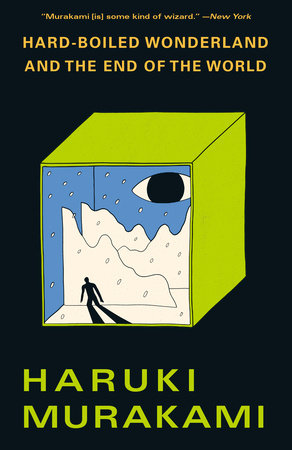
Hard-Boiled Wonderland and the End of the World
An unnamed data processor is drawn into a dangerous struggle over information encoded in his consciousness, while in a walled town a newcomer learns to read dreams from unicorn skulls after being separated from his shadow.
About
Spoiler notice: Spoilers include the old scientist’s explanation of the narrator’s altered consciousness and the connection between the two storylines. The final choices and ending are not revealed.
Hard-Boiled Wonderland and the End of the World moves between two very different places, alternating chapters between them as its story unfolds. In one, an unnamed narrator works in a secretive system that processes information through the mind. A scientist has given him a new task, and the work draws him into a contest over valuable data. The city around him is recognisably modern, yet its hidden arrangements and underground dangers lend it the clipped unease of a thriller. In the other strand, a newcomer enters a remote town enclosed by a high wall. The town seems quiet and ordered, but the newcomer must surrender his shadow and learn to read dreams from the skulls of unicorns. The contrast between these lives gives the novel its central puzzle: what, if anything, binds them?
The city chapters follow the narrator through an assignment that becomes more dangerous as he learns how much other people want the information he carries. His specialist work involves a method of encoding data inside consciousness. The scientist who introduced the technique is eccentric and secretive; his granddaughter, hostile pursuers and creatures beneath the city all become part of the narrator's increasingly strange predicament. He responds to danger with a dry, self-possessed voice that steadies the action even as his understanding of the assignment begins to change. The suspense comes not only from whether he can escape the threats around him, but from discovering what has been done to his own mind. Knowledge is valuable here because it can be stolen, hidden or altered, and the narrator's work leaves him caught between those possibilities.
The walled town follows a different rhythm. Its streets are hushed, its routines carefully defined, and its inhabitants appear to accept the wall as the limit of their world. The newcomer is assigned a role as a dream reader and learns to approach the unicorn skulls kept in the town library. His shadow, left outside him, remains a separate presence and a source of counsel. These details make the town both a place with rules and a landscape of inward images. The chapters do not explain everything at once; they let custom, silence and small encounters accumulate. The slower pace can feel far from the city plot, but the town has its own tension, built around what a person must give up to belong and what may still resist the life prescribed for him.
The alternating structure asks readers to hold both narratives in mind without immediately reducing one to an explanation of the other. Their differences are clear: one is crowded, fast and technologically charged; the other is sparse, dreamlike and governed by ritual. Yet both focus closely on an individual whose sense of self is under pressure. The city narrator tries to make choices while powerful systems act on his consciousness. In the town, the newcomer’s identity is reshaped through separation from his shadow and the routines of the place. The chapters’ repeated shifts create a quiet form of suspense. A detail from one setting can change how the other feels, even before the novel makes their relationship explicit.
The title names the two modes of the book. “Hard-boiled” suggests the tough, self-possessed voice of the urban strand, where danger is met with wit and practical decisions. “The End of the World” points toward the town’s enclosed, almost timeless atmosphere. Murakami places familiar cultural references, a resourceful young woman, a scientist’s inventions and subterranean creatures beside a world of walls, shadows and dream interpretation. The result combines elements of speculative fiction, fantasy and noir without settling comfortably into any one category. Its oddness is part of the design: the reader moves between registers, learning their rules and noticing the questions they share.
Underneath the chase and the dreamlike customs is an inquiry into consciousness. The narrator’s work and the town’s rituals make questions about the mind concrete rather than abstract. Memory, thought and identity are treated as vulnerable, capable of being altered or divided. The book also considers the costs of knowledge: discovery may bring understanding, but it can expose a person to forces he did not know were at work. These concerns give emotional weight to scenes that might otherwise read as playful invention. The humour remains, as do the eccentric encounters, while a more serious question develops about how much of a life belongs to the person living it. In each setting, the characters have to make sense of rules they did not create and cannot entirely control.
First published in Japan in 1985, the novel brings together a tightly voiced adventure and a contemplative fantasy through its alternating design. The city plot gathers speed as the narrator faces pursuit and tries to understand the technique used on his mind. The town moves through quieter rituals, yet its wall and the separation from his shadow make belonging there feel unsettled. Neither strand can be treated as an interruption of the other: each changes the questions raised by its counterpart. Their gradual convergence gives the book its shape while leaving room for the reader to consider what each world might mean. As the characters encounter limits on what they can know and choose, the novel asks how identity survives when the mind itself becomes a contested space.
Book details
- Author
- Haruki Murakami
- First published
- 1985
- Series
- No series listed
- Subgenre
- Science fantasy, Literary fiction, Translated literary fiction
- Primary genre
- Literary Fiction
- Tags
- No tags for this book.
Review
Editor profile
Baby Bat
Goodreads and social links will be added soon.
- Goodreads — link coming soon
- Social media — link coming soon