
Greenwood
In 2038, Jake Greenwood guides wealthy visitors through one of the last surviving forests on a British Columbia island.
About
Spoiler notice: Spoilers cover the four central Greenwood generations, their period settings, Jake's work on the island, Liam's accident, Willow's environmental protests and Everett's care of an abandoned infant. Later family revelations and the ending are withheld.
In 2038, Jacinda Greenwood, known as Jake, guides wealthy visitors through one of the last forests left standing. The old-growth trees on a British Columbia island have become both a rare refuge and an attraction for people able to pay for access. Jake is more qualified than her tour-guide job suggests, but the work keeps her close to the forest and away from the wider conditions beyond it. The story opens from that precarious present onto a family history Jake barely knows. The forest is precious enough to shape her livelihood, while the people who came before her will change what she understands about her place in the family.
The narrative then steps back to 2008 and Jake’s father, Liam, a carpenter who has fallen at a worksite in an empty mansion. He is left on the concrete floor, calling out, while the immediate danger of the accident narrows the story to his body and the memories that surface around it. Liam’s life connects the modern family to the previous generation and to a different relationship with wood. His craft gives him practical skill and an intimacy with timber that is distinct from the commercial scale of the older Greenwood legacy. Moving from Jake to Liam also changes the meaning of the opening: the reader knows that his story belongs to the family she is trying to trace, but not yet how his choices and history shaped the daughter now guiding tourists among threatened trees.
In 1974, Liam’s mother Willow is out of jail after one of her environmental protests. Her activism is bound to the family’s past: she sees it as an attempt to answer for the damage associated with her father’s once-vast timber empire. The novel does not present that inheritance as a tidy moral equation. Willow’s political commitments shape how she raises her son as well as what she opposes in public, and her section keeps attention on the personal consequences of trying to correct a legacy. The gap between intention and effect runs through the family’s history. Willow’s era gives the book a different kind of forest conflict from Jake’s: not the rarity of a surviving grove, but the struggle over the people and institutions that cut forests down, and what one generation believes it owes the next.
The 1934 section follows Everett Greenwood, a Depression-era drifter living in a maple-syrup camp. When he hears an infant crying, he becomes responsible for a child and is pulled into a web of crime, secrets and betrayal. His encounter gives the family story a vulnerable centre: a precarious adult, a child in need and decisions made under pressure. Everett’s section reaches behind the generations readers have already met, but the effect is not simply to explain them. The difficult circumstances of the past have their own immediate stakes, while the choices made there will matter to descendants who cannot see their origins clearly. Christie sets the scene against economic hardship and environmental strain, joining the family’s private uncertainty to a period when survival demands resourcefulness.
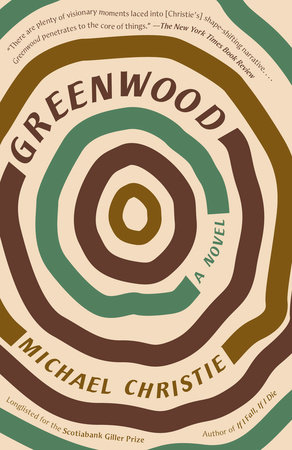
Greenwood’s sequence takes its shape from the cross-section of a tree. It opens on the outer ring of 2038, moves inward through 2008, 1974 and 1934, reaches back to the family’s beginnings in 1908, then works outward through those layers again. Christie has described the form as an imitation of concentric growth rings, with each layer building on what came before. That design makes chronology part of the book’s subject. Readers meet people first through the fragment each later generation has inherited, then encounter earlier events that revise the meaning of familiar names, objects and obligations. The family is not presented as a simple line of descent: its history includes secrets and uncertain kinship, and each new ring changes how the others fit together.
The forest is more than a backdrop connecting these periods. Trees are workplaces, raw material, political causes, a source of skilled craft and, by Jake’s time, an increasingly scarce part of the world. The novel places reverence for forests beside the money made from them, and asks who can reach remaining wild places when environmental decline makes them scarce. Its near-future island turns conservation into an experience sold to wealthy visitors, while the family’s earlier generations meet timber through industry, protest and labour. The Great Withering gives these shifts a larger horizon, but the focus stays with people whose work, convictions or family histories bind them to trees. The ecological frame therefore keeps changing scale, from a single tree and its rings to an island, an industry and a damaged world.
Across Jake, Liam, Willow and Everett, Christie follows what can travel between generations: money, property, craft, political belief, silence and the consequences of choices made before a child could understand them. The family’s relationship to forests is neither constant nor uncomplicated. A timber fortune can provide wealth while carrying a legacy of destruction; protest can express a desire to repair harm while affecting family life; carpentry brings direct knowledge of wood into an ordinary working life; and a guide’s job depends on a landscape becoming rare. The nested time structure lets these lives speak to one another without making them interchangeable. Greenwood is a multigenerational literary and climate-fiction story about a family trying to make sense of its inheritance as the forests around it become harder to take for granted.
Book details
- Author
- Michael Christie
- First published
- 2019
- Series
- No series listed
- Subgenre
- Climate fiction, Dystopian, Literary historical fiction
- Primary genre
- Literary Fiction, Historical Fiction
- Tags
- No tags for this book.
Review
Editor profile
Baby Bat
Goodreads and social links will be added soon.
- Goodreads — link coming soon
- Social media — link coming soon