
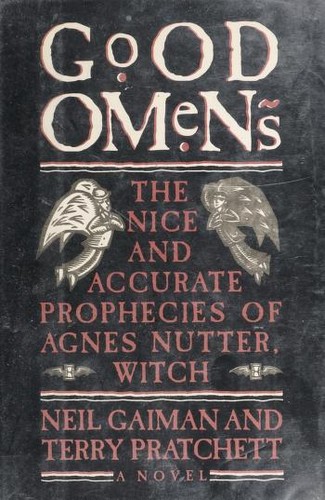
Good Omens
The Antichrist has been born and delivered to a small country hospital, where a satanic order of nuns swaps him with the son of an American diplomat.
About
Spoiler notice: Spoilers for the complete novel, including the baby swap, Adam’s powers and the resolution at Tadfield air base.
Good Omens brings the end of the world into a setting where its supernatural agents have become deeply attached to ordinary life. Aziraphale is an angel and Crowley a demon, but centuries on Earth have given them common interests that their employers would not approve of. They first meet around the expulsion from Eden, where Aziraphale’s decision to give the departing humans his sword already complicates the distinction between following orders and doing something kind. By the modern day, Crowley has been given a decisive assignment: deliver the infant Antichrist so that he can grow into the person who initiates Armageddon. The hospital’s satanic nuns mishandle the exchange. The baby reaches the Young family in Lower Tadfield, while Crowley and Aziraphale spend years influencing the wrong child, Warlock.
Their mistake leaves Adam Young free to grow up among people who do not know his cosmic importance. His closest companions are Pepper, Brian and Wensleydale, the group known as the Them, whose concerns revolve around their village, adventures and arguments. Meanwhile, the adults charged with guiding humanity have settled into recognisable habits of their own. Aziraphale keeps a bookshop whose rare stock he is reluctant to sell; Crowley enjoys his apartment and vintage Bentley. Both have reasons to preserve the world beyond winning a celestial contest. Their friendship has developed through the practical compromises of spending so long among humans. The novel moves between these different circles, letting an eleven-year-old’s local loyalties and two supernatural officials’ private comforts become obstacles to a supposedly inevitable ending.
The approach of Adam’s birthday exposes the failed arrangement. A hellhound arrives for the real Antichrist, but Adam’s wish for an ordinary small dog changes the creature’s appearance and expected behaviour. He names it Dog. Crowley and Aziraphale, discovering that Warlock is not the boy they need, return to a hospital that has become a management-training centre. Their investigation intersects with Anathema Device, a descendant of Agnes Nutter, whose book of prophecies offers an accurate but difficult guide to coming events. After a collision with Crowley’s Bentley, Anathema loses the book into the pair’s possession. Adam, meanwhile, encounters her ideas about the environment and the occult. The conversation gives his imagination new material just as his power begins turning ideas into changes that other people can no longer dismiss.
Agnes’s book gives the search a different kind of uncertainty from an ordinary mystery. Its predictions are accurate, but interpreting a seventeenth-century witch’s understanding of the future requires work. Anathema has inherited that work as a responsibility rather than receiving a clear set of instructions for saving everyone. Physical books also belong to Aziraphale’s everyday world, while electronic systems offer very different vulnerabilities. Newton Pulsifer, who becomes involved through Shadwell’s Witchfinder Army, has an unhappy history with technology: his attempts to make it work tend to do the opposite. Alongside the prophecy, the story uses objects that acquire unexpected significance, from Crowley’s Bentley to the sword, scales and crown delivered to the Horsepersons. Tools of transport, record-keeping and authority become part of the approaching catastrophe.
The apocalypse develops through recognisably modern forms of harm. War, Famine, Pollution and Death ride motorcycles toward their appointed confrontation; destruction does not need to look ancient to fulfil an ancient role. Around Adam, reports of environmental damage feed a growing wish to remake the world. That wish threatens to become another demand for obedience. His friends resist the idea that Tadfield should belong to him alone, bringing the enormous question of power back to the place they share. Heaven and Hell have their own hierarchies, and neither treats the possibility of cancelling the war as an obvious solution. Crowley and Aziraphale must decide how far their attachment to Earth can take them beyond their assigned duties. The competing sides keep returning to plans and permission while the people caught between them face what those plans would actually destroy.
The converging journeys reach the Tadfield air base, where the Horsepersons have put nuclear destruction in motion. Newton’s disastrous touch with computers becomes useful when it stops the countdown. Adam’s friends confront War, Famine and Pollution with makeshift counterparts of their symbols, while Death departs. Even that does not satisfy the representatives of Heaven and Hell. The Metatron and Beelzebub still demand the final battle, but Adam refuses to treat the destruction of his world as a necessary duty. Aziraphale and Crowley challenge the assumption that the expected battle and the true divine plan must be identical. The claim leaves the celestial authorities unable to insist that they fully understand what has happened. Adam also prevents Satan’s furious arrival from reopening the confrontation. The immediate disaster ends through several kinds of resistance, including friendship, practical incompetence and a refusal to accept an order’s supposed inevitability.
Afterward, the restored world still has room for uncertainty. Aziraphale and Crowley wonder what larger conflict might come later, then return to the human pleasure of lunch. Adam is grounded by parents who understand his behaviour in domestic terms, and his escape with Dog brings the conclusion back to fields, neighbours and stolen apples. These smaller consequences belong to the same world that the armies were prepared to erase. The book leaves the full meaning of the divine plan unresolved, even after its characters have acted against the ending they were told to expect. Its movement from Eden to Lower Tadfield places grand claims about human nature beside particular choices. Adam’s attachment to his friends and home has mattered because they are people and places he knows, with lives that cannot be replaced by an abstract victory.
Book details
- Author
- Terry Pratchett and Neil Gaiman
- First published
- 1990
- Series
- No series listed
- Subgenre
- Urban fantasy
- Primary genre
- Fantasy
- Tags
- No tags for this book.
Review
Editor profile
Baby Bat
Goodreads and social links will be added soon.
- Goodreads — link coming soon
- Social media — link coming soon