
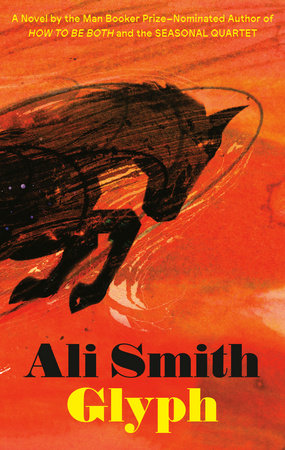
Glyph
As children, sisters Petra and Patch turn a story about a wartime death into an imagined ghost.
About
Spoiler notice: Spoilers for the premise and early relationship setup, including the sisters’ childhood ghost story, their estrangement, Petra’s phantom-horse experience and Patch’s reunion with Petra alongside Billie. Later developments and the ending are not summarized.
Ali Smith’s Glyph begins with two sisters, Petra and Patch, trying to make sense of a story about a death that happened before either of them was born. As children, they hear a family account of a young soldier run over by a tank during the Second World War. The tale is terrible and difficult to picture, so the girls invent a ghost around it: a way of approaching the dead through play and imagination. Years later, the story still belongs to them, but it has changed shape. Smith’s novel follows the sisters across childhood and adulthood as private memories become entangled with the histories people inherit, repeat and struggle to understand.
Petra and Patch grow apart, and the adult Petra is living at a distance from her sister when the old images return with unsettling force. A phantom horse appears in Petra’s bedroom, disrupting the ordinary explanations she relies on. Unable to decide what she has seen, Petra contacts Patch. That call brings Patch back into her life, along with Billie, Patch’s teenage foster daughter, who is encountering Petra as an adult for the first time. Their reunion gives the novel a domestic centre: people who share a past must find a way to speak across the gaps that time, conflict and family silence have opened.
The sisters’ childhood stories are not interchangeable memories. One concerns a soldier whose body is crushed beneath a tank; another reaches back to the First World War and a horse blinded by gas. In the girls’ imaginative game, the dead can be addressed and their absence briefly given a voice. As adults, Petra and Patch have to face the difference between inventing a figure and representing an actual person whose life was destroyed. The question is not whether imagination can change what happened. It is what telling a story can do for those left with the knowledge of it, and what responsibility follows when the dead cannot answer back.
Billie changes the rhythm of the family reunion. She is young enough to question the assumptions Petra and Patch have carried for years, and she is attentive to violence unfolding beyond their family history. The present enters the sisters’ conversations through news, public protest and the ways official language describes political events. Her response to the world gives the older women a difficult point of contact: their inherited stories of war are not sealed safely in the past when other people are living through violence now. Smith places everyday family care beside public acts of witnessing, asking what attention requires when suffering is visible and still easy to disregard.
The title’s ghost, Glyph, connects a made-up presence with the marks stories leave behind. Smith’s narrative moves between remembered events, present-day encounters and the sisters’ shared inventions, so readers are asked to notice how a story changes as it travels. Petra and Patch do not hold identical accounts of their childhood, and neither can simply recover an untouched version of what happened. The book treats memory as something shaped in conversation: one person remembers, another revises or adds context, and a third asks why a detail matters. That process can preserve experience, but it can also expose the limits of what anyone knows about another person’s past.
Glyph is companion to Smith’s novel Gliff, and the connection between the books appears in the characters’ lives as well as their shared interest in imagination and history. The publisher presents Glyph as a story that can be read on its own; its central relationship is the difficult bond between two sisters, with Billie joining their conversations from a different generation. Readers who know Gliff may recognise an echo between the novels, while this book’s ghost story and family structure provide their own point of entry. The link invites comparison without making the sisters’ present conflict depend on a recap of the earlier novel. It also gives the title pair a linguistic playfulness: the similar sounds invite a connection, while each novel establishes its own characters and questions. That balance suits a story attentive to how a word or image can travel between people and acquire a different weight in a new setting.
Across these strands, Smith brings the scale of war into a story about sisters trying to understand one another. The novel’s wordplay and shifts between the real and the imagined keep that movement active: language can soften, obscure or sharpen what people see. Petra’s apparition is at once a disturbance in a bedroom and a prompt to revisit the stories behind it; the sisters’ family memories open outward toward public history. Glyph asks what imagination is for when it meets grief, and whether attention can become a form of care. Its focus remains on the work of remembering together, and on the fragile responsibility involved in giving a voice to people who have been silenced.
Book details
- Author
- Ali Smith
- First published
- 2026
- Series
- No series listed
- Subgenre
- Literary fiction
- Primary genre
- Literary Fiction
- Tags
- No tags for this book.
Review
Editor profile
Baby Bat
Goodreads and social links will be added soon.
- Goodreads — link coming soon
- Social media — link coming soon