
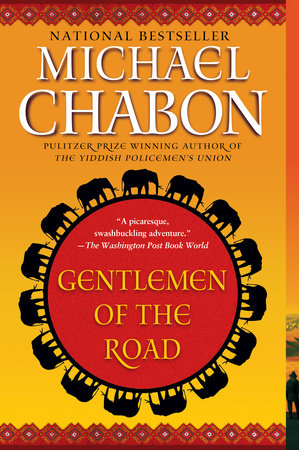
Gentlemen of the Road
Around the year 950, Zelikman, a wandering physician from the west, and Amram, a former soldier from Abyssinia, earn their living through hired violence and clever deceptions along the roads of the Caucasus.
About
Spoiler notice: Spoilers cover the opening premise, the characters’ alliance and the political conflict surrounding Filaq; later reversals, character fates and the ending are withheld.
Gentlemen of the Road begins with a pair of men who have made uncertainty into a trade. Around the year 950, Zelikman and Amram move through the Caucasus as hired blades, thieves and practiced swindlers, surviving by skill and improvisation. They are an unlikely partnership: Zelikman is a pale, lean physician from the west, while Amram is a much larger former soldier from Abyssinia. Their professions suggest a familiar adventure premise, but Chabon gives the pair habits and temperaments that resist the clean shapes of heroic fantasy. One man has medical knowledge as well as a talent for violence; the other brings blunt physical power alongside a quick wit. Both know that the road rewards adaptability more reliably than honourable plans.
The historical setting is Khazaria, a medieval empire whose name is less familiar to many readers than the empires and kingdoms usually used as backdrops for adventure. Chabon told the Washington Post that he had encountered the Khazars years earlier and found the history of a long-lived medieval empire, connected with both Byzantium and the Vikings and notable for its Jewish rulers, arresting. That sense of discovering an unfamiliar corner of the past informs the novel’s imaginative geography. The book does not ask to be read as a history textbook; it turns the distance and gaps in the record into space for a vivid, deliberately romantic adventure. The Caucasus and the routes leading east are not neutral scenery. They put travellers, merchants, soldiers and competing political powers in contact, making movement itself a source of danger and possibility.
The two wanderers are pulled into a struggle when they become entangled with Filaq, a young Khazar prince whose family has been killed by the usurper Buljan. The publisher describes Zelikman and Amram as escorts and defenders who become reluctant generals in a revolution; the broad shape is that of a restoration quest, but the tone is more wayward than solemn. Filaq has a claim to recover, yet the adults around him have their own survival instincts and private calculations. The arrangement creates friction between a political purpose and the pair’s preference for getting through the next encounter alive. Chabon’s characters can be brave without being dutiful and useful without becoming selfless. Their shifting degree of commitment gives the journey its motion.
The book’s origins as a serial help explain its appetite for incidents, interruptions and cliff-edge situations. It first appeared in fifteen instalments in The New York Times Magazine in 2007. In a contemporaneous Publishers Weekly interview, Chabon said that planning an episodic novel required him to work out the plot in detail and sustain readers’ interest from week to week; he also described plot as harder for him than language. That comment offers context for the book’s conspicuous construction. It moves through set pieces, reversals and encounters with an energy that acknowledges the pleasures of old adventure fiction. The episodic form does not erase its designed quality: each new predicament tests what the unlikely trio owe one another and whether their temporary alliances can survive another change in fortune.
Language is one of the novel’s chief instruments. Chabon builds an ornate, playful narrative voice around a deliberately old-fashioned adventure, mixing formal turns of phrase with bodily danger, jokes and improbable details. The effect is not simply a modern story wearing antique costume. The prose keeps drawing attention to how stories of heroic action are made, and how easily their grand poses can coexist with opportunism, melancholy or self-protection. The humour undercuts the idea that swords automatically make their owners noble. At the same time, the book takes pleasure in motion: roads, horses, disguises and sudden alliances carry characters into situations larger than the small schemes with which they began. Its comedy and its adventure work together by allowing danger to remain real while refusing to treat every convention with reverence.
The novel also approaches Jewish history through invention, an approach Chabon discussed directly in his interviews. He said that the Khazars felt like secret knowledge and that the impulse to write about what fascinated him mattered more than anticipating critical approval. The Guardian’s review identifies the book as a Jewish-inflected adventure and points to the way the setting gives that history a place inside a form often associated with other traditions. Chabon’s Khazaria is a literary creation built from historical reference, not a complete account of medieval life. That distinction matters because the book’s vividness can make its imagined world feel unusually legible. Its achievement as a premise lies in asking what a swords-and-road adventure might look like when its protagonists and historical frame shift away from the usual European court or crusading kingdom.
Gentlemen of the Road therefore works on two linked scales: a compact adventure about three people drawn into a dangerous political cause, and a playful examination of the stories that make wandering, fighting and empire seem romantic. Chabon’s interviews describe the project as a deep imaginative journey, while the publisher stresses its picaresque, swashbuckling shape. Those descriptions meet in the novel’s tension between a recognisable quest and characters who remain unreliable about their own motives. It is interested in spectacle, but also in the awkward details that spectacle tends to smooth away: injury, appetite, distrust and the effort required to travel with someone whose loyalties are uncertain. The result places an uncommon historical setting at the centre of a lively genre experiment without claiming that its invented adventure exhausts the history behind it.
Book details
- Author
- Michael Chabon
- First published
- 2007
- Series
- No series listed
- Subgenre
- Historical adventure, Adventure fiction
- Primary genre
- Historical Fiction, Adventure
- Tags
- No tags for this book.
Review
Editor profile
Baby Bat
Goodreads and social links will be added soon.
- Goodreads — link coming soon
- Social media — link coming soon