
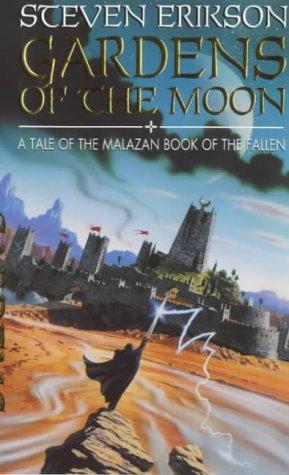
Gardens of the Moon
The Malazan Empire has taken Pale's last floating fortress, and the novel begins in the middle of an army that has been fighting this war for years.
About
Spoiler notice: Spoilers for the complete first novel, including divine possession, Tattersail’s fate, Raest’s awakening and the outcome in Darujhistan.
Gardens of the Moon begins inside a war whose soldiers already have years of history with one another. The Malazan Empire is advancing across Genabackis under Empress Laseen, and the siege of Pale leaves its surviving forces wondering whom they can trust. Above the city hangs Moon’s Spawn, the fortress of Anomander Rake and his Tiste Andii. It retreats after the magical battle; capturing Pale does not mean the empire has captured Rake. Imperial casualties include many of the Bridgeburners, the veteran company led by Whiskeyjack, while the mage Tattersail suspects that the danger came from her own side. Even an apparent victory has competing explanations. The opening follows soldiers and commanders trying to understand orders whose political purposes have been concealed from them.
Ganoes Paran enters that uncertainty as a young officer recruited by Adjunct Lorn to investigate a slaughter and the strange girl who becomes the soldier Sorry. Paran’s appointment as captain of the Bridgeburners places him among veterans with reasons to distrust imperial authority. Sorry is being used by Cotillion, a god whose intervention turns an ordinary recruit into a deadly instrument. When she stabs Paran, divine bargaining brings him back from death, making his survival part of another struggle he did not choose. Tattersail’s care for him develops into a personal attachment alongside their suspicions about the army. Lorn, meanwhile, has private reasons to hate Tattersail but must serve the empress’s objectives. Their histories make loyalty difficult to separate from grief, revenge and the demands of a position.
The campaign’s next target, Darujhistan, has a different rhythm. Gas from beneath the city feeds its lamps through a network of pipes, illuminating streets where council politics, theft and assassination overlap. Crokus, a young thief, steals jewellery and finds a coin whose apparent luck draws the attention of Oponn, the twin gods of chance. His accidental involvement sits beside deliberate intrigue: the alchemist Baruk seeks an understanding with Rake, while assassins undermine arrangements the empire might use against the city. Around the Phoenix Inn, Crokus’s companions have their own connections to these disputes. Rallick Nom wants to restore the dispossessed Coll, and Kruppe’s apparently wandering conversation conceals a spymaster’s knowledge. Darujhistan emerges through homes, taverns, ambitions and friendships as well as the plans outsiders have made for it.
Whiskeyjack’s squad enters the city to prepare an occupation, planting explosives at intersections rather than carrying out the original order against its gates. The operation depends on contacts they cannot simply assume will remain available. Kalam and Quick Ben try to reach the assassins, but Rake’s agents have already disrupted that world. Quick Ben’s dealings also show how much of the conflict runs through magic rather than military formations. He has moved the dying mage Hairlock into a wooden puppet, giving an ally a new body whose instability becomes dangerous. Warrens provide access to powers and other realms, and a bargain with a god can change an assignment as decisively as an imperial order. The soldiers are competent specialists whose knowledge still leaves them vulnerable to forces working beyond their sight.
Lorn travels with Tool, an ancient undead T’lan Imass, to a Jaghut barrow. Her purpose is to release Raest and turn his destructive power against Rake, weakening an opponent the empire has not subdued. Tool’s age and the old hostility between his people and the Jaghut give the mission a history much longer than Malazan expansion. Raest’s power is stored in a Finnest, which Lorn removes; waking him is easier than controlling what follows. Elsewhere, the struggle over Sorry changes when Rake confronts Shadowthrone. Cotillion withdraws, leaving the girl with broken memories, and Crokus calls her Apsalar. What looked like a single terrifying soldier becomes a person trying to recover a life. The same story keeps returning to the distance between those who command a weapon and those made to become one.
The movement between viewpoints gradually brings these separate plans together. Paran’s contact with Rake’s sword Dragnipur takes him into the realm of souls imprisoned within it, while Tattersail’s death does not entirely end her presence: her soul is carried toward rebirth among the Rhivi. Mortal deaths and divine claims therefore remain active parts of the unfolding politics. Within the army, Dujek’s developing break with imperial authority offers the Bridgeburners another possible allegiance. Darujhistan’s own disputes converge on a masquerade at Lady Simtal’s estate, where Rallick’s confrontation with Councilman Orr is tied to Coll’s ruined position. The gathering concentrates people who have been pursuing different objectives, with consequences that reach well beyond the social occasion. Their connections become clearer without reducing the war to one planner’s design.
Raest’s awakening makes those converging schemes an immediate threat. After fighting dragons, he takes possession of Crokus’s uncle Mammot, bringing the ancient power into the city. The Finnest helps bring an Azath House into being, and the struggle around it ends with Raest contained rather than delivered obediently to Lorn’s plan. Another disaster is prevented when Kalam recognises that the Bridgeburners’ explosives could ignite Darujhistan’s gas and destroy the city. Lorn dies, leaving Paran beside an enemy whose personal history he has begun to understand. Dujek’s rebellion opens the possibility of an alliance with former opponents, while Apsalar, Crokus, Kalam and Fiddler depart by boat. These outcomes settle the immediate confrontation without making the empire, the gods or the ancient peoples transparent. The first volume closes with changed loyalties and surviving relationships, leaving its larger conflicts alive beyond the city that has brought them together.
Book details
- Author
- Steven Erikson
- First published
- 1999
- Series
- Malazan Book of the Fallen, book 1
- Subgenre
- Epic fantasy, Grimdark
- Primary genre
- Fantasy
- Tags
- No tags for this book.
- Reading order
- Also on this shelf: Memories of Ice (book 3), Toll the Hounds (book 8), The Crippled God (book 10)
Review
Editor profile
Baby Bat
Goodreads and social links will be added soon.
- Goodreads — link coming soon
- Social media — link coming soon