
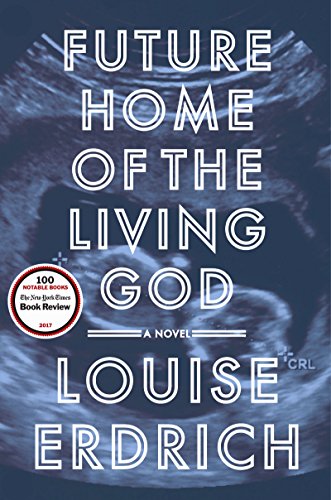
Future Home of the Living God
As evolution appears to reverse across the natural world, pregnant Cedar Hawk Songmaker begins writing to her unborn child.
About
Spoiler notice: This account reveals the premise, Cedar's pregnancy, her decision to meet her Ojibwe birth family, and the growing threat of government control over pregnant women. It does not disclose later events, individual fates, or the ending.
In Louise Erdrich’s near-future novel, Cedar Hawk Songmaker writes a journal to her unborn child while the rules of nature begin to shift. She is four months pregnant when the book opens. Scientists on television describe changes among small organisms and plants; reports suggest that dogs have stopped reproducing in predictable ways. The signs do not yet make a coherent explanation, and daily life continues in the midst of them. Cedar’s journal holds those oddities beside ordinary concerns, giving the story its intimate scale: a biological crisis reaches her first as a person trying to understand what may happen to her child, not as an expert who can explain what is happening to the world. Cedar sees partial pieces of evidence, such as plant changes and breeding irregularities, rather than a clear chain of cause and effect.
Cedar’s own sense of identity is also unsettled. She is Ojibwe-born and was adopted by Glen and Sera Songmaker, a Minneapolis couple who celebrated her Native heritage as she grew up. They gave her a name that signalled that identity and kept her hair in braids. Cedar remembers the expectations that came with this care, including being treated as if she could speak for Native history and nature. At college, conversations with other Native students complicate the picture she had formed of her origins. Erdrich places Cedar’s search inside that tension: it is a return to people and history she has not known firsthand, and a chance to replace an imagined family with actual relatives whose lives do not fit her assumptions. The Native classmates she meets have lives and experiences different from the tidy image that her adoptive household had celebrated for her.
When Sera gives Cedar a letter from her birth mother, Mary Potts, Cedar decides to travel north to meet her. She has a direct reason for wanting to know her birth family: the genetic changes affecting reproduction may matter to her pregnancy. Her adoptive parents worry that authorities could respond by confining pregnant women, but Cedar goes anyway. The trip is therefore both a family visit and an attempt to learn what her own history might mean for the child she is carrying. The route takes her from the Minneapolis life she knows to a reservation community where she must find her place among people who already share relationships and routines. Congress is already debating whether pregnant people should be confined, bringing the danger close to Cedar's immediate situation.
The Potts household is a collection of particular people rather than the symbolic family Cedar once pictured. Her birth mother, Mary, is called Sweetie; Mary Potts Senior is the family’s elderly matriarch, and Little Mary is Cedar’s teenage half-sister. Sweetie looks after the family, while her husband Eddy, Cedar’s stepfather, reads Dostoevsky at the Superpumper, the family’s gas station and supermarket. He is also writing a memoir of his own. Their home and business make the reservation setting specific and contemporary, with family responsibilities, work and personal ambitions all close together. Meeting them gives Cedar a lived connection to her Ojibwe relatives, while showing her that kinship does not make people predictable or turn them into answers to every question she has. Sweetie also proposes a shrine to Kateri Tekakwitha, hoping pilgrimages could bring visitors to the reservation; her idea joins spiritual devotion to the family's practical economic world.
The wider emergency appears through small failures and unsettling gaps as well as official announcements. When Cedar relies on GPS to find the Potts home, the family tells her their place is not on the map and that Siri is dead. Elsewhere, national borders are sealed and strange organisms are reported in ordinary parks and yards. These details make the crisis feel uneven: people keep working, visiting family and using familiar technology, yet the systems they depend on no longer seem dependable. The novel keeps the cause of the biological changes unclear, so the reader encounters the same uncertainty Cedar does. Her observations cannot settle the science, but they show how an extraordinary event enters the texture of everyday life. Some of the strange organisms are jellyfish-like forms that collect cell-phone information for corporations, so the environmental crisis overlaps with an already intrusive digital landscape.
As the government moves toward controlling pregnancy, Cedar's private search for family takes place against a growing political struggle. The authorities' interest in pregnant women threatens to reduce them to subjects of monitoring and policy, while Cedar's journal records her thoughts and relationships in her own voice. Eddy also leads an Ojibwe effort to reclaim land. His work places Indigenous sovereignty and control of territory alongside the state's control of reproduction. Questions about who defines family, who controls land, and who has authority over a pregnancy converge in Cedar's uncertain future. The government also invokes religious authority, while Cedar has a distinct spiritual life of her own.
Book details
- Author
- Louise Erdrich
- First published
- 2017
- Series
- No series listed
- Subgenre
- Dystopian, Literary fiction, Epistolary novel
- Primary genre
- Sci-Fi, Literary Fiction
- Tags
- No tags for this book.
Review
Editor profile
Baby Bat
Goodreads and social links will be added soon.
- Goodreads — link coming soon
- Social media — link coming soon