
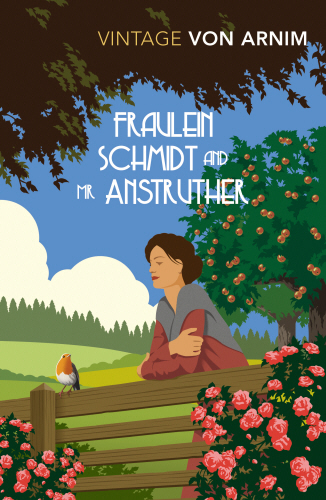
Fräulein Schmidt and Mr. Anstruther
After Englishman Roger Anstruther leaves Jena, Rose-Marie Schmidt writes to him about the love they have just declared and the year he spent lodging with her family.
About
Spoiler notice: This overview discusses the broken engagement, family bereavement and Rose-Marie’s decision in the final letters.
Rose-Marie Schmidt begins writing to Roger Anstruther in a state of delighted surprise. He has spent a year lodging with her family in Jena while studying German, and just before leaving he has declared his love. The familiar rooms and streets suddenly seem transformed. Fräulein Schmidt and Mr. Anstruther gives that first happiness to the reader through her own letter, then follows the relationship in eighty-one pieces of correspondence from the same voice. Roger's replies reach us through what she reports, answers and sometimes quotes. This creates an intimacy with Rose-Marie without giving an equally direct view of him. We learn to recognise a change in the relationship partly by hearing how she changes the way she addresses the person at its other end.
She is twenty-five, a professor's daughter living with her father and stepmother, accustomed to household work and to having limited money. Roger's English connections belong to a different social world, and her stepmother is quick to explain why that world may not welcome the match. Rose-Marie writes candidly about the warnings, her own appearance and the conventions that encourage women to conceal what they feel. Her humour makes the letters lively without removing the vulnerability in sending them. An observation can turn into a joke, an argument or an admission before the page is finished. The reader is following a woman who can examine an absurdity sharply while still wanting something the people around her consider imprudent.
The engagement breaks under pressures Roger does not resist. His father favours wealthy Nancy Cheriton, and Rose-Marie reads enough in Roger's careful explanation to recognise that obedience is not the whole story. He is also attracted to the suitable woman placed before him. Rather than accept a marriage he offers only if she insists, Rose-Marie returns his freedom and refuses to compete. Her letter combines anger, wounded pride and an effort to behave bravely. It also makes a precise distinction between the love she thought they shared and an obligation that might now be extracted from him. The speed of the reversal is painful: the promises that made her feel secure have been replaced by another conviction he can express with similar assurance.
After serious illness and an interruption in the correspondence, the letters resume on the terms of friendship. Rose-Marie has survived a cold that affected her lungs and begins finding a way to live beyond the loss. Writing to Roger can offer companionship without restoring the engagement, but keeping that boundary requires work. A familiar person may still understand books, jokes and daily experiences while no longer being someone she would trust as a husband. The book gives considerable space to that possibility. Love does not disappear from her thinking, yet her life has subjects other than the man who abandoned their plans. Friendship could become a valuable new relationship if he can accept that it is what she is offering.
Her stepmother's death changes the household's finances and Rose-Marie's feelings about the woman herself. An annuity disappears, leaving her and her father dependent on her mother's smaller income and requiring a move from their Jena flat. At the Galgenberg she makes a different home, translates her father's book and continues writing about work, neighbours and the natural world around her. The letters let these activities occupy real time. Money has to be considered, meals and rooms have to be managed, and a manuscript has to be worked through. Her account also acknowledges how the presence of illness and death can make a letter from elsewhere seem horribly out of tune. Correspondence connects separate lives without ensuring that their emotional circumstances match.
The neighbours give Rose-Marie other relationships to observe and encourage. Joey Collins's attachment to Vicki brings English habits into contact with German expectations about courtship, presents and family approval. A costly necklace at Christmas creates exactly the sort of complication Rose-Marie has predicted: a gift meant as pleasure requires its giver to explain what he intends. Joey's account of the festivities lets her turn social misunderstanding into comedy, including the contrast between his casual clothes and the family's ceremonial dress. Watching another courtship also enlarges the novel beyond her own disappointment. She can be interested, useful and amused in the lives around her. That continuing appetite for people is part of what Roger receives in her letters, even when he misunderstands the affection behind them.
His renewed proposal finally makes the correspondence impossible to preserve. Rose-Marie explains that she wanted a frank, dependable friendship, while he has kept treating her letters as a route back to the romance. She no longer loves him in that way and does not trust the constancy of a man who has already changed his mind once. As he persists, her answers become shorter and more definite. The expansive voice that has supplied the whole novel contracts into refusals: she will not see him, does not love him and will never marry him. The final letter says she will not write again. No later reconciliation qualifies that decision. Ending the exchange costs her a friendship she had hoped to build, but lets her determine what will happen to her own voice.
Book details
- Author
- Elizabeth von Arnim
- First published
- 1907
- Series
- No series listed
- Subgenre
- Epistolary novel, Historical fiction
- Primary genre
- Literary Fiction, Romance
- Tags
- No tags for this book.
Review
Editor profile
Baby Bat
Goodreads and social links will be added soon.
- Goodreads — link coming soon
- Social media — link coming soon