
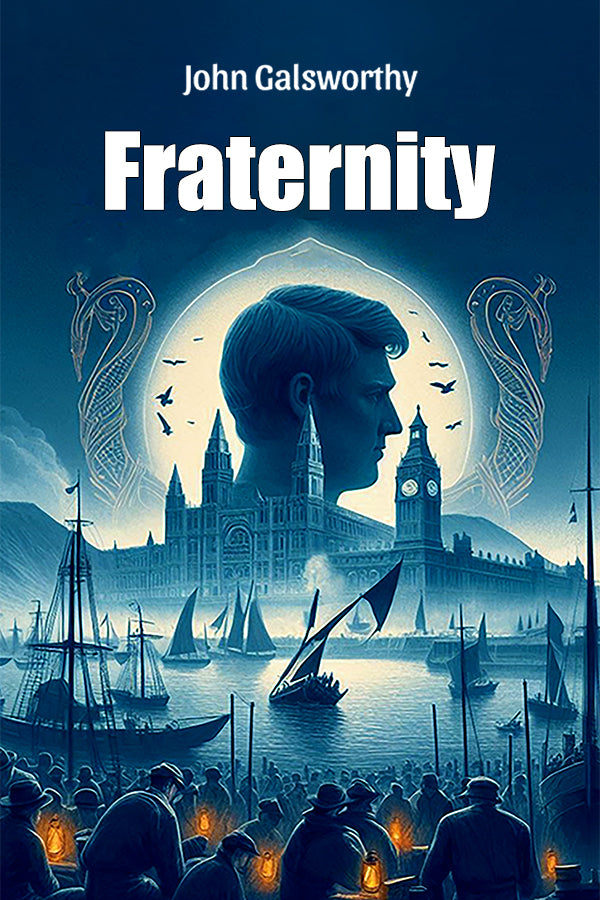
Fraternity
Painter Bianca Dallison's work brings Ivy Barton, a young model from a poorer background, into the orbit of Bianca and her husband, Hilary.
About
Spoiler notice: This overview includes the violence in the Hughs household, Hilary's departure and the final scene with Mr. Stone.
A woman considering a new dress, a tired shop assistant, an elderly newspaper seller and a seamstress with her children occupy the same Kensington street at the beginning of Fraternity. Their proximity does not mean that they share a world. Cecilia Dallison can worry about distress while buying something she wants, then feel uncomfortable when that distress approaches her directly. John Galsworthy follows her from the pavement into the home of her sister Bianca and brother-in-law Hilary, bringing the question of what people owe one another into an apparently cultivated domestic setting. The household contains paintings, conversation and Mr. Stone, the sisters' father, who is writing a book about universal brotherhood. Its ideal will be tested through relationships much harder to manage than an abstract declaration of fellowship.
Bianca's painting The Shadow provides one of those tests. She asks Hilary to find a model and makes a distinction between a lady and the woman she needs for a partly draped figure. Their shared smile at the distinction reveals a long marriage full of tact that has become an obstacle to intimacy. They have avoided open quarrels while moving steadily apart. Hilary finds Ivy Barton through an artistic acquaintance, and her first visit puts a practical demand before his sensibility. She is hungry, without reliable work and uncertain about what she will be expected to do to earn a living. Her questions concern the hours and pay; his attention also notices her appearance and manner. Sympathy begins in circumstances that already contain unequal knowledge, resources and desires.
The help offered to Ivy gives her a room in the Hound Street household of Mrs. Hughs, who does sewing for the Dallisons. Later, when Bianca no longer wants her to sit, Mr. Stone employs her to copy his manuscript. This arrangement makes an especially pointed meeting between lofty purpose and everyday need. He dictates ideas about human unity while she speaks about the people around her, their past occupations and their troubles. They can converse without quite addressing the same subject. For Ivy, regular paid work offers a degree of independence; for the old man, the work belongs to a vision extending beyond any single person's circumstances. Hilary, listening from outside, can recognize both her loneliness and the limits of a connection founded upon such different expectations.
Hound Street exposes a harsher set of dependencies. Mrs. Hughs lives with her husband's violence while also fearing the loss of her place in his affections. When Thyme and the young doctor Martin visit, her damaged wrists give them visible evidence of mistreatment. Their advice that she leave seems clear and reasonable to them, but her response is entangled with years of marriage, children and jealousy of Ivy. The novel does not make Ivy responsible for the husband's abuse simply because another character accuses her. Later, the threat of his bayonet brings the family before a magistrate. In court, Mrs. Hughs's frightened loyalty complicates the account she gives. Protection offered from outside must contend with attachments and fears that cannot be understood merely by naming the correct course of action.
Hilary's growing involvement with Ivy also reveals the distance between a generous statement and a relationship he can actually sustain. He buys clothing and proposes that she move, but discovers how little he knows about her understanding of those acts. His claim that every woman is a lady fails against her simple observation that a lady would not be living where she does. Buying things can change her immediate circumstances without removing the distinction both of them recognize. The discomfort extends into his marriage, where Bianca experiences his concern for the model through the history of their own estrangement. His helpfulness is real, but it becomes increasingly difficult to separate compassion from desire, or either of those from the pleasure of imagining himself able to rescue someone.
The proposed departure abroad makes that confusion unavoidable. Bianca visits Ivy's room, where the packed luggage gives the plan a concrete shape. Hilary then arrives after a prolonged struggle with himself, finding a girl whose expectations can no longer remain conveniently vague. His response moves between attraction and an appalled vision of living with someone whose habits and background he scarcely understands. When Ivy kisses him, physical revulsion breaks the prospect he had approached without firmly deciding to accept. He leaves money and goes alone. The scene refuses the graceful form that his cultivated feelings might have given the arrangement from a distance. Ivy must cope with the abandonment and count the notes that remain, while he retreats from the future his intervention had encouraged her to expect.
The last chapter brings that retreat back into the Dallison home. Stephen reads Bianca a letter in which Hilary acknowledges that class has defeated his impulse to take Ivy, while declaring that he will not return to their marriage. Going alone has preserved neither the new relationship nor the old one. Bianca wanders among the familiar objects of his study and later imagines the model's presence before returning to the reality of moonlight and trees. Below her window, Mr. Stone appeals to the universe, unable to continue the work through which he hoped to reveal human unity. His call to his brothers attracts a policeman, who searches the garden for the people addressed and finds nobody. The ideal remains audible, but the final practical response cannot discover the fellowship it invokes.
Book details
- Author
- John Galsworthy
- First published
- 1909
- Series
- No series listed
- Subgenre
- Literary fiction, Modern classics
- Primary genre
- Literary Fiction
- Tags
- No tags for this book.
Review
Editor profile
Baby Bat
Goodreads and social links will be added soon.
- Goodreads — link coming soon
- Social media — link coming soon