
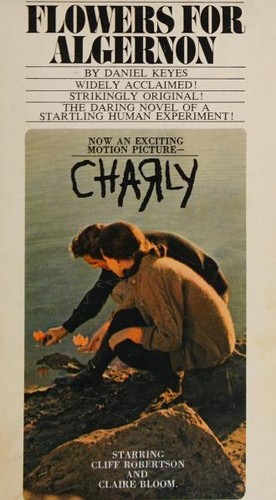
Flowers for Algernon
Charlie Gordon is thirty-two and works in a bakery, and he has been chosen for an experimental operation that may raise his intelligence.
About
The American author Daniel Keyes first wrote Flowers for Algernon as a novelette in 1958, and it reached print in 1959. The Hugo Award for Best Short Fiction went to it in 1960, and Keyes expanded the story into a novel published in 1966, which shared the Nebula Award for Best Novel that year. Both versions take the form of progress reports kept by the narrator.
Charlie Gordon is thirty-two and works in a bakery, and he has been chosen for an experimental operation that may raise his intelligence. He writes about it in reports whose spelling and grammar improve as he does, which is how the reader tracks the change. The operation was tested first on Algernon, a laboratory mouse that solves mazes.
Charlie's growing understanding includes the fact that he is the second test rather than the point of the experiment. What he gains is an education, a memory of how people treated him when he could not answer back and a sharp view of the researchers using him. The novel expands significantly on his emotional state and his family history compared with the earlier novelette.
The reports also cover what the experiment does to Algernon, and Charlie is well ahead of the doctors in working out what comes next. The book is a standalone story rather than part of a series, and the novelette version can be read separately from the novel.
Book details
- Author
- Daniel Keyes
- First published
- 1966
- Series
- No series listed
- Subgenre
- Classic science fiction
- Primary genre
- Sci-Fi
- Tags
- No tags for this book.
Rating
Review
Editor profile
Baby Bat
Goodreads and social links will be added soon.
- Goodreads — link coming soon
- Social media — link coming soon