
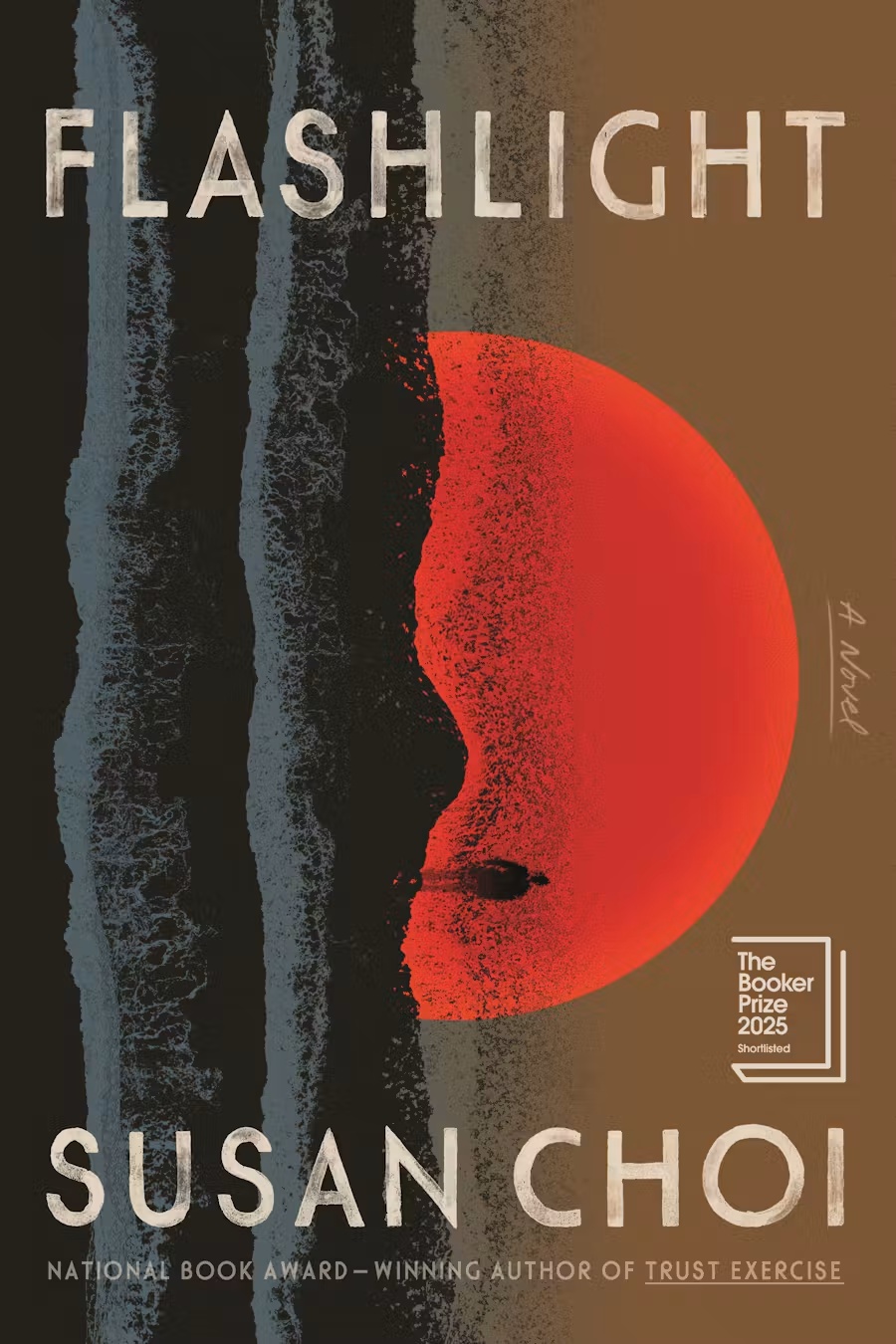
Flashlight
When ten-year-old Louisa is found alone on a Japanese beach after a walk with her father, Serk, the family’s life is changed.
About
Spoiler notice: Spoilers for the opening disappearance of Serk and the broad family premise; later revelations and the ending are not described.
Susan Choi’s Flashlight begins with a catastrophe that changes the shape of one family. Louisa is ten when she walks with her father, Serk, along the breakwater in a coastal Japanese town. She is later found on the beach, barely alive, while he is missing and presumed drowned. Louisa and her American mother, Anne, return to the United States, carrying a question that cannot be answered by the immediate facts of that night. The book’s account repeatedly circles back to the event as it follows its effects across time and place. This opening gives the novel a mystery, but its focus extends beyond solving a disappearance: the family’s grief, history and sense of belonging have all been unsettled at once.
Choi structures the story through chapters that shift from one family member to another and return to the night by the sea. That movement changes what the reader can see without making any single perspective complete. Louisa experiences the event as a child whose understanding is necessarily limited; Anne must face the practical demands of life after the loss while carrying her own past; Serk’s history reaches back to family and political choices made before Louisa was born. Each viewpoint adds context to the same rupture. The structure makes memory part of the subject: a family’s account of the past is built from what its members know, what they remember and what remains beyond their view.
Serk’s background connects the family’s private crisis to a larger history. He is Korean, born and raised in Japan, and became separated from relatives who later moved to North Korea amid the postwar promises of Pyongyang. His identity has been shaped by movement between places that do not fit neatly into one national story. Before his disappearance, he takes Louisa and Anne to Japan; the reason for that trip becomes part of the question the novel follows. Through Serk’s family, the book attends to Korean communities in Japan and the choices made by people living through a divided and changing region. These circumstances are not presented as detached historical information: they form part of the relationships and histories that Louisa inherits.
Anne’s history creates a different route into the family’s past. She is American and estranged from her own relatives after a reckless adventure in her youth. After Serk vanishes, she and Louisa must return to ordinary life in the United States without the person who had connected their small household. The publisher’s description emphasizes that grief can draw them together while also separating them. Their relationship therefore carries both shared loss and distinct experience: Louisa is a child trying to understand what happened, while Anne is a parent making decisions in its aftermath. The novel’s alternating attention to family members allows those differences to matter without reducing either character to a single response to bereavement.
A further strand enters through Tobias, Anne’s son from before her life with Serk, whose reappearance has consequences for the family. His presence broadens the story’s idea of kinship beyond the household Louisa has known. The novel’s scope reaches across decades and continents, placing the family’s personal history beside postwar Korean migration, suburban American life and the North Korean regime. The Booker Prize judges describe its movement across continents and decades, balancing historical tensions with intimate dramas. This combination links events that might otherwise seem distant: decisions made by earlier generations continue to shape the choices and relationships of people born later. The book’s wide frame keeps individual characters at its centre as it moves through that history.
The title’s flashlight offers a useful way to understand the novel’s handling of knowledge. A beam can reveal a portion of a scene while leaving the surrounding space dark; likewise, each return to the disappearance changes the available picture without making family memory transparent. Choi’s official description calls attention to the limits of what the characters can see and understand. Questions about language, identity, memory and family are therefore connected to the story’s form as well as its events. The shifting chapters allow a detail to take on new significance when viewed from another life or another period. Rather than treating uncertainty as a temporary obstacle, the narrative uses it to show how people construct explanations from partial histories and inherited accounts.
Flashlight joins a family mystery to a multigenerational historical novel. Its starting point is specific: a child survives a walk by the sea, her father disappears, and she and her mother must continue without him. From there, the story moves among the family members and the places that have shaped them, including Japan, the United States and North Korea. The result is a portrait of people whose private attachments are entangled with national histories, migration and memory. Choi’s sixth novel was shortlisted for the 2025 Booker Prize. The selected US hardcover edition from Farrar, Straus and Giroux was published on 3 June 2025 under ISBN 9780374616373.
Book details
- Author
- Susan Choi
- First published
- 2025
- Series
- No series listed
- Subgenre
- Literary fiction, Historical fiction, Family saga
- Primary genre
- Historical Fiction, Literary Fiction
- Tags
- No tags for this book.
Review
Editor profile
Baby Bat
Goodreads and social links will be added soon.
- Goodreads — link coming soon
- Social media — link coming soon