
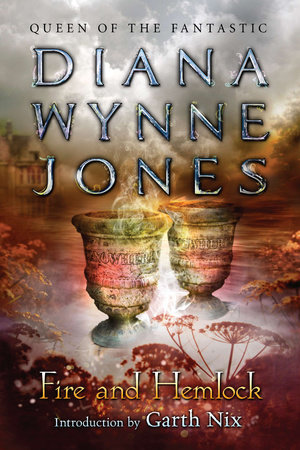
Fire and Hemlock
While staying with her grandmother, young Polly Whittacker meets cellist Tom Lynn and becomes involved in his strange, dangerous world.
About
Spoiler notice: This overview discusses Polly and Tom’s friendship, the returning memories that prompt Polly’s investigation, and the dangers suggested by their stories and folklore sources. It avoids the novel’s final confrontation and ending.
Fire and Hemlock begins with a problem of memory. As a young adult preparing to return to college, Polly Whittacker finds that an old book brings back another account of her childhood, one in which the unusual cellist Tom Lynn had a central place. In the ordinary version, much of her early life seems unremarkable; in the recovered one, she and Tom are friends whose lives have become entangled. The discrepancy makes her question not only what happened but how she came to forget. Polly’s search sends her back through a relationship formed when she was a child, and through clues that were present in books and invented adventures. Jones lets the reader approach the fantasy through the same uncertain evidence Polly must interpret, so recollection itself becomes part of the mystery.
The story moves between Polly at different ages rather than treating childhood as a closed prologue. Her first meetings with Tom take place while she is staying with her grandmother, away from the turmoil of her parents’ relationship. Their connection grows through letters, visits, and the stories they make together. Tom is a musician with a complicated life, and Polly’s attention to him gives her a role in events she does not yet understand. When the older Polly recovers these memories, she has to reassess what the younger girl could know and what she was capable of changing. The change in perspective gives the book a coming-of-age shape without reducing growing up to a simple march toward certainty: adult Polly must use the imaginative habits she formed as a child to investigate the past.
Books and storytelling are practical parts of the relationship. Tom sends Polly books, and the two invent adventures whose details do not stay safely on the page. Their make-believe begins to intersect with the peril surrounding Tom, leaving Polly to decide which elements are playful invention and which may describe a real danger. The friendship is not a side excursion from the plot; it supplies both the emotional bond that motivates Polly and the material through which she can reason. The books Tom chooses become more than gifts: their contents offer clues about the strange limits on his life. Stories help Polly think through what she sees, while the reader follows her effort to work out where invention ends and danger begins.
Jones builds the supernatural pattern from two related but distinct folk traditions: Tam Lin and Thomas the Rhymer. Their influence goes beyond familiar names or a borrowed fairy queen. Polly encounters the old ballads as texts and tries to understand how they might illuminate what is happening around her. Their stories also shape the events she and Tom invent, so legend exists both as a possible pattern for their lives and as something they can read and question. This layered use of folklore makes interpretation a form of action. A traditional story offers possibilities, but Polly must judge what fits her circumstances rather than assuming that an inherited tale supplies a ready-made answer. Jones also draws on a wider literary landscape, reinforcing the sense that books and remembered stories can help people imagine choices that their everyday world seems to deny.
The everyday English setting helps the fantastic elements remain difficult to separate from ordinary life. Polly deals with family strain, school-age decisions, letters, books, and the shifting closeness of a friendship; supernatural danger enters through those familiar channels. The story moves between 1980s England and an otherworldly realm, but the boundary between them is not a clean line Polly can simply cross. Details that first look like incidents in her personal history can also carry the pressure of a much older pattern. That overlap gives the novel its tension: the fantastic does not replace ordinary experience so much as alter the meaning of what Polly remembers. A friendship, a parcel of books, or a story written together can become part of a larger danger without losing its everyday emotional weight.
Polly’s heroism develops through persistence, imagination, and a willingness to reconsider her own account of events. She is not introduced as an expert who already knows the rules of the supernatural world. Instead she gathers fragments: memories, correspondence, the stories she and Tom made, and the traditional ballads that seem to echo their circumstances. Her qualities are recognizably ordinary—stubbornness, thoughtfulness, temper, and a capacity to care—yet these become sources of strength as she keeps looking for answers. Because the story is framed by an older Polly recalling her younger years, agency accumulates over time. What she can understand and do changes as her experience grows, while the narrative preserves the limits and mistakes that belonged to her younger self. Jones makes the path to heroism a process of attention and persistence rather than a sudden gift of certainty.
The novel’s central questions concern what people owe one another when affection, imagination, and danger have become intertwined. Polly’s bond with Tom is built through shared stories and sustained across separations, yet understanding it requires more than sentiment: she has to examine the past and recognize the forces that constrain him. Jones links that private effort to the older ballads without making the characters mere stand-ins for their legendary counterparts. The folklore creates pressure and possibility, while Polly’s particular memories keep the stakes personal. This is a fantasy about the power of stories to shape perception, but also about the work of checking a story against lived experience. The book leaves its larger pattern open enough to sustain uncertainty, inviting attention to how Polly and Tom continue to imagine a way through it.
Book details
- Author
- Diana Wynne Jones
- First published
- 1984
- Series
- No series listed
- Subgenre
- Myth retelling, Young adult fantasy, Fae and faerie
- Primary genre
- Fantasy
- Tags
- No tags for this book.
Review
Editor profile
Baby Bat
Goodreads and social links will be added soon.
- Goodreads — link coming soon
- Social media — link coming soon