
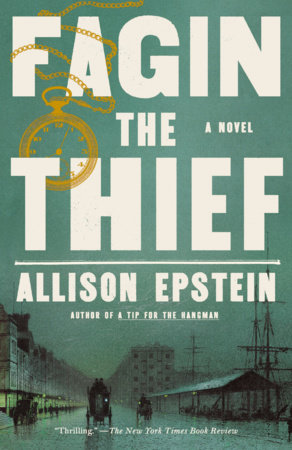
Fagin the Thief
In nineteenth-century London, Jacob Fagin grows up in Stepney with his mother after his father is executed for theft.
About
Spoiler notice: This About discusses Jacob Fagin's origins, criminal apprenticeship, relationships with Bill Sikes, Nancy, the Artful Dodger and Oliver Twist, and the setup of a major robbery. It withholds the robbery's full consequences and the novel's ending.
Allison Epstein's Fagin the Thief takes a character Charles Dickens introduced as a criminal mentor in Oliver Twist and gives him a life of his own. The novel begins long before Oliver enters Jacob Fagin's world, following Jacob from childhood in Stepney, a Jewish neighborhood in nineteenth-century London. His father has been executed for theft, and Jacob grows up with his mother, Leah. A pickpocket's offer of instruction redirects his prospects: a trade in stolen goods promises a route to money unavailable through ordinary work. From this starting point, Epstein builds a historical novel around a familiar literary figure without treating Dickens's account as the whole of Jacob's story. The perspective shifts the focus from Oliver's passage through the criminal underworld to the man who helps shape it, and asks how an infamous role might look from inside a life formed by poverty, prejudice and choice.
Jacob's education in theft is also an education in navigating a divided city. Under the guidance of a seasoned pickpocket, he learns skills that allow him to move among London's wealthy districts while remaining part of its hidden economy. The publisher's description frames this work as a shadow life built in the spaces between the city's richest neighborhoods and its dangerous streets. Jacob's growing competence brings independence, but it does not detach him from the circumstances that made the trade seem practical. The reader's guide identifies his early mentor as Leftwich and invites attention to the beliefs Jacob takes from him, as well as to the way those beliefs change over time. His story therefore concerns more than technique or a rise through a criminal hierarchy: it follows a person learning to survive within structures that offer little protection to poor children and little room for easy moral judgments.
The book's central relationships complicate Jacob's self-image as a self-sufficient operator. Leah's ideas about family and responsibility differ from his, and their bond remains an influence as he makes a life beyond the home they shared. Jacob later takes in Bill Sikes, a teenager drawn to theft whose volatile temper unsettles the fragile arrangements around him. What begins as a decision to guide another young criminal develops into a relationship shaped by attachment, power and danger. The reader's guide notes that the novel includes sections more closely focused on Bill, widening the account beyond Jacob's view of him. Epstein does not present mentorship as a simple rescue: Jacob's choices can provide care while also drawing others deeper into a world organized around risk. Their connection makes questions of influence and responsibility part of the story's personal stakes.
Jacob's circle expands to include Nancy, his closest friend, and the Artful Dodger, a young thief he treats as a protégé. Their ties give the novel the shape of a found family assembled among people with few dependable sources of security. The children who come to Jacob need him, according to the discussion prompts in the publisher's guide, and that need becomes bound up with how he understands himself. Care and criminal instruction occupy the same space: the skills that help the group get by also expose them to harm and make departure difficult. Nancy's friendship in particular gives Jacob a relationship that is not reducible to his authority over a pupil. The group is not an uncomplicated substitute for a conventional household. Its loyalties, inequalities and vulnerabilities are part of the novel's examination of what support can mean when institutions and family structures fail to provide it.
Oliver Twist eventually arrives at Jacob's door, bringing Dickens's familiar plot into contact with the life Epstein has imagined. The reader's guide describes Oliver's appearance as a point that shifts the novel's course. That encounter links the book to its literary source while preserving its distinct center of gravity: Jacob's history, rather than Oliver's, organizes the narrative. Epstein also places the characters in a social world where antisemitism and class prejudice affect how people are seen. The publisher's materials describe the novel as a reimagining that complicates the villain's earlier characterization; the guide directs readers to consider Jacob's Jewish identity, the prejudices imposed on him and the beliefs he forms for himself. This framing matters because the book neither erases his crimes nor treats a stereotype as a complete explanation of a person. It makes the inherited Dickensian role a subject for examination.
The plot gathers these personal and social pressures around a major robbery. Bill's growing ambition and Jacob's competing obligations strain the group, and the plan goes awry, forcing Jacob to confront what he stands for and what a life is worth. The publisher's description establishes that dilemma without resolving it; this account leaves the consequences and ending undisclosed. Suspense comes from the collision between criminal plans and relationships that cannot be managed like a job. The novel combines historical fiction with crime-driven momentum, placing acts of theft beside questions about kinship, survival, belief and responsibility. Its London is both setting and system: a city of sharply unequal neighborhoods where movement between rich and poor worlds can be a source of opportunity and exposure. By following Jacob across the years before and around Oliver's arrival, Epstein reframes a familiar literary villain as the protagonist of a separate, morally complex life.
Book details
- Author
- Allison Epstein
- First published
- 2025
- Series
- No series listed
- Subgenre
- Historical fiction, Crime thriller
- Primary genre
- Historical Fiction, Mystery & Thriller
- Tags
- No tags for this book.
Review
Editor profile
Baby Bat
Goodreads and social links will be added soon.
- Goodreads — link coming soon
- Social media — link coming soon