
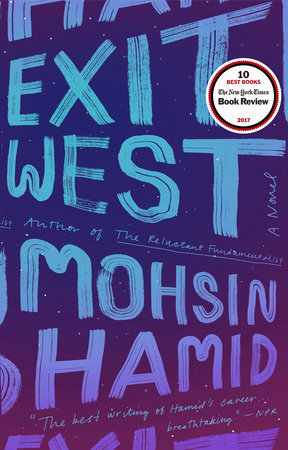
Exit West
In an unnamed city approaching civil war, Nadia and Saeed begin a relationship as violence disrupts the routines of daily life.
About
Spoiler notice: Spoilers cover the opening crisis, Nadia and Saeed’s relationship, and their departure through mysterious doors. Later developments and the ending are withheld.
Nadia and Saeed meet in an unnamed city where daily life continues even as the threat of civil war grows. They begin a relationship amid evening classes, work, family and the small habits that make a place feel ordinary. Nadia is fiercely independent; Saeed is more restrained and closely attached to his family. Their differences matter from the beginning, but they do not prevent affection. Hamid places a developing love story inside a city whose public danger keeps narrowing the space for private choice. At first, the couple can still arrange to meet and make plans. As violence reaches more directly into their lives, the same routines take on a different weight: a journey across town or a quiet evening can no longer be treated as guaranteed. The pressure stays grounded in the couple’s immediate choices, so the city’s deterioration is felt through what becomes harder to do together, not through sweeping claims about a whole population.
The city remains unnamed, a deliberate feature the author’s publisher highlights in its discussion guide. That choice keeps the setting from standing in for one easily identified conflict or country. The novel gives the place a texture through its streets, homes, phones, work and social expectations, while leaving its borders indistinct. This is not a claim that all cities or migrations are alike. Rather, the story holds specific characters in an invented crisis and asks readers to follow the consequences for them. Saeed and Nadia respond differently to the danger around them, and each brings personal loyalties and fears to decisions that affect them both. Hamid’s focus stays close to these people even as the circumstances pressing on them grow larger than either can control. Leaving an unnamed place also means readers cannot reduce Nadia and Saeed to representatives of one national story; the novel still gives their setting social texture and their decisions personal stakes.
The strange doors at the heart of the novel alter what escape can mean. They offer passage between places, but the possibility of leaving does not make departure safe, painless or emotionally simple. The doors are speculative, a fantastical device set beside recognizable details of contemporary life. Their presence changes the practical question from whether the characters can travel conventionally to what they must give up, carry with them or learn after crossing. Migration here is not presented as a clean transition from danger to comfort. A new location brings unfamiliar conditions and a changed relationship to home; the characters have to reckon with uncertainty rather than assuming that movement solves what they have endured. The doors make distance suddenly traversable while leaving its human cost in view. They do not make migration voluntary in any uncomplicated sense when the alternative is remaining amid escalating danger.
Nadia and Saeed’s relationship is tested by more than the strain of immediate survival. They do not want precisely the same things, and the habits that once seemed like personal preferences become important when they have fewer choices. Saeed’s connection to his family and familiar community shapes how he thinks about leaving; Nadia’s independence makes the prospect of relying on others feel different to her. These are not simple opposing positions, nor does one stand for every migrant’s experience. They are individual responses formed by character, history and circumstance. The novel tracks the way closeness can offer support while also changing under pressure. Love does not erase disagreement or guarantee that two people will experience displacement in the same way. Their differing needs resist a tidy lesson about what a couple should do. The book lets attachment and autonomy remain in tension, without turning either character into a symbol or a verdict.
The book also attends to the ordinary material of life in a crisis. The publisher’s reading guide points readers toward routines, pleasures and the changing geography around the couple, alongside its question about what the doors do physically and emotionally. That emphasis matters because the story is not made only from dramatic escape. People still seek privacy, companionship and familiar comforts while public conditions become less predictable. Small acts can offer steadiness, but they cannot return the world to what it was. By keeping attention on the everyday as well as the extraordinary, Hamid lets the reader see how upheaval enters private life gradually and then changes what once seemed routine. That balance keeps fear from becoming the only register of the book. Moments of routine remain meaningful because they belong to particular people, rather than serving as proof that hardship can be overcome by attitude alone.
As Nadia and Saeed move into an uncertain future, the novel keeps its scale both intimate and broad. Its central relationship gives the reader a close view of two people negotiating attachment, autonomy, memory and change; its doors open the story outward to questions of movement and belonging. The device does not turn displacement into an easy metaphor or make the characters’ losses interchangeable. Instead, it puts extraordinary movement beside familiar emotional negotiations: how to stay connected, what a person owes to home, and how people respond when their surroundings no longer feel secure. Exit West follows these questions without promising that love or relocation can settle them neatly. Its premise is concise, but the consequences it explores continue beyond the moment of departure. The novel’s broad questions therefore arise from the characters’ particular situations, not from a claim that every journey follows their path. Its open imaginative device gives those personal changes a wider frame.
Book details
- Author
- Mohsin Hamid
- First published
- 2017
- Series
- No series listed
- Subgenre
- Literary fiction
- Primary genre
- Literary Fiction
- Tags
- No tags for this book.
Review
Editor profile
Baby Bat
Goodreads and social links will be added soon.
- Goodreads — link coming soon
- Social media — link coming soon