
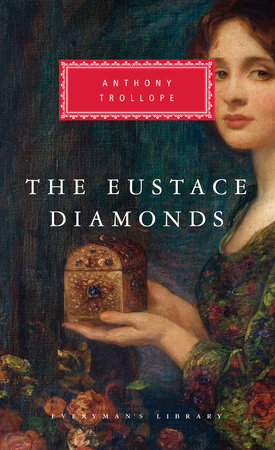
The Eustace Diamonds
A wealthy young widow refuses to surrender a valuable diamond necklace claimed by her late husband's family.
About
Spoiler notice: Full-plot spoilers, including both robberies, Lizzie's concealment, the criminal trial and the separate marriages of Lizzie and Lucy.
Lizzie Greystock learns early that looking prosperous can be more immediately useful than having money. Her father's death leaves debts rather than security, and her own jewels have been pawned. She persuades the jeweller Benjamin to help recover them by exaggerating her position, claiming both to be of age and to have received a marriage proposal from the wealthy Sir Florian Eustace. Neither statement is true when she makes it, but the anticipated marriage eventually happens. Anthony Trollope gives that success an uncomfortable foundation: Florian is seriously ill, loves Lizzie with a confidence she does not deserve, and provides generously for her. His early death leaves her a wealthy widow and, subsequently, the mother of his heir. She has achieved the social transformation she wanted, while the manner of achieving it has already disclosed how readily she treats truth as negotiable.
The diamond necklace introduces a possession that wealth alone cannot make secure. Lizzie keeps it after Florian's death and maintains that he gave it to her. Mr Camperdown, the Eustace family's lawyer, regards it as family property that must be preserved for her son rather than retained among the widow's personal belongings. Letters demanding its return accumulate, and Lizzie alternates between ignoring them, worrying over their implications and looking for someone who will support her. The narrative distinguishes her habit of inventing convenient statements from the unresolved legal question of ownership. What Florian actually said when handing over the necklace, what Lizzie now claims he said, and what lawyers can establish are different matters. A magnificent ornament consequently becomes an awkward object to protect, transport and explain, its value inseparable from the trouble of keeping it.
Marriage offers Lizzie several possible kinds of protection. Lord Fawn brings a title and respectable connections, but the disputed necklace makes him unwilling to proceed with their engagement. Lord George appeals to her appetite for a more adventurous romance, one she imagines through the language of a daring Corsair. Her cousin Frank Greystock offers another attraction, although he has obligations of his own. Frank loves Lucy Morris, an orphan who earns her living as a governess at Fawn Court, and the contrast between the women runs through the book. Lucy has little money to add to a marriage, while Lizzie's income could ease the demands of Frank's legal and parliamentary career. He continues to think well of his own intentions even when his attention to his wealthy cousin leaves Lucy waiting. Trollope makes self-excusing delay part of the harm, rather than allowing good intentions to settle the question.
The first robbery occurs during Lizzie's journey from Portray in Scotland to London. At a Carlisle hotel, a burglar carefully cuts through the fastening of her bedroom door and carries away the iron box believed to contain the diamonds. Friends, hotel staff and police gather around her, taking the loss of the necklace for granted. But Lizzie has kept the precious parcel separately beneath her pillow, and the thieves have obtained only the box. Her initial silence comes from embarrassment at admitting the arrangement; she then sees an advantage in letting Camperdown believe that the disputed property has disappeared. The false account grows harder to correct with every conversation. The burglary itself is genuine, and she has not arranged it, but her response creates a second story that the police pursue while the actual necklace remains in her possession.
In London, Lizzie finally confides in Lord George, who finds himself burdened with knowledge he would rather not possess. She offers him the diamonds, but he refuses to take them, recognising the danger of handling such conspicuous and disputed property. Her own attempt to keep possession while avoiding discovery soon meets a disaster she cannot manage through words. While she is staying with Mrs Carbuncle in Hertford Street, Patience Crabstick remains behind as the other servants go out, and a burglary leaves desks and a dressing-case forced open. This time the necklace really is gone. The genuine loss does not release Lizzie from her earlier deception; it makes exposure more likely, because others now know what she had concealed. Her distress includes grief for the treasure and fear that the story of its disappearance will reveal her false statements at Carlisle.
The investigation eventually establishes the Hertford Street burglary through evidence from Patience and Billy Cann, along with the transfer of the stones through Benjamin. The jewels have travelled abroad, been recut and passed into the possession of a wealthy Russian princess. They are not restored to the Eustace family. At the criminal trial, Lizzie avoids appearing by claiming illness and obtaining a medical certificate, despite the disbelief of those trying to bring her to court. Her earlier evidence is used, and Benjamin and Smiler receive fifteen-year sentences. The result leaves an uneven distribution of consequences: the convicted men are punished, the lawyers have spent heavily without recovering the necklace, and Lizzie escapes the threatened punishment for staying away. Public curiosity has meanwhile made her conduct an entertainment, with spectators anticipating the pleasure of hearing her cross-examined.
The two marriage stories reach separate conclusions. Frank returns to Lucy, asks forgiveness and renews their relationship; after a period at the Bobsborough deanery, she becomes his wife. Lizzie accepts Mr Emilius, a clergyman whose ambition and interest in her money she partly understands. She hopes to retain control of her income, but their eventual marriage does not secure the terms she imagined. The closing gathering at Matching Priory turns the scandal into conversation among people whose rank lets them discuss it at a comfortable distance. Gossip about Emilius's past remains gossip within that scene, while the larger uncertainty concerns Lizzie's future with him. Her money has preserved possibilities after the necklace is lost, but it has also attracted another interested suitor. The book ends with society still talking and with little confidence that her latest arrangement will bring happiness.
Book details
- Author
- Anthony Trollope
- First published
- 1872
- Series
- Palliser Novels, book 3
- Subgenre
- Literary fiction, Victorian fiction, Modern classics
- Primary genre
- Literary Fiction
- Tags
- No tags for this book.
- Reading order
- This is the only Palliser Novels title on the shelf right now.
Review
Editor profile
Baby Bat
Goodreads and social links will be added soon.
- Goodreads — link coming soon
- Social media — link coming soon