
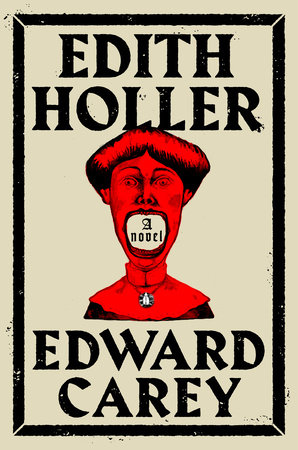
Edith Holler
In Norwich in 1901, twelve-year-old Edith Holler has spent her life inside the family theatre, where her father warns that the building will collapse if she leaves.
About
Spoiler notice: Spoilers include Edith’s suspicions about the Norwich disappearances, her play about Mawther Meg and Beetle Spread, and her father’s engagement to Margaret Unthank. Later reversals and outcomes are not disclosed.
A story can make a room feel larger than a city, especially when its narrator has never been allowed to leave that room. In Edward Carey’s Edith Holler, the room is the Holler Theatre in Norwich, England, and the narrator is Edith, a bright twelve-year-old who has grown up among its actors, machinery and backstage inhabitants. The year is 1901: Queen Victoria has died, and her son has taken the throne. Edith knows the streets outside mostly through windows, books and the stories other people bring into the playhouse. Her father warns that the theatre will collapse if she steps beyond it. What might sound like a superstition has become the rule around which her whole childhood is arranged.
Edith is motherless, and the theatre’s eccentric staff form the company of adults who surround her. Its rooms, passages and hidden working spaces are familiar territory; the city itself is a distant subject she studies with appetite. She reads about Norwich and pieces together its history from the safety of the building, where ordinary tasks and theatrical effects are never far apart. A prop, a costume or a sound through the walls can change how a place seems. Edith’s access to information is unusual: she has accumulated knowledge without the direct experience of moving freely through the streets. That gap gives her account its special tension. She can be observant and inventive while still needing to test what she has learned against the limits imposed on her.
One thread in her research concerns the children who, according to the histories she finds, have died or disappeared in Norwich across the centuries. Edith suspects that the disappearances connect to Mawther Meg, a monstrous figure in local legend, and to Beetle Spread, the region’s peculiar delicacy. The story she constructs is frightening, but it is also a child’s effort to make a pattern from incomplete records and inherited tales. Carey lets folklore and town history occupy the same imaginative space without turning Edith’s suspicion into straightforward fact. Her fascination is both scholarly and theatrical: she wants to know what happened, and she understands that a story can make an audience look at a troubling subject it might otherwise ignore.
Writing becomes the means by which Edith can act. She shapes what she has discovered into a play, drawing on the legend of Mawther Meg and on Hamlet as a theatrical model. The play is not only a private refuge or a display of cleverness; it gives Edith a way to speak to people who have dismissed her concerns. Its progress toward performance brings together the theatre’s practical labor and the child’s wish to be taken seriously. The company around her knows how to create illusions for an audience, while Edith is trying to use that craft to point toward something she believes is real. The boundary between invention and testimony becomes uncertain, and that uncertainty is part of the novel’s design.
The pressure on Edith’s enclosed world increases when her father announces his engagement to Margaret Unthank, a peculiar and imposing newcomer who is heir to the Beetle Spread fortune. Edith worries about what the engagement may mean for her father, for the theatre and for the play she has made. Margaret’s arrival changes the balance inside the building: Edith’s home is also her father’s workplace and a public attraction, so family authority, business and performance overlap. The conflict is not simply about whether a child may disobey a parent. It asks who gets to control the stories told about a family and a town, and what happens when a young person’s account threatens more powerful interests.
Carey’s illustrations belong naturally to a novel so concerned with stagecraft, props and the way pictures help stories travel. The theatre offers a setting in which people routinely pretend, transform themselves and persuade an audience to believe. Its creaking structure and hidden spaces also give the book a gothic atmosphere, while Edith’s curiosity and theatrical imagination leave room for comic strangeness. These qualities work together rather than settling into a single register: a curious detail can be funny, unsettling or both. The result keeps attention on Edith’s point of view, which is energetic and self-dramatising but shaped by what she has not been permitted to see.
Edith Holler is a historical novel about a child trying to make her own account of a world governed by adults, old stories and theatrical illusion. Its Norwich setting is at once a real city with a past and a place filtered through Edith’s books and imagination. The novel’s central questions arise from that distance: how can someone recognize harm when evidence is incomplete, and how can a story make others listen? Carey places those questions inside the practical life of a playhouse, where narratives are built collectively and belief is part of the performance. Edith’s effort to write and stage her version of events gives the book its forward movement, while the theatre remains the vivid, confining world from which her knowledge begins.
Book details
- Author
- Edward Carey
- First published
- 2023
- Series
- No series listed
- Subgenre
- Historical fiction, Literary historical fiction
- Primary genre
- Historical Fiction, Literary Fiction
- Tags
- No tags for this book.
Review
Editor profile
Baby Bat
Goodreads and social links will be added soon.
- Goodreads — link coming soon
- Social media — link coming soon