
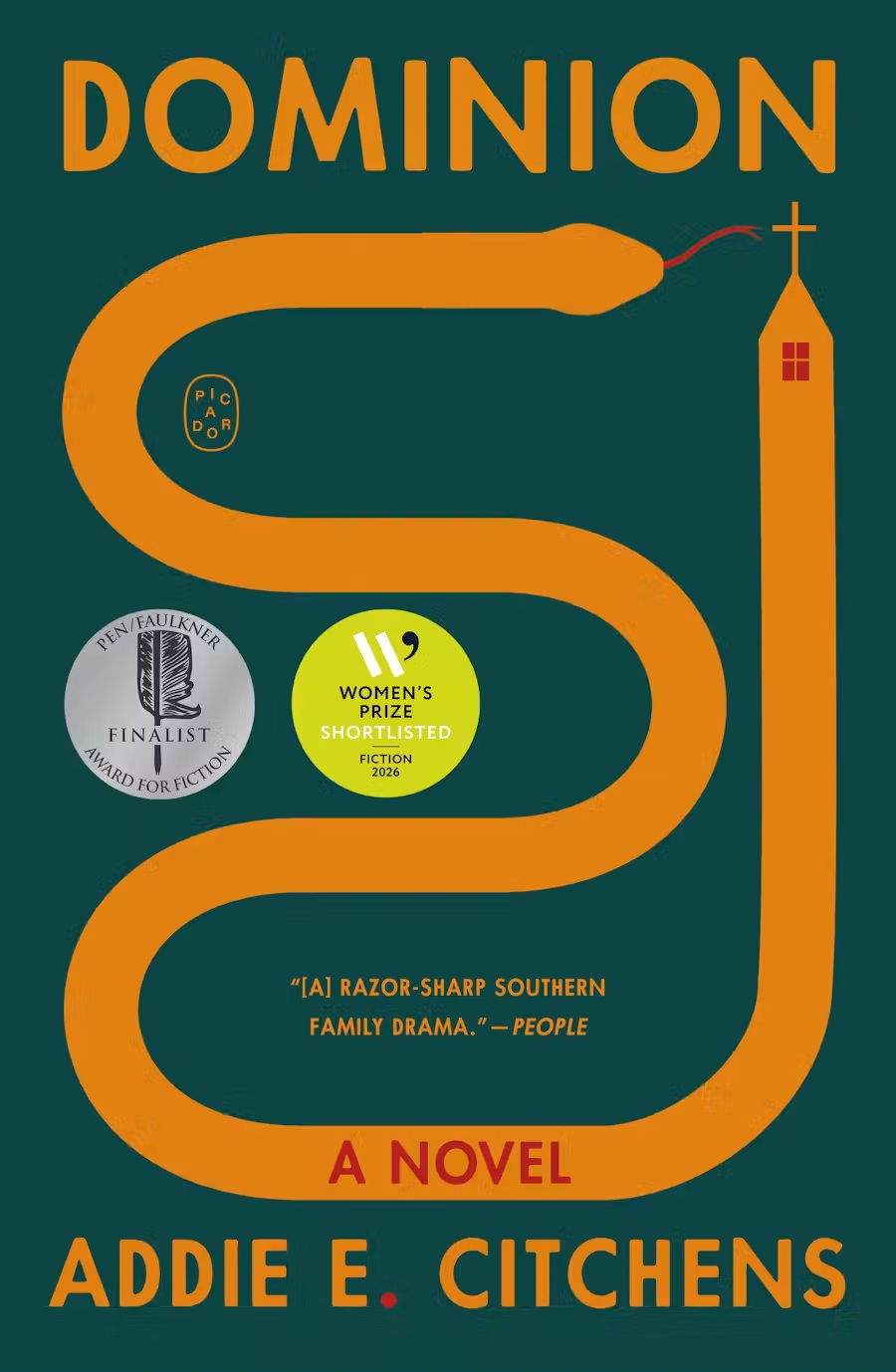
Dominion
In Dominion, Mississippi, Reverend Sabre Winfrey Jr.
About
Spoiler notice: Spoilers for the premise and opening setup: Reverend Sabre Winfrey's influence over Dominion, Wonderboy's position as his favored youngest son, and the violent encounter that unsettles the town. Later consequences and the ending are not summarized.
Dominion is set in a Mississippi town where the Reverend Sabre Winfrey Jr. occupies several kinds of authority at once. He leads Seven Seals Missionary Baptist Church, owns the local radio station and a barbershop, and is described by the publisher as keeping an iron hand on much of the community. The setting makes power visible through familiar institutions: the pulpit, the airwaves, a place of business, and a household. Sabre’s influence is not confined to what he says in church. It reaches into public life and family life, shaping the standards by which people are judged. The story’s opening materials place these structures in view before its larger conflict develops. By giving one man influence across so many settings, the novel frames Dominion as a community where private conduct and public reputation are closely connected. The town is not simply a backdrop; it is part of the arrangement that allows authority to operate.
At home, Sabre and his wife Priscilla raise five sons. The youngest, Emanuel, is known as Wonderboy, a name that gathers the town’s admiration around him. The publisher describes him as unusually gifted at singing and running, and as someone who attracts attention. That public affection matters because the book’s premise places him inside his father’s influence and at the centre of a shock that reaches beyond the family. The official Women’s Prize guide describes an encounter with a stranger that leads to a violent altercation and unsettles the community. The account here stays with that setup rather than the later events. Wonderboy’s position as both beloved son and local favorite creates a tension between how a person is seen and what those around him may have to face. The novel places that tension within a family whose standing is closely tied to the Reverend’s power.
Priscilla and Diamond provide the story’s intimate vantage points. Priscilla is Sabre’s wife and the mother of his sons; Diamond is a young woman connected to Wonderboy. The publisher presents both as women who love these men and who bear the consequences of their choices. This arrangement brings the reader close to people whose knowledge is shaped by affection, dependence and proximity. Their perspectives can register the gap between a man’s public charm and the effects of his conduct in private. The Women’s Prize guide likewise describes the narrative as moving through the women who love the men and the bargains women make to survive patriarchal power. That focus places women’s judgment and experience at the centre of the account, even in a town where the pulpit and its messages are dominated by men. The novel’s premise therefore turns on who gets to define events and whose lives absorb their cost.
The Reverend’s sermon notes give the book a visible frame. The Women’s Prize guide identifies them at the openings of Chapters 1 through 7 and describes them as a way of presenting the novel’s themes. Their presence lets religious language appear as part of the town’s daily life and as a tool through which authority explains itself. The notes can be read alongside the behaviour the publisher’s description associates with Sabre and his family, creating a contrast between public instruction and private conduct. This structural choice links belief to social power without reducing the church to scenery. Sermons are repeated, heard by a community and given moral weight; they can shape what people are encouraged to notice, excuse or blame. In a story concerned with secrets, shame and silence, a formal voice that speaks with certainty becomes especially consequential. The framing device makes the language of authority part of the narrative’s subject.
The book’s questions about morality and responsibility are grounded in the institutions it depicts. Sabre’s religious standing gives his words public reach, while his family position makes his expectations personal. Wonderboy’s admiration among peers and townspeople adds another layer of social protection and attention. Against this backdrop, the women’s perspectives raise questions about how affection can coexist with harm, how silence can preserve a community’s preferred image of itself, and what it costs to challenge accepted authority. These are themes named in the publisher’s description and reflected in Citchens’s interview, where she speaks about church structures that enable abusive male authority and the routes women take toward freedom. The novel’s conflict is consequently both domestic and communal. Its concerns extend beyond one household because the family’s influence is woven into the town’s religious, commercial and social life.
In the Women’s Prize interview, Citchens connects the early drafts of Dominion to childhood observations of church hypocrisy: men held authority to interpret the gospel, she says, while women performed much of the work of cleaning, feeding and caring for people without a pulpit from which to voice concerns. That account offers context for the novel’s attention to the labor and speech of women around a powerful religious leader. It does not turn the fictional town into autobiography; rather, it clarifies the questions Citchens says helped spark the story. Her focus on women’s experience sits beside the book’s concern with the stories a community tells about goodness, respectability and sin. Dominion therefore brings domestic life, religious language and public standing into a single field of view, asking readers to consider who benefits when power goes unquestioned and who must live with its consequences.
Book details
- Author
- Addie E. Citchens
- First published
- 2025
- Series
- No series listed
- Subgenre
- Literary fiction
- Primary genre
- Literary Fiction
- Tags
- No tags for this book.
Review
Editor profile
Baby Bat
Goodreads and social links will be added soon.
- Goodreads — link coming soon
- Social media — link coming soon