
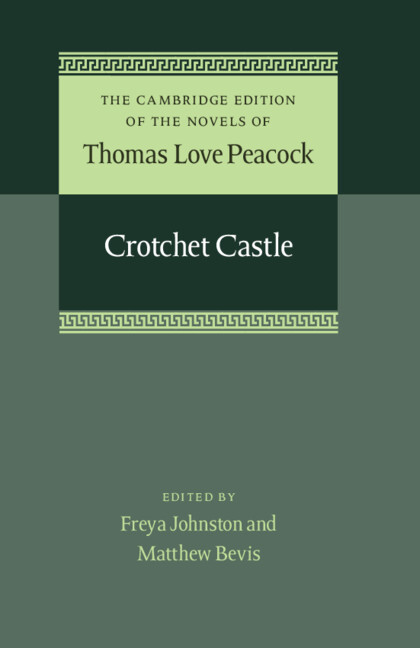
Crotchet Castle
At a Thames-side villa, Mr Crotchet entertains guests whose arguments range across money, progress and the past.
About
Spoiler notice: Full-plot spoilers, including Susannah’s marriage, the financial collapse and young Crotchet’s disappearance.
Crotchet Castle is a Thames-side villa with the name and appearance of something older and grander. Its owner, Ebenezer Mac Crotchet, has retired from business with enough money to establish himself as a country gentleman. He enjoys inviting people who will argue, and the house becomes a meeting place for competing accounts of politics, learning, science and the proper organisation of society. Thomas Love Peacock’s novel, published in 1831, places those arguments within a family whose prosperity also shapes its marriage plans. The elder Crotchet wants the standing that money alone cannot supply, while his son has built a formidable financial position of his own. Their claims to security depend on arrangements that conversation at a comfortable table can make seem more permanent than they are.
Young Crotchet is a partner in Catchflat and Company, profiting from the financial schemes in which the narrator describes him as especially accomplished. He once intended to increase his fortune by marrying Susannah Touchandgo, a banker’s daughter. When her father disappears and the expected wealth is no longer available, the engagement ends. Susannah loses both the financial position and the attachment on which she had relied. She retreats to a farmhouse in North Wales, paying modestly for her board and contributing lessons in English, French and music. The change gives her daily work and a place within another household. Her former lover continues to pursue wealth and advancement, while the woman he has abandoned develops a life far from the circles in which his success is celebrated.
Another proposed match joins young Crotchet to Lady Clarinda, whose family possesses a title but urgently needs money. Her brother Lord Bossnowl is also expected to marry Crotchet’s sister Lemma, bringing the two households into a double arrangement. Captain Fitzchrome’s attachment to Clarinda supplies an alternative she is initially unwilling to accept. His affection cannot provide the houses, carriage and fashionable life she wants, or solve her father’s financial and political difficulties. These relationships make marriage part of the same conversation as property and social rank. The Reverend Doctor Folliott, a frequent presence among the guests, can question the solidity of financial prosperity while appreciating the lobsters that accompany it. The advantages of money remain tangible even when its foundations invite suspicion.
The company’s disagreements continue beyond the villa as the guests undertake a leisurely river voyage and move towards Wales. Their interests give the journey several competing meanings. Mr Chainmail’s admiration for the medieval past differs from the economic and progressive schemes advanced by other travellers, while Folliott repeatedly challenges the claims made for intellectual improvement. The arguments are attached to people with preferences, appetites and social ambitions, rather than presented as a single consistent lesson from the narrator. Clarinda’s refusal of Fitzchrome takes place within this travelling party. The captain leaves, and her response to his departure complicates the certainty with which she has defended her material expectations. The journey allows private disappointments to develop alongside disputes about how the world ought to work.
In Wales, Chainmail meets a young woman at a mountain lake and accompanies her to the Ap-Llymry farmhouse. She is Susannah, whose withdrawal from young Crotchet’s world has already been described. Their acquaintance leads to a marriage that is established by the later Christmas gathering at Chainmail Hall, where she appears as the happy bride. Young Crotchet must encounter the woman he deserted in circumstances that contrast with his own increasing difficulties. Before the feast, news arrives that Catchflat and Company has stopped payment. The theories of prosperity discussed throughout the visit now confront a particular business failure. Folliott treats it as the reckoning neglected by paper-based financial confidence, while Mr Mac Quedy resists accepting the collapse as a refutation of his science.
The Christmas entertainment is interrupted by a crowd demanding weapons under the name of Captain Swing. Chainmail’s medieval furnishings and armour, previously part of his preferred style of life, become resources in an immediate confrontation. He and Folliott lead a sortie that scatters the assailants, while other guests find less heroic ways of occupying themselves. The company then returns to food, drink, music and dancing. The incident supplies each disputant with another opportunity to explain events in his own terms: poverty, education, political economy and older relations between landlord and tenant all enter the discussion. The men have acted together without arriving at agreement about the causes of what has happened. Their resumed festivities do not settle the social arguments that the disturbance has brought to the door.
After that night, young Crotchet disappears from England. The failed firm pays sixpence in the pound, and the narrator leaves his destination uncertain. Some imagine that he has drowned; those who know him better favour the possibility that he has crossed the Atlantic with remaining capital. Neither suggestion becomes a confirmed account of his later life. Clarinda, meanwhile, refuses to be offered again on the marriage market. Fitzchrome renews his attentions, and affection, gratitude and his constancy lead her to accept a more modest future with him, eventually obtaining her father’s reluctant consent. The ending changes the practical terms of their lives without resolving every theory debated along the way. Financial greatness has proved precarious, while relationships dismissed as insufficient have acquired a different value.
Book details
- Author
- Thomas Love Peacock
- First published
- 1831
- Series
- No series listed
- Subgenre
- Literary fiction, Modern classics
- Primary genre
- Literary Fiction
- Tags
- No tags for this book.
Review
Editor profile
Baby Bat
Goodreads and social links will be added soon.
- Goodreads — link coming soon
- Social media — link coming soon