
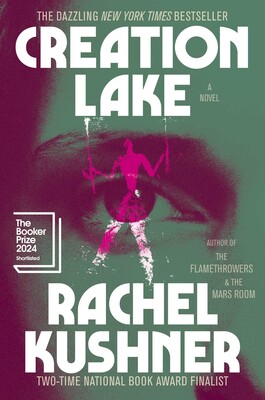
Creation Lake
Sadie Smith, an American spy-for-hire working under an assumed name, is sent to infiltrate an environmental commune in rural France.
About
Spoiler notice: This About discusses Sadie Smith’s undercover assignment, her access to the French commune, Bruno Lacombe’s prehistoric ideas and the competing interests around the group. It avoids the novel’s final developments and ending.
Creation Lake places a spy-for-hire inside a conflict whose scale keeps widening. Sadie Smith, an American agent using an assumed name, is sent to rural France to infiltrate a commune of environmental activists. She approaches the assignment with the confidence of someone accustomed to turning people and situations into instruments. Lucien, a young Parisian filmmaker, is one of her first routes into the group; their apparently accidental meeting is part of her method. The premise supplies the machinery of an espionage novel, but Rachel Kushner makes the machinery depend on a narrator whose account is itself a performance. Sadie can describe her tactics with assurance, yet the people she studies have their own purposes and histories. Her narration therefore holds two possibilities at once: she is an effective observer, and she may be less in control than she believes.
The setting shifts attention away from the familiar image of espionage in capitals and government buildings. The commune occupies a landscape of old farms and prehistoric caves in southwestern France, where local political conflict meets questions that stretch far beyond the immediate assignment. Sadie’s employers want her to provoke disruption among the activists, while the group’s presence has already drawn the attention of the French state. The book does not treat this rural community as an uncomplicated refuge or as a symbol standing for every environmental movement. It is a particular set of people living amid disputes over land, authority and the shape of a future. Kushner’s choice of place lets contemporary power and a much older human past sit within the same frame: political decisions play out among fields and villages, while caves make the distance between modern life and prehistory feel physically close.
Bruno Lacombe is the figure who unsettles Sadie’s initial distance. He mentors the young activists but has withdrawn from modern society to live in a cave, where he pursues an intense interest in Neanderthals and the deep history of human life. At first Sadie treats his beliefs as eccentric material to assess. Yet Bruno’s counter-histories and laments become more than curiosities within her operation. They challenge the assumptions through which she has organised her own account of progress, politics and human nature. Kushner does not present Bruno’s theories as settled historical knowledge: their force comes from the way they expose longing, the desire to recover an origin or discover a message from ancestors. In her Booker interview, Kushner describes her interest in both what can be known about ancient people and the wish to believe that the past contains guidance for the present. Bruno gives that tension a character and a voice.
The novel’s ideas arrive through a voice built for speed and control. Sadie’s observations, judgments and self-justifications make her story feel close to a private record, but the reader must keep in mind that she is trained to deceive. Her certainty can be entertaining while also making the limits of her perspective visible. Bruno’s emails add another stream of thought: his language and arguments reach the reader through Sadie’s access to them, so even this countervoice is framed by the person trying to interpret and use it. The contrast matters. A spy plot ordinarily rewards information and mastery; here, information accumulates without guaranteeing understanding. Kushner’s short, vaulting sections keep the account mobile, shifting between action, reflection and philosophical detours. The form allows the book to move quickly while giving space to arguments about history, ideology and the stories people tell themselves.
Sadie’s assignment also tests the boundary between political commitment and instrumental behaviour. She enters the commune to influence its members, not to join their cause, and the people around her are initially pieces in a plan. But the longer she listens to Bruno and observes the group, the harder it becomes to keep her intellectual curiosity separate from the operation. This is not a simple conversion story: the novel keeps the reader attentive to the gap between what Sadie says, what she wants and what she does. The employer’s vague demands are another source of unease. The operation is directed by shadowy contacts in business and government, and its requested provocations raise questions about who gets to define disorder and whose interests are protected by calling a group dangerous. The suspense grows from that uncertainty as much as from the danger of exposure.
Creation Lake brings spy fiction, noir and a novel of ideas into one sustained argument about control. Its subject is not only whether Sadie can carry out an assignment, but how people shape one another through stories, categories and competing accounts of the past. The activists’ present-day struggle, Bruno’s attention to prehistory and Sadie’s professional cynicism all offer different ways to explain human behaviour. None arrives as a neutral position: each is bound to a person with motives and limits. Kushner has said she wanted to set a group of young people moving from Paris toward a rural outpost and collision with the French state, while also exploring the attraction of ancient history. That design gives the novel its particular scale. It can follow a covert operation and ask, at the same time, how much of the past survives in the present, and what people hope to find when they look backward.
Book details
- Author
- Rachel Kushner
- First published
- 2024
- Series
- No series listed
- Subgenre
- Literary fiction, Espionage
- Primary genre
- Literary Fiction, Mystery & Thriller
- Tags
- No tags for this book.
Review
Editor profile
Baby Bat
Goodreads and social links will be added soon.
- Goodreads — link coming soon
- Social media — link coming soon