
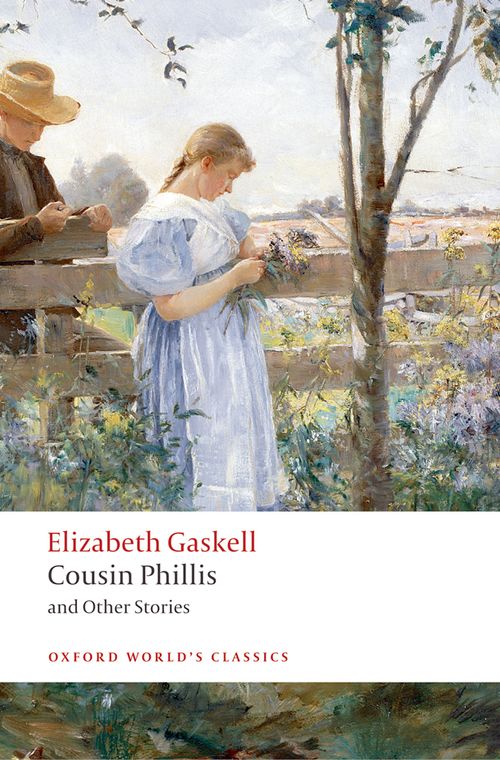
Cousin Phillis
Railway clerk Paul Manning discovers his relatives at Hope Farm, where Phillis Holman shares a life of learning and practical work with her parents.
About
Spoiler notice: Full-plot spoilers, including Holdsworth’s marriage, Phillis’s illness and the unresolved hopes of the ending.
Paul Manning begins his account with the pleasure of becoming independent at seventeen. Installed in lodgings above a pastry-cook’s shop, he can decide when to eat the provisions his mother has packed, arrange his own small room and begin work as a clerk on a branch railway. That freedom soon includes loneliness, but the mixture of pride and uncertainty establishes the young observer through whom Elizabeth Gaskell tells Cousin Phillis. The story appeared serially in 1863–64 and in book form in 1864. Paul looks back on the people he met while his working life was beginning, including an engineer he admired and relatives he had not known existed. His recollection gradually becomes an account of how affection and good intentions can lead someone to interfere without understanding what will follow.
Paul is nearly nineteen when his work brings him near Hope Farm, the home of his mother’s relatives. Initially, the prospect of meeting another minister fills him with dread: his experience of religious visits suggests long questions, long prayers and very little freedom to relax. Ebenezer Holman proves to be a different presence. He combines his Independent ministry with the running of a farm, working among his labourers during the week and preparing for his congregation as the weekend approaches. His wife and their daughter Phillis belong to a household shaped by daily work, learning and close family feeling. Paul’s discovery of that household enlarges his experience of what a home can be, giving him somewhere to visit beyond his lodgings and the routines of the railway office.
Phillis is seventeen, but her education and knowledge unsettle Paul’s easy assumptions about himself. She studies with her father and moves between intellectual interests and practical duties without treating them as separate lives. Latin belongs to the household’s evenings, while books and conversation exist alongside the work required by the farm. Her parents continue to think of her as their child, a habit that becomes increasingly important as feelings develop beyond the family circle. Paul comes to love her as a sister and rejects his father’s imagined match between them. His position is therefore that of a cousin and confidant, rather than a disappointed suitor. He has access to the household and grows attentive to Phillis, but that closeness does not mean he always understands what she can bear to have spoken aloud.
Edward Holdsworth, the engineer under whom Paul works, brings another set of experiences into Hope Farm. Paul admires his confidence, education and knowledge of the wider world, and Holdsworth becomes a welcome visitor to the Holmans. Before leaving for railway work in Canada, he tells Paul that he loves Phillis and hopes to return to speak to her himself. Those words are important precisely because Phillis has not received a proposal from him. Later, seeing her distress at his absence, Paul repeats what Holdsworth has said. He hopes to relieve her suffering and is encouraged by her happiness at hearing it. Phillis wants any further declaration to come from Holdsworth when he returns. Paul’s intervention gives her something to anticipate, while leaving the relationship dependent on a man who is now far away.
News from Canada eventually brings a different future: Holdsworth marries Lucille Ventadour. Paul’s knowledge becomes a burden as he tries to protect Phillis’s feelings and conceal what he believes others have not noticed. Wedding cards then bring the marriage into the family’s ordinary conversation. Phillis forces herself to speak, while her father senses that something is wrong. His confrontation with Paul draws out the earlier disclosure, and Phillis intervenes to explain that Paul acted because he had seen her unhappiness. Her father struggles to understand that she could have loved someone and imagined leaving a home where she was so cherished. Their painful exchange exposes the distance between parental love and recognition of a daughter’s separate emotional life. Phillis collapses, and a doctor identifies her subsequent illness as brain fever, the term used within the story.
The illness changes the rhythm of the entire farm. Phillis’s parents nurse her, Paul carries urgent messages and the workers try to continue without their employer’s usual direction. Two visiting ministers urge Holman to show resignation and examine whether the suffering is punishment for sin. He resists both their demands for words he cannot honestly feel and their explanation of his daughter’s illness. Elsewhere, care takes a quieter form. Timothy Cooper, whom Holman has dismissed after a damaging mistake, spends a market day preventing carts from disturbing Phillis’s sleep. Paul learns of the watch only afterwards. Holman’s response is to acknowledge his own pride and take Timothy back, adjusting the work to his abilities. The episode places a useful act of kindness beside the visitors’ confident attempts to interpret another person’s pain.
Phillis survives, but the ending does not give her back her earlier life unchanged. Her physical strength returns more readily than her energy or pleasure. Gifts and familiar books cannot immediately restore her interest, and her parents struggle to reach her through their anxious attention. Betty, the household servant, speaks bluntly about the need for Phillis to begin helping herself towards cheerfulness. Soon afterwards, Phillis asks Paul whether she might stay with his parents for a short time, hoping that different surroundings will give her a change of thought. Her final confidence that they can return to the peace of the old days is a wish and a determination, rather than an outcome the narrator goes on to confirm. The story stops there, with survival established and the work of recovering a meaningful life still ahead of her.
Book details
- Author
- Elizabeth Gaskell
- First published
- 1864
- Series
- No series listed
- Subgenre
- Literary fiction, Modern classics
- Primary genre
- Literary Fiction
- Tags
- No tags for this book.
Review
Editor profile
Baby Bat
Goodreads and social links will be added soon.
- Goodreads — link coming soon
- Social media — link coming soon