
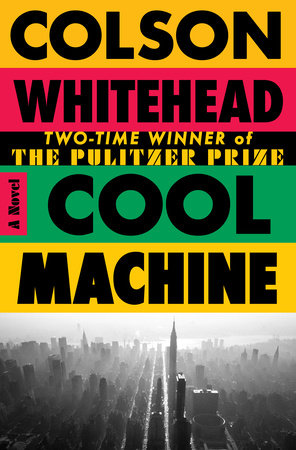
Cool Machine
In 1981, Harlem furniture dealer Ray Carney is named Sterling Furniture’s Dealer of the Month, but his wife Elizabeth cannot secure a bank loan for her travel agency.
About
Spoiler notice: This About covers the novel’s three dated sections, Ray Carney’s business and family situation, and the problems that draw him and Pepper into new work. It avoids the books’ outcomes and ending.
Cool Machine returns to Ray Carney, the Harlem furniture dealer whose respectable business has long shared space with his work fencing stolen goods. The novel is set in 1981, 1983 and 1986, and follows him through three linked stories as New York changes around him. Carney has acquired experience, money and a wider view of what he can do, but those gains do not make him invulnerable. The ordinary ambitions of running a shop and supporting a family sit beside the risks of criminal work, and the dividing line between those lives remains difficult to hold. Colson Whitehead uses that tension to make the book a crime story about choices as well as a portrait of a city moving into a new decade.
The opening section finds Carney’s business in an unusually strong position. Sterling Furniture has named him Dealer of the Month, and he has rebuilt and enlarged his Harlem store after the fire that closes Crook Manifesto. At home, his wife Elizabeth wants to start a travel agency, but the bank will not lend her the money she needs. Carney responds by considering one more heist, joining his uncle Rich and a crew whose plans take them beyond his familiar role as a fence. Their operation reaches from New Jersey warehouses toward the Waldorf Astoria, making the city’s distance between ordinary commerce and hidden wealth part of the story’s terrain. Carney’s success in legitimate retail and his criminal skill develop together, yet the novel keeps asking what kind of person those abilities are making him.
The chronology gives the book a wider view than a single caper. Each section has its own situation and focus, while characters and consequences connect the years. In 1983, the attention moves to Pepper, Carney’s old friend and criminal partner. Age and accumulated injuries are catching up with him when Elizabeth asks him to act as a bodyguard for someone entering the East Village art and club scene. That assignment carries the story south from Harlem into downtown spaces that feel unfamiliar to Pepper. He is physically diminished, but his fluency with violence still shapes how he reads the people around him. The collision between a protection job and a scene organised around art, nightlife and self-invention lets Whitehead place different New York worlds close together without pretending they operate by the same rules.
The last section moves to 1986 and brings Carney back into action over a family matter. He has never stopped thinking about his cousin Freddie, who died years earlier; now Freddie’s son Robert disappears. Carney comes out of retirement and works with Pepper again to find him. The search draws him through Harlem’s criminal networks and Queens politics, while putting at risk the security he has spent years creating for Elizabeth and their family. This setup shifts the emphasis from a planned score to an urgent effort to locate someone. It also connects the book’s family concerns to the city’s broader systems of power: personal loyalties have to be pursued through institutions and neighbourhoods where influence is rarely straightforward.
Whitehead’s New York is both a particular historical place and a working system of competing interests. The publisher describes a city beginning to emerge from financial decline, with real-estate development and Wall Street expanding under Reagan-era capitalism. Across the trilogy’s later years, those changes appear in concrete contrasts: sleek construction and prestigious businesses share space with abandoned tunnels, fire-scarred blocks and people displaced from the surface. The novel ranges from Harlem through Manhattan and out toward the Meadowlands, treating geography as part of how money, danger and opportunity move. Its atmosphere depends on that mixture of glamour and neglect. A shop award can matter deeply to Carney even as he remains connected to the illicit economy that helped him build his standing.
The three-part design also gives the novel room to shift its angle of attention. The first story follows a crew assembling a large operation; the second stays closer to Pepper and the social environment he must navigate; the third turns the search for Robert into a family-centred investigation. This variation keeps the book from treating crime as a single repeated trick. A heist asks what can be planned and controlled, a bodyguard job asks who is exposed to danger, and a disappearance makes the cost of delay immediate. The episodes remain connected through recurring relationships and Carney’s changing sense of himself. The sequence lets the reader see how the same city can invite ambition, threaten stability and demand loyalty in different ways as the years pass.
Cool Machine is the third and final book in Whitehead’s Harlem Trilogy, after Harlem Shuffle and Crook Manifesto. It advances Carney’s story into the 1980s rather than repeating the earlier books’ periods and problems: the first volume follows his earlier life, the second moves into the 1970s, and this volume follows the 1981, 1983 and 1986 episodes. Readers can recognise the continuing cast and the effects of earlier events, but this installment gives each year a distinct plot of its own. Uncle Rich’s schemes, Pepper’s bodyguard work and Carney’s search for Robert create different kinds of pressure, all connected to the question of what his criminal competence can and cannot fix. The result brings the series’ crime plotting together with its attention to work, family, aspiration and a city that keeps changing the terms of survival.
Book details
- Author
- Colson Whitehead
- First published
- 2026
- Series
- Harlem Trilogy, book 3
- Subgenre
- Literary fiction, Historical fiction, Crime thriller
- Primary genre
- Literary Fiction, Mystery & Thriller, Historical Fiction
- Tags
- No tags for this book.
- Reading order
- This is the only Harlem Trilogy title on the shelf right now.
Review
Editor profile
Baby Bat
Goodreads and social links will be added soon.
- Goodreads — link coming soon
- Social media — link coming soon