
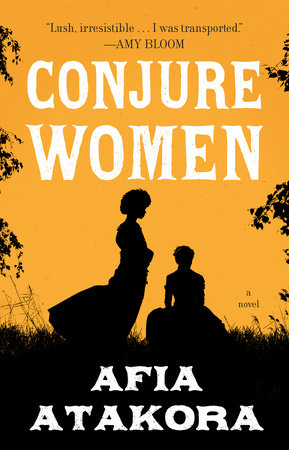
Conjure Women
In a former Southern plantation town after the Civil War, healer and midwife Rue is called to care for Black-Eyed Bean, a child whose unusual birth has made neighbours uneasy.
About
Spoiler notice: Spoilers for the opening: in 1867, midwife Rue is called to the home of Sarah and Jonah when their infant, Black-Eyed Bean, is believed to be ill; the community already fears his unusual birth. The novel also moves back into Slaverytime before the Civil War. Later revelations and the ending are not summarized.
Conjure Women opens in 1867, two years after slavery has ended, when Rue is roused from sleep by the cry of a sick baby. The former plantation has become a town of low cabins, where people gather outside Jonah and Sarah’s home and whisper about their son, Black-Eyed Bean. Rue enters as a midwife and healer, but the crowd’s attention follows her too: people look to her for help while expecting her to embody the almost absolute magic they associate with her mother. At the bedside, she finds Sarah washing her children and Bean’s strange, unchanging black eyes. This uneasy night establishes the novel’s central predicament. Rue is needed because of her practical knowledge, yet the same community can turn that dependence into suspicion.
Atakora moves back and forth through named periods, including Slaverytime, Wartime and Freedomtime, to show how the present was made. Rue’s mother, Miss May Belle, is an enslaved healer and midwife who also practices conjure. Her skill makes her useful to the people around her, but it cannot make her free of the plantation’s ownership and violence. Rue grows up watching her mother’s authority take shape within those limits. She is observant and capable, but reluctant to inherit the work that keeps drawing women into birth, illness and grief. Her resistance is not a rejection of May Belle’s care; it comes from knowing what the role costs and how quickly gratitude can become fear.
Rue’s childhood friendship with Varina crosses the sharpest boundary in their world. Varina is the daughter of Marse Charles, the white plantation owner, while Rue is the daughter of one of the women he enslaves. The girls share childhood time, but their closeness exists inside an unequal household whose rules adults enforce. May Belle objects to the friendship, and the adult women’s different positions shape what each girl can understand about the other. As they grow older, Rue’s healing knowledge and Varina’s status as the master’s daughter carry different kinds of power, neither simple nor secure. Their bond links intimate memories to the larger history of the plantation, even as war and emancipation alter the conditions under which they can meet.
The novel’s timeline makes the change in law visible without treating freedom as a clean break. By 1867 the enslaved community has become a town, and Rue has delivered its children and entered homes as a healer. People stay on the land where they were enslaved, carrying memories, relationships and fears into a newly named life. The work of caring for neighbours gives Rue a place in this community, but it also makes her privy to births, illnesses and private talk. She is respected as Miss Rue, a title whose meaning is tied to her mother’s death and to the work she has taken up. Public regard rests beside the possibility that those same neighbours may blame her when misfortune strikes.
Black-Eyed Bean concentrates that uncertainty. He was born with a caul, and his appearance gives anxious neighbours a reason to treat him as a sign of danger. When sickness and loss trouble the community, fear gathers around the child and around the women associated with conjure. Rue’s work with Sarah’s family brings her close to the rumours, but it does not let her control what the town believes. The novel holds open the difference between healing as skilled, embodied care and magic as a story other people tell about that care. Birth is both ordinary and perilous: Rue has attended many, understands the labour, and still knows that a baby can arrive quiet or that praise can shift into blame. The opening gives the reader that pressure before explaining every cause behind it.
Faith becomes another force shaping the town after slavery. Bruh Abel, a preacher who arrives with Christian teaching, offers people a language for interpreting suffering and a path into a religious community. His presence meets a world where May Belle’s remedies and conjure practices have long answered needs the plantation order did not protect. The novel places these forms of belief in lived conflict: what counts as healing, what counts as sin, and who has the authority to name either? These questions touch bodies as well as doctrine. The women seek help through pregnancy, birth and illness, while the men around them interpret those acts through their own beliefs and desires. Rue must navigate a role that is welcomed when it serves the town and distrusted when it challenges the town’s explanations.
Atakora’s before-and-after structure keeps one generation’s choices beside the next generation’s consequences. Rue’s relationship with her mother is shaped by admiration, inherited knowledge and a wish to choose a different life; her friendship with Varina is shaped by affection and the racial order that neither girl made. After emancipation, Rue’s ties to Sarah, Jonah and their children make care a daily practice rather than an abstract promise. The novel’s historical frame follows a community through slavery, war and Reconstruction, while its intimate centre stays with women whose labour and knowledge are essential yet often contested. Conjure Women brings the reader into the complicated space between being needed and being believed, where healing, memory and fear all influence how a fragile freedom is lived.
Book details
- Author
- Afia Atakora
- First published
- 2020
- Series
- No series listed
- Subgenre
- Historical fiction, Literary historical fiction, Southern gothic
- Primary genre
- Historical Fiction, Literary Fiction
- Tags
- No tags for this book.
Review
Editor profile
Baby Bat
Goodreads and social links will be added soon.
- Goodreads — link coming soon
- Social media — link coming soon